














Inshore

Cracking The Code: Spring Squid

Cracking The Code: Spring Squid
Cracking the Code: Cape Cod Squid — Drift to Find, Anchor to Load
Cape Cod Squid  ·  Spring
Cracking the Code
Target
Squid
Location
Cape Cod Inshore Waters
Season
Spring
System
Squid-Biki Rig
Depth
8–20 ft

Drift to Find, Anchor to Load

Spring squid on Cape Cod is the simplest trip of the season — two hours, a Squid-Biki Rig, and a bucket full of dinner and fluke bait. But you have to find them first.

SC
Salty Cape TV powered by Hogy
Spring
7 min read
Hogy Squid-Biki Rig — Cape Cod spring squid fishing

Cape Cod inshore waters, spring. The squid are in — shallow, accessible, and aggressive. First trip of the season.

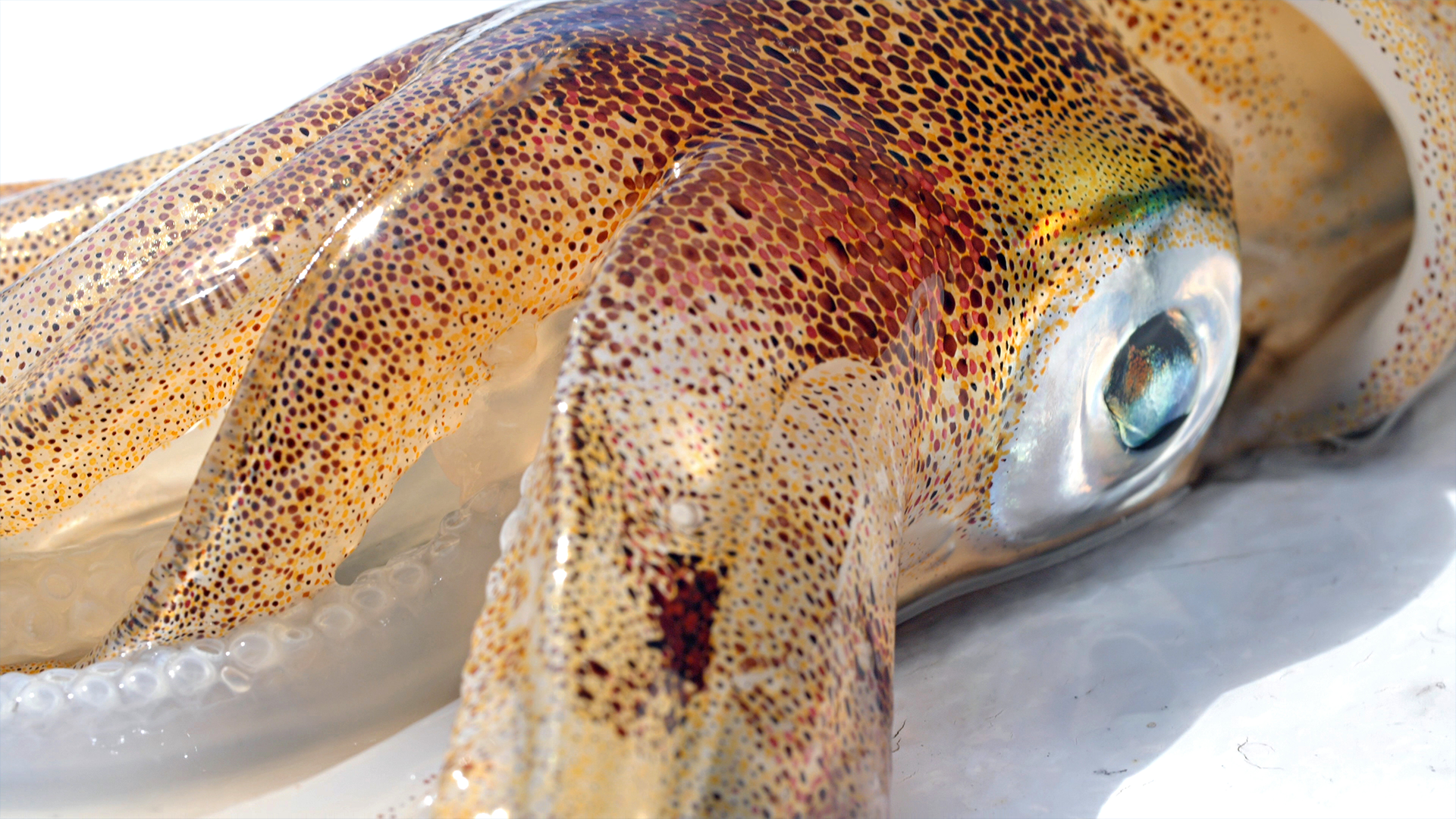
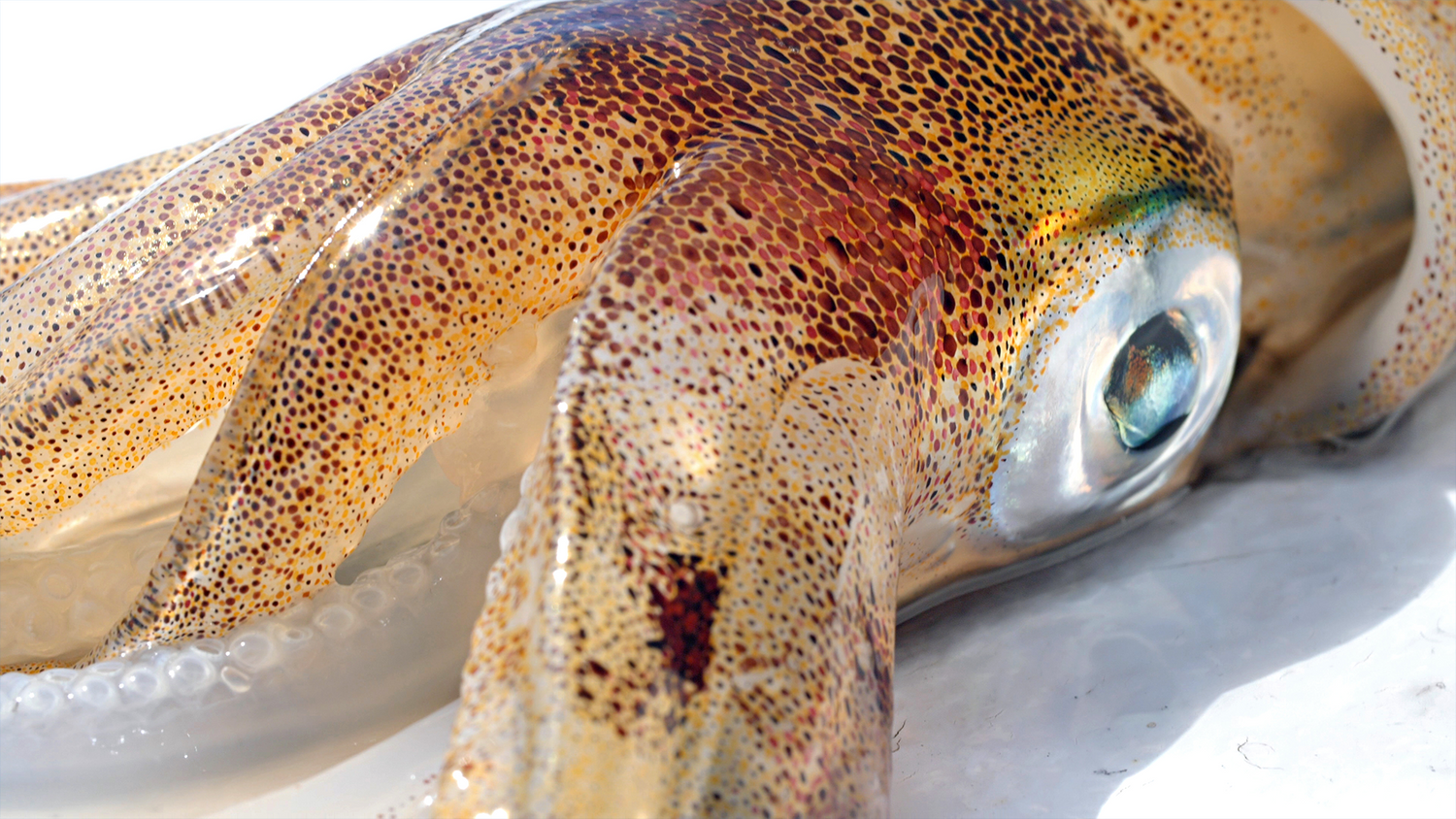
Every spring the loligo squid move into the shallow inshore waters of Cape Cod to spawn. They do it every year, in the same places, at the same time. The water is still cold, the bass haven’t shown up yet, and the squid are stacked in 8 to 20 feet of water — close to the marina, close to the boat ramp, close to home. Two hours of effort produces dinner and a bucket of bait for fluke season. There’s no better shakedown cruise.

The system is simple: one Squid-Biki Rig, 30-pound fluorocarbon, and a weight on the bottom. What takes judgment is the search — squid concentrate in pods, and you have to find the pod before you commit to the anchor. Drift first. Anchor when you find them.

The challenge: squid move around. A drift through the area tells you where they are today — not where they were yesterday. Drop the anchor too early and you’re fishing empty water. Find the concentration first, then commit.
Step 1Historical Analysis

What the calendar tells you before you leave the dock

Context that shapes every decision that follows.

Loligo squid spawn in the shallow inshore waters of Cape Cod every spring, typically from April through early June. Water temperatures in the 48–56°F range are the trigger. When the water hits that window, the squid move in, stack up over sand and gravel bottom, and are accessible from close to shore. You don’t need to run far. You need to know which bodies of water they’re holding in on any given day — and that’s a drift problem, not a drive problem.

Local Knowledge — Cape Cod Spring Squid
  • Squid are close to the marina in spring — no long run required. Launch and start drifting the likely areas from the previous day’s reports.
  • They move daily. Where they were yesterday is a starting point, not a guarantee. Drift before committing to the anchor.
  • Concentrations form over sand and light gravel bottom in 8–20 feet. Look for any natural edge or subtle depth change where squid can pin bait.
  • The fleet is a tell. On a hot bite, 15–60 boats can show up on one pod. If you see a pile of boats anchored, there’s a reason. Get uptide and work in from there.
  • Spring squid = dinner + fluke bait. A few hours of effort fills a bucket. These same squid will be your best fluke bait for the whole season.
Step 1 output
Spring water temps trigger the squid push. Close to shore, 8–20 ft. Drift first to find the pod, then anchor. Reports from yesterday are a starting point — not a guarantee.
Step 2Environmental Factors

What the conditions tell you on arrival

Does the environment support what the historical read predicted?

Squid fishing is forgiving on weather — overcast, calm, or light chop all produce well. What matters more than weather is current. Squid orient to current and hold near the bottom in it. A slight tidal drift is ideal. Flat calm with no current means squid spread out and are harder to concentrate. A moving tide keeps them stacked. Time your trip around the tide stage, not just the sunrise.

Wind matters for anchor position. You need to be able to swing uptide and hold position without dragging. On busy days with boats stacked up, dragging anchor is not only unproductive — it’s a hazard. Keep an eye on your swing and check your scope frequently.

Step 2 output
Any weather works. Moving tide is the key variable — current concentrates squid. Plan around tide, not sunrise. Confirm anchor position holds before committing.
Step 3Observational Factors — B.A.S.E.

What the drift tells you

Four layers. Each one narrows the answer further.

MH
The Unlock Key

“We marked a nice pile and pulled four out just while I was getting the anchor ready. That’s when you know you’ve found the jackpot. Get the hook down and stay on them.”

LayerWhat We SawWhat It Eliminated / Confirmed
B
Birds & Bait
No surface bird activity — squid don’t drive bait to the surface like bass do. Presence is confirmed by sonar and by hooking up, not by reading birds. Boat concentrations are the visual tell.
Skip the surface read for squid. Use the sounder and the Squid-Biki Rig to confirm presence. Where the boats are anchored is more useful than the sky.
A
Activity
Squid bite on the drift but not as aggressively as when concentrated. Once on the anchor over a pod, multiple squid per drop is common — two at a time on one rig, three on a good day. Pink was the top color on this session.
Confirmed: on the pod, the bite is consistent and repeatable. Don’t rotate off the anchor once it’s hot. Stay on them. Swap colors only when the bite slows.
S
Structure
Sand and light gravel bottom in 8–20 feet. Squid don’t need hard structure the way bass or sea bass do — they concentrate over clean bottom near depth changes and current edges. Sonar returns show a distinct cloud near the bottom.
Confirmed: find the sonar cloud, anchor uptide of it. Squid are where the marks are, not where the bottom is hardest. Clean bottom over depth change is the target.
E
Echoes / Sonar
Dense cloud of returns near the bottom = a pod of squid. Marks that appear diffuse or spread through the column are harder to concentrate. Look for the tight bottom cloud before committing to the anchor.
Sonar confirmation is the green light for dropping anchor. Diffuse marks = keep drifting. Tight bottom cloud = get the hook down immediately.
Step 3 output
Look for the tight sonar cloud near the bottom. When marks concentrate and the Squid-Biki Rig is producing on the drift, get the anchor down. Pink confirmed as top color on this session. Stay on the pod — don’t rotate off.
Step 4Structure & Approach

Drift first — anchor when you find the pod

The approach is a two-phase system. Most anglers skip phase one.

Squid fishing has a phase that most people skip: the search drift. The temptation is to anchor where you fished last time, or where the other boats are already anchored. But squid concentrate in pods that shift daily. A drift through the area costs you 15 minutes and tells you exactly where the fish are today. That’s always worth it.

RL
Capt. Rob Lowell

“We’re going to do a quick drift over the area, bounce around a little bit, do a couple of drifts and see if we can figure out where the concentration is. Once we get into them really good, then we’ll go up current and anchor on them.”

Approach — step by step

1
Start where you fished yesterday — or where reports put them. Don’t anchor yet. Put the Squid-Biki Rig down on the drift and start reading the sounder. You’re looking for the pod, not fishing it yet.
2
Make 2–3 drift passes over the likely area. Keep the rig working. If you’re getting singles on the drift, squid are spread — keep moving. If you start getting consistent hits or the sounder shows a tight cloud, mark the spot.
3
When the sounder shows a dense bottom cloud — get the anchor ready. Position the boat uptide of the mark. You want to swing back over the pod, not drop on top of it and scatter it.
4
Set the anchor uptide with about 100 feet of scope in shallow water. A shallow angle tells you you’re not going to drag. Check your swing frequently — other boats are doing the same thing and dragging anchor is a real hazard when the fleet is stacked up.
5
Once anchored, drop the Squid-Biki Rig to the bottom and work it slowly. If you’re on the pod, the bites come immediately. Multiple squid per drop is a sign you’re dialed in. Stay put.
6
When the bite cools, swap colors before you move. The pod may still be there — the squid just need a different look. Cycle through Pink, Glow, Amber, and Green before pulling the anchor.
Squid jigging approach diagram — drift to find, anchor to load

Phase 1: Search drift to locate the pod. Phase 2: Position uptide, anchor, work the Squid-Biki Rig over the concentration.

Step 4 output
Two-phase approach: drift to locate, anchor to load. Set uptide with ~100 ft scope. Check swing frequently. Stay on the pod when it’s hot. Color-swap before moving.
Step 5Gear, Lure & Technique

The Squid-Biki Rig — simpler than it looks

No hooks. No barbs. Just upward-facing tines and steady pressure.

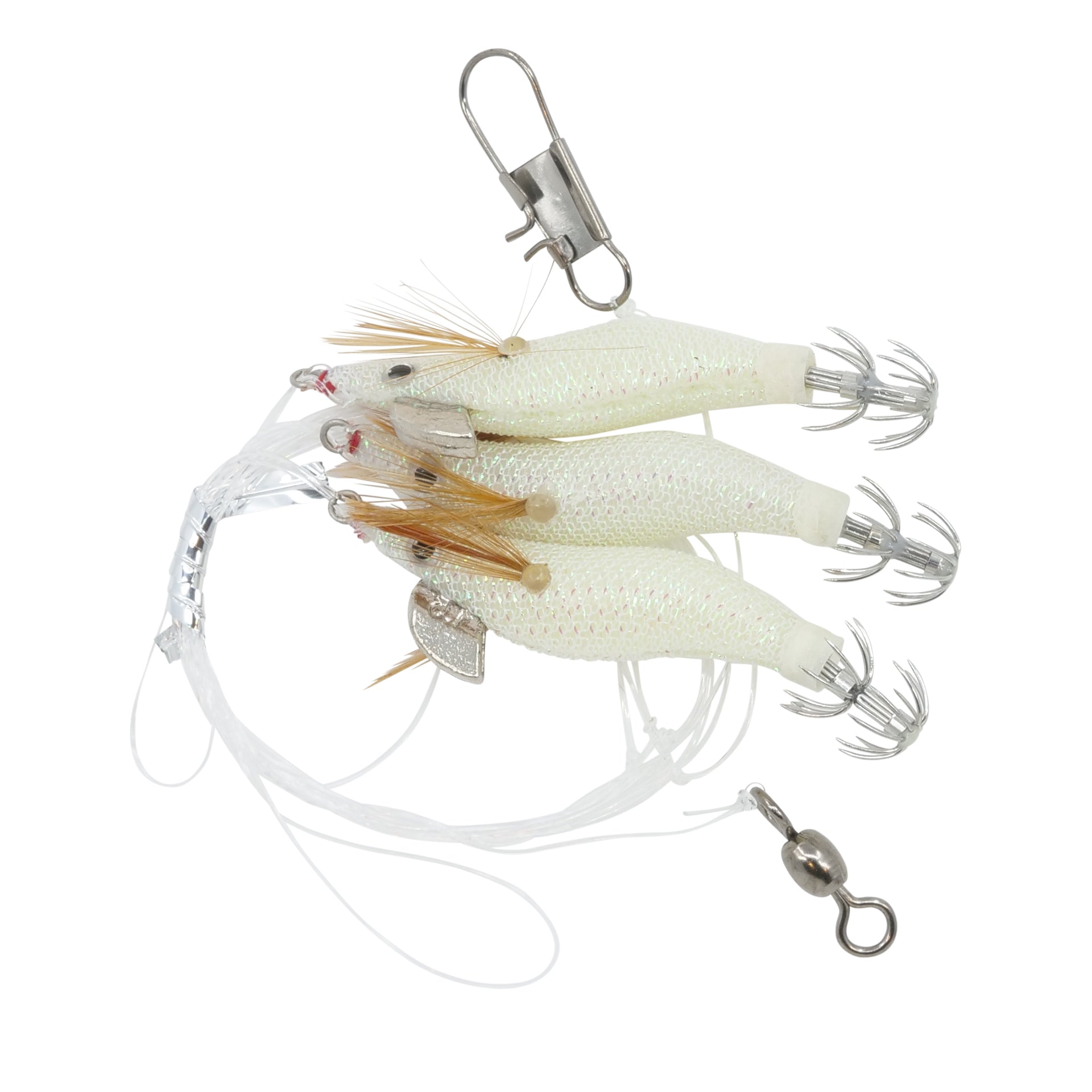
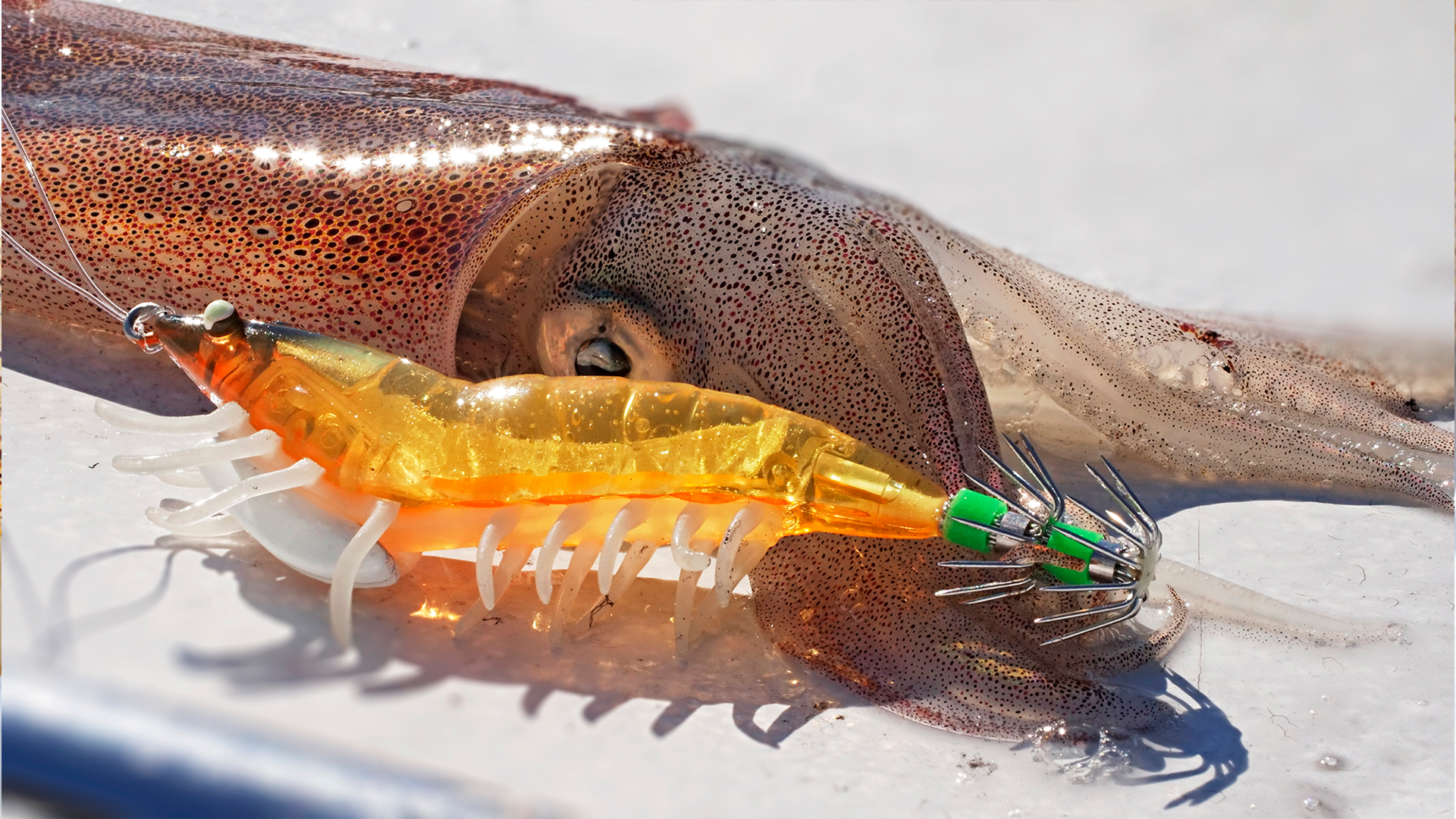
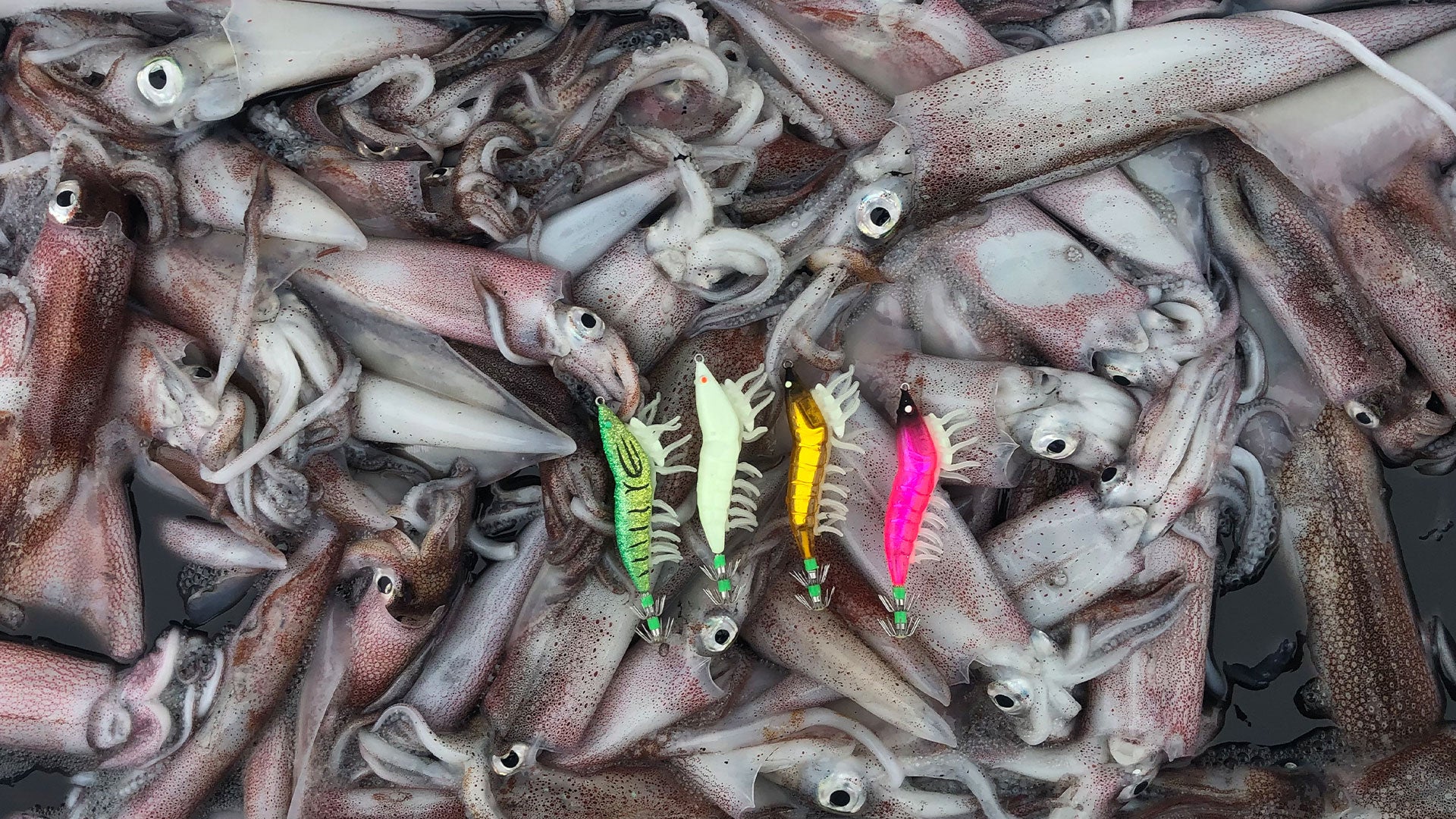
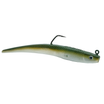
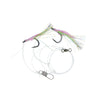
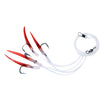
The Hogy Squid-Biki Rig is a three-dropper hi-low style rig with keeled squid jig bodies — no hooks, no barbs, just upward-facing tines that snag the squid mantle when they attack the jig. Because there’s nothing holding the squid once it’s on, the retrieve has to be slow and steady all the way to the surface. The moment you stop reeling or lose tension, the squid drops off. That’s the whole technique.

On a good day, squid will chase each other to the surface as you reel — and the jig above the one already hooked will pick up a second fish on the way up. Two at a time is common when the bite is hot. Three at a time happens.

The Lure for the Job
The System
Three-dropper hi-low rig with keeled squid jig bodies. Keeling keeps the jig oriented correctly in the current so the upward-facing tines are always in the right position to snag the squid mantle on contact. Comes rigged on 30lb fluorocarbon — no rebuild required. Add your own bottom weight based on depth and current.
Action
The Squid-Biki Rig doesn’t need to be worked aggressively. Send it to the bottom, let the boat motion set the keeled jig bodies, and jig slowly upward. The squid attack from below and impale themselves on the tines. On a hot bite, they’re on before you’ve moved the rig six inches off the bottom.
Speed
Slow. Very slow. The retrieve is a steady, uninterrupted wind from bottom to surface. Any pause or loss of tension and the squid drops. No stopping. No pumping. Just a smooth, consistent reel until you see the squid at the surface.
Color
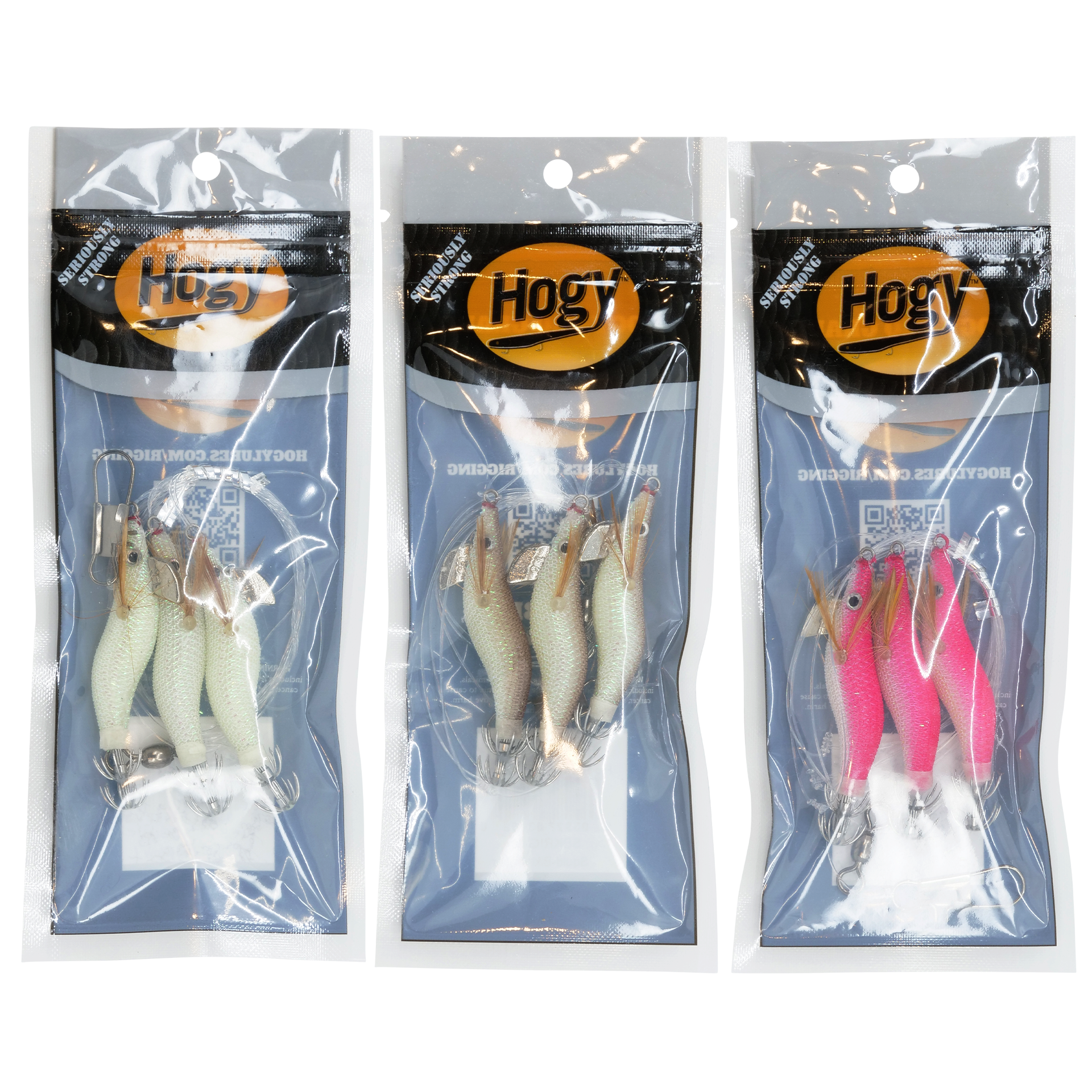
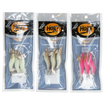
Pink was the top producer on this session. The Squid-Biki Rig comes in Pink, Amber, and Glow — carry all three. Start with the color that’s been producing and swap when the bite cools. Sometimes the squid just need a different look, especially as light conditions change through the session.
Depth
8–20 feet for spring Cape Cod squid. Bottom weight selection scales with current and depth — heavier weight in more current, lighter in slack. You want the rig near the bottom, not arcing through the mid-column.
Limitations
No hooks means no room for error on the retrieve. A stopped reel = a dropped squid. In strong current, the rig can kite off the bottom — upsize your bottom weight to maintain contact. Check for weeds on every drop; a fouled jig is an invisible jig.
Rigging
  • Squid-Biki Rig ties directly to your main line or short fluorocarbon leader via the top snap or swivel.
  • Bottom weight clips to the lower snap — adjust weight to match depth and current.
  • 30lb fluorocarbon leader recommended to avoid losing rigs on bottom contact.
  • Check jig bodies for weeds on every drop, especially on the first few casts in a new area.

Outfit

Loadout
Rig
Hogy Squid-Biki Rig — Pink (primary), Amber, Glow as backups
Bottom Weight
Scale to depth and current — start light, upsize if the rig drifts off bottom
Leader
30lb fluorocarbon — protects the rig from bottom abrasion
Rod & Reel
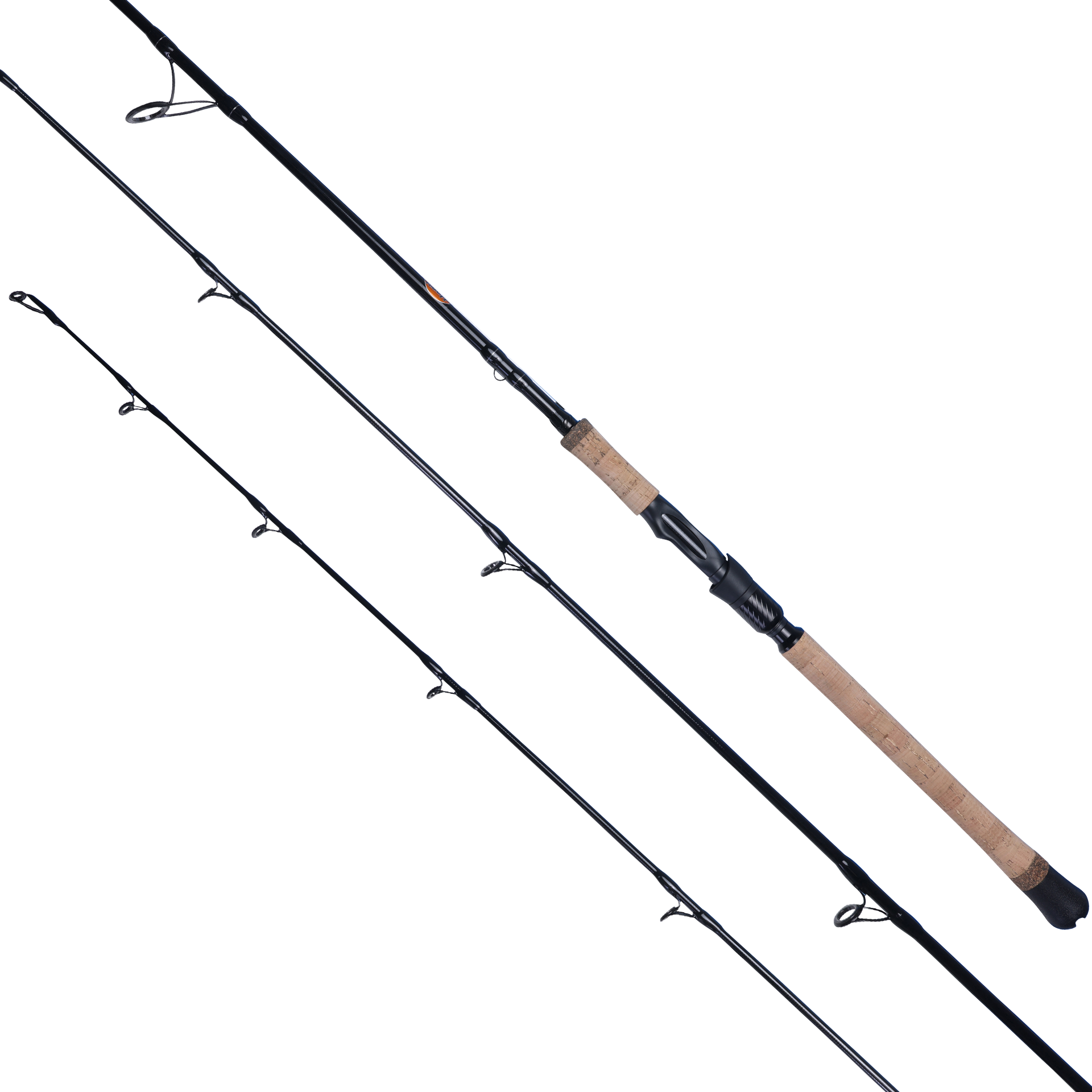
Light spinning outfit — 7ft medium, 2500-3000 reel, 10-15lb braid
Technique
Drop to bottom → let keel set → slow steady jig up → uninterrupted retrieve to surface

The Squid-Biki Rig retrieve — step by step

1
Drop the Squid-Biki Rig to the bottom. Let the line go fully slack for 3–5 seconds. This allows the keeled jig bodies to orient correctly in the current. A jig that hasn’t settled is a jig that isn’t working.
2
Jig the rig slowly upward — 1–2 feet at a time, then pause. You’re not working it aggressively. A gentle lift is all the Squid-Biki Rig needs. The squid do the work — they attack from below and drive themselves onto the tines.
3
If you feel any weight change or resistance — you have one. The strike is a softening or a subtle added weight. Don’t set the hook. Just start reeling steadily. The hook-set is irrelevant — maintaining tension is everything.
4
Reel slow and steady to the surface. No pumping, no pausing, no stopping. One continuous retrieve. If you stop, the squid drops. Keep the rod tip up and the line tight from bottom to boat.
5
Watch for followers on the way up. Squid are aggressive and will chase a hooked squid toward the surface. When one is hooked, the jig above it can pick up a second fish. Two at a time is common when the bite is hot.
6
Check the jig for weeds on every drop — especially when first arriving in an area. A single strand of weed on a tine kills the presentation. Four to five jigs with no bite in an active area usually means a fouled rig, not absent squid.
MH
Capt. Mike Hogan

“The beauty of squid fishing is there’s really not a whole lot to it. You drift, you anchor, you send your Squid-Biki Rig down to the bottom, nice slow easy jig — and in a couple hours effort you’ve got dinner, you’ve got bait, and the boat is broken in for the season.”

Squid season typically runs April through early June on Cape Cod. Check current Massachusetts DMF regulations for size and bag limits. Squid can be used as live or fresh bait for fluke — they also freeze exceptionally well. Fill the bucket.

The decision at a glance

Signal from the SystemDecision
Spring water temps (48–56°F)Squid push is on. Launch and start drifting near the marina. Close to shore, short run.
Sporadic hits on the drift, diffuse sonar marksKeep drifting. The pod hasn’t been found yet. Two more passes before committing.
Consistent hits + tight sonar cloud near bottomGet the anchor ready. Go uptide, set the hook, get the Squid-Biki Rig back down immediately.
Bite cools on the anchorSwap colors before you move. Try Glow, Amber, or Green before pulling the anchor. The pod may still be there.
Fleet of boats already anchoredWork uptide of the concentration. Don’t crowd anchored boats. Squid spread from the main pod — find the edge of it.
Anchor draggingReset immediately. Check scope after every position move. 100 feet of scope in 10–15 feet of water is a shallow angle — if it’s not, let out more line.
Dropped squid on retrieveYou stopped reeling. The Squid-Biki Rig requires uninterrupted steady pressure from bottom to surface. No pauses. Keep the tension on.
Step 5 output
Hogy Squid-Biki Rig, Pink. 30lb fluorocarbon. Bottom weight scaled to depth and current. Drop to bottom, let keel set, slow steady retrieve with zero pauses. Stay on the pod when it’s hot. Two at a time is the target.
Putting it together
Drift to find, anchor to load

Step 1 set the context: spring loligo squid push in Cape Cod inshore waters, 8–20 feet, accessible from the marina. Step 2 confirmed moving current as the key variable — tide concentrates squid. Step 3 identified the unlock: the sonar cloud is the green light, not the first bite on the drift. Step 4 executed the two-phase approach — drift passes to locate the pod, then anchor uptide once the marks and the bites confirmed the concentration. Step 5 closed the loop: the Squid-Biki Rig, Pink, on a slow steady retrieve with zero pauses from bottom to surface. Two hours. Dinner and a season’s worth of fluke bait. First trip of the year, dialed in before lunch.
Next in the series
Cracking the Code: [ Next Episode ]
[ One-line teaser. ]
Squid Squid-Biki Rig Spring Inshore Cape Cod Anchored Presentation Capt. Mike Hogan Capt. Rob Lowell Cracking the Code

Reading next

Cracking The Code: Spring Haddock & Cod Stellwagen Bank
Cracking The Code: Seabass Season Opener

Leave a comment

All comments are moderated before being published.

This site is protected by hCaptcha and the hCaptcha Privacy Policy and Terms of Service apply.

Related Videos

Spring Squid Fishing on Cape Cod - Squid Run

Big stripers love squid and early spring hosts the largest migration of the year. Large style soft baits can easily mimic the size, shape, movement and color of squid. Working areas near rips, Captain Mike Hogan explains tips and techniques for taking advantage of this explosive fishery.

Nantucket Sound Squid Fishing aboard FV Skipjack

We’ve kicked off the 2018 fishing season targeting recently arrived squid shoals staging in Vineyard Sound. Capt. Mike Hogan boards F/V Skipjack with Larry Backman and targets squid in fast current using the new Hogy Charter Squid Jig.

How-To: Slack Tide Squid Fishing Techniques

In late April, Nantucket Sound fills with spawning large loligo squid, creating an excellent opportunity for anglers to stock up on offshore baits for later in the season or grab a few for the grill. In this video, Salty Cape crew heads out aboard F/V Skipjack for a day of squidding off the coast of Barnstable, MA.

Related Blogs

Bluefin TunaCrack The Code: East Of Chatham Tuna Trolling Spread

Crack The Code: East Of Chatham Tuna Trolling Spread

Bluefin Tuna  ·  Crab Ledge, East of Chatham  ·  Summer Cracking the Code Capt. Mike Hogan  ·  Salty Cape TV powered by Hogy Location Crab Ledge — East...

CastingCrack The Code: Topwater Striper Handkerchief Shoal

Crack The Code: Topwater Striper Handkerchief Shoal

Cracking the Code: The Franken Popper at Handkerchief Shoal Striped Bass  ·  Handkerchief Shoal  ·  Early Summer Cracking the Code Capt. Mike Hogan  ·  Salty Cape TV powered by H...

CastingCrack The Code: Micro Squid Rips Finicky Stripers

Crack The Code: Micro Squid Rips Finicky Stripers

Cracking the Code: Four Retrieves on One Cast — Surface Eraser vs. Finicky Monomoy Stripers Striped Bass  ·  Monomoy Rips  ·  Mid-June Cracking the Code Capt. Mike Hogan &...

InshoreCrack The Code: Monomoy Rips Topwater Striper

Crack The Code: Monomoy Rips Topwater Striper

Cracking the Code: Poppers on a Squid Bite at Monomoy Striped Bass  ·  Monomoy Rips  ·  S2022 E6 Cracking the Code Capt. Mike Hogan  ·  Salty Cape TV powered by Hogy ...

InshoreCracking The Code: Monomoy Rips Striped Bass

Cracking The Code: Monomoy Rips Striped Bass

Cracking the Code: Surface Eraser on the Monomoy Squid Rips Striped Bass  ·  Monomoy Rips  ·  S2024 Cracking the Code Capt. Mike Hogan  ·  Salty Cape TV powered by Hogy ...

Bluefin TunaCracking The Code: Light Tackle Bluefin - The Gully

Cracking The Code: Light Tackle Bluefin - The Gully

Light-Tackle Bluefin  ·  The Gully  ·  S2025 E6 Cracking the Code Capt. Mike Hogan  ·  Salty Cape TV powered by Hogy Location The Gully — S. of Block Island Season Midsummer Species Bl...