


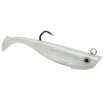



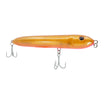
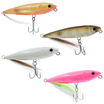
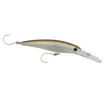
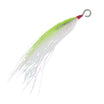
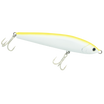
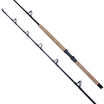
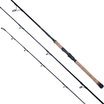
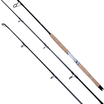
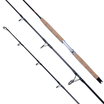
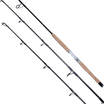
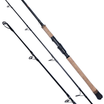
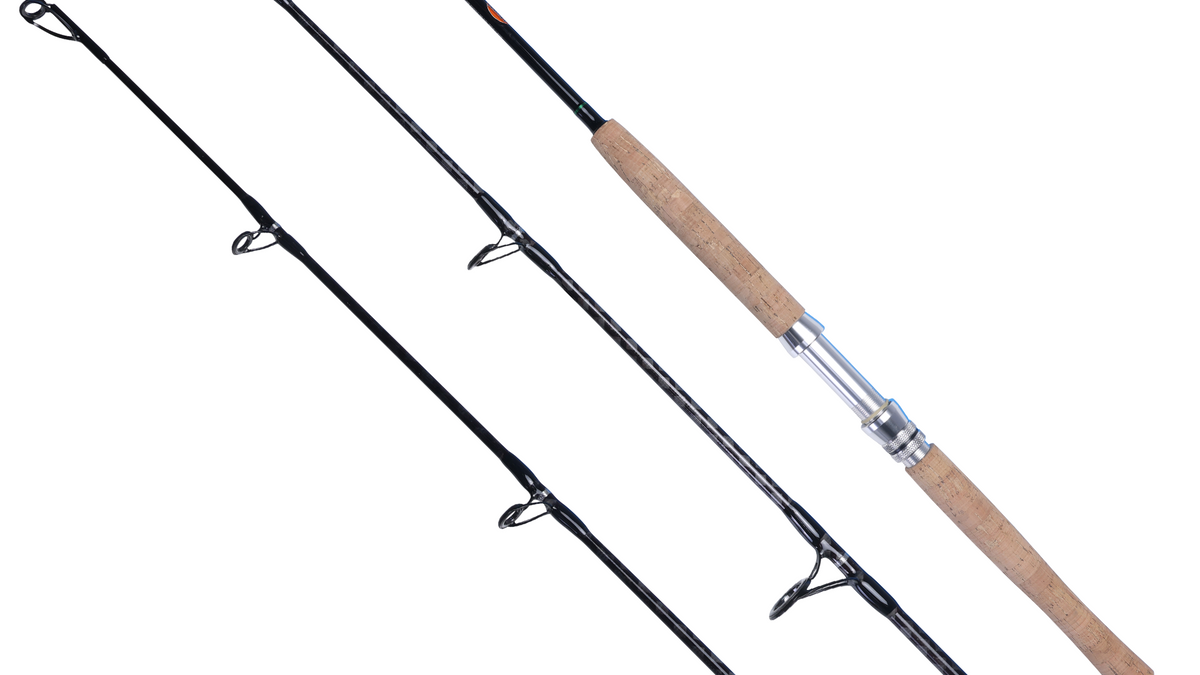
Gear Deep Dive: 6'6" Hybrid Tuna Rod (The One-Rod Quiver)
Cast. Jig. One rod. Total flexibility. One outfit that casts a 5oz slider and drops a 10oz jig, for travel, for guests, and for days you cannot predict.

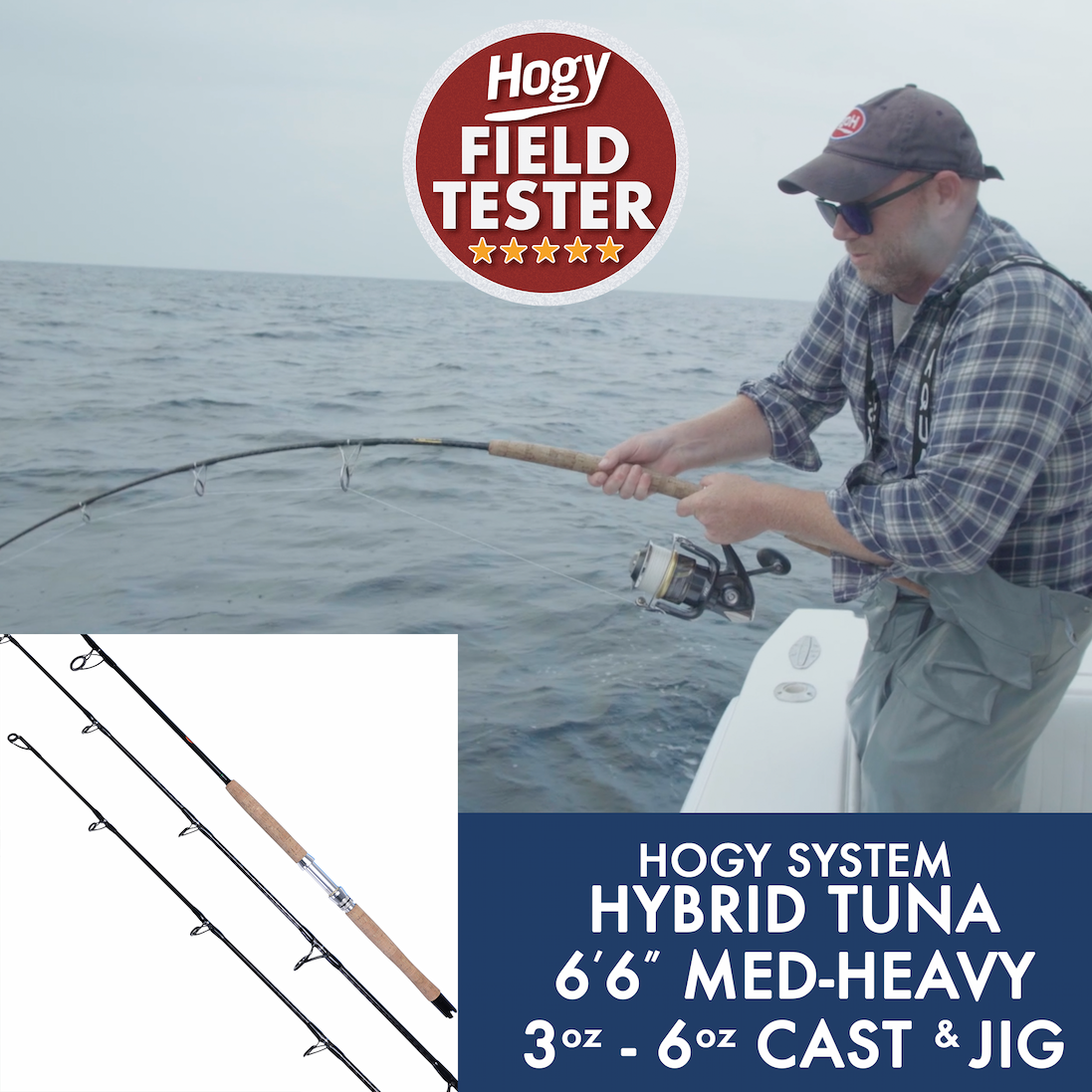
The One-Rod Quiver.
When You Would Use It
Bridges the gap between dedicated casting and dedicated jigging. A genuine hybrid for tuna anglers who need to do both in the same trip, sometimes on the same drift.
At 6'6" it is long enough to cast plugs and paddles accurately, and compact enough to jig vertically without the leverage penalty a 7' rod carries on a deep fish.
For the angler who goes offshore occasionally, and the backup rod that switch-hits. One rod that covers the whole tuna day, or the spare on a full-system boat that steps into either job.
Most rods that claim hybrid capability are compromises in the bad sense: they cast adequately but jig poorly, or jig well but cannot generate casting distance. This one is designed from the blank up for both.
Every other rod in the system gets an A+ in one category and a C in another. The 7' casts about 25 feet further than this rod and jigs only in a pinch. The 5'9" jigs better than anything and a short lob is its casting ceiling. This one scores an A in one method and a B in everything else, and over a season that adds up to more fish than either specialist would have given you on the days you guessed wrong.
When it is the call
A day you cannot predict, where you may need to cast and jig on the same drift. Four reads point here:
- Showings on top and marks below them. Cast the showing, drop on the marks, no rod change in between.
- Rod count is limited. Travel, a small boat, or a cockpit that will not take a quiver.
- You are running guests. Fewer rods on deck means less confusion and faster decisions when a school comes up.
- Stand-up jigging. The one rod in the system with a medium butt rather than a short one, and it is deliberate.
When it is not
A dedicated casting day at range. The 7' reaches about 25 feet further and is more comfortable over eight hours of it. Or a whole session vertical at 100 feet plus, where the 5'9" is meaningfully more efficient.
The Action: Moderate-Fast
This rod is moderate-fast. The same action that makes it cast is what makes it jig. The tip loads cleanly on the cast, and the midsection absorbs the load in both casting and vertical work.
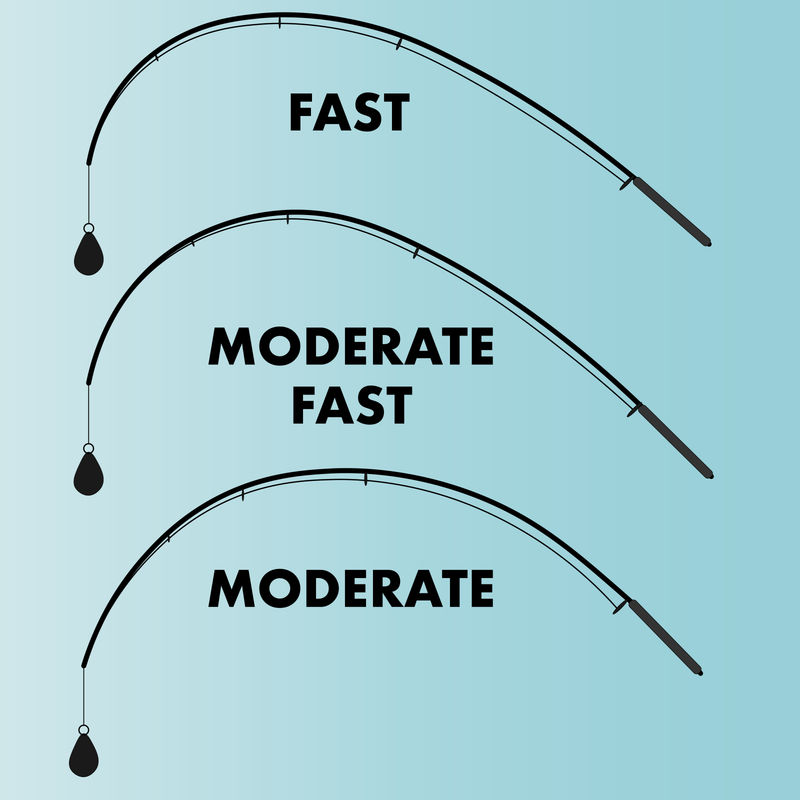
Fast, moderate-fast and moderate. This rod is the middle one: tip first, then the midsection.
Why moderate-fast for a cast-and-jig rod
The same action that makes this rod cast is what makes it jig.
- Why fast fails at jigging: Too stiff to load smoothly on the lift and fall. It kills the rhythm and reduces the hook-up rate.
- Why fast fails at fighting: It rips hooks on single-hook soft plastics when a tuna makes a hard run.
- Why moderate fails at casting: It loses tip recovery speed, which costs distance and accuracy on a heavy lure.
- What moderate-fast gives you: The tip loads cleanly on the cast, and the midsection absorbs load in both casting and vertical work.
Fast versus moderate-fast
A fast blank casts and loses the fish. A moderate blank jigs and loses the cast. Here is the difference with tuna on the line.
| The moment | Fast | Moderate-fast (this rod) |
|---|---|---|
| Where it bends | Top third only, stiff below | Tip first, then the midsection |
| A 5oz Slider at a showing | Casts it, then pulls the hook on the first hard run | Casts it, and the midsection cushions the run |
| A 10oz jig on the lift and fall | Too stiff to load smoothly. It kills the rhythm | Loads on the lift and stays tight on the fall |
| A single hook in a soft plastic | Rips out when a tuna makes a hard run | Stays pinned |
| A fish that ends up under the boat | A stiff disconnect | Cushions the sustained load |
Moderate-fast does both jobs. Responsive when you put energy in, forgiving when the fish puts energy out.
The upgrade: two sweet spots and a medium butt
Two sweet spots, one blank. Casting runs 4 to 6oz. Jigging runs 6 to 12oz, with the sweet spot at 6 to 10. The overlap in the middle is where the rod is most itself, and it is why you can throw a 5oz slider at a showing and then drop a 10oz jig on the marks underneath it without changing anything.
This is the one rod in the system where the butt is not short, and it is deliberate. It is medium length, for stand-up jigging.
- Long enough: A medium butt keeps it comfortable under the arm on long vertical retrieves, which is what stand-up jigging actually asks for.
- Short enough: Keeps your elbows at or below shoulder height in a hip-fighting position so your core carries the load, and keeps the rod from sweeping or catching in a small cockpit.
- No hardware required: No harness, no fighting chair, no complex rigging across the full weight range of this rod.
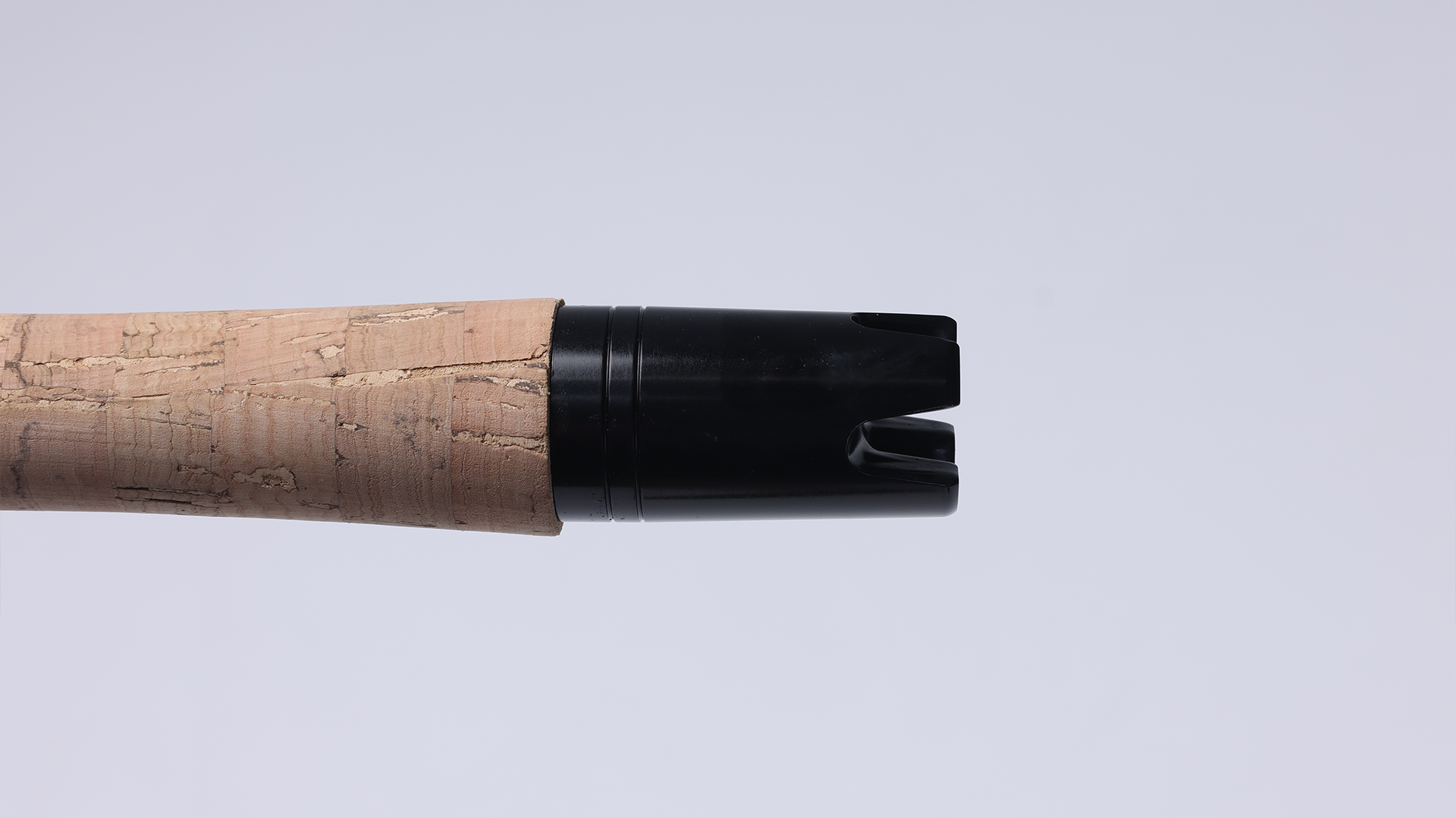
Gimbal butt on the one medium-length butt in the system. It tucks under the arm on a long vertical retrieve.
This rod is designed to be in your hand when the situation shifts, and when it does the design is ready.
- The scenario: Fish that were on the surface mark deep. The rod in your hand becomes the drop rod.
- Why it copes: The compact blank prevents the leverage penalty a longer casting rod creates in a vertical fight, and the moderate-fast midsection cushions the sustained load without a fast blank's stiff disconnect.
- The limit: Not as efficient as the 5'9" for extended deep work. It handles an unplanned vertical fight better than most anglers expect.
How the action shapes the retrieve
- Loads on the lift: The moderate-fast tip gives smoothly through the lift and fall, which is what keeps a jigging rhythm alive.
- Recovers on the cast: The same tip returns fast enough to generate line speed on a heavy lure.
Action for fighting fish
- Midsection absorbs: The same cushion as the 7' Casting Rod, in a shorter blank that gives the fish less leverage.
- Reserve power: Medium-heavy tuna-rated, comfortable well beyond school-class fish.
The Outfit in Detail
A rod on its own is half an answer. This is the whole one.
| Spec | Value |
|---|---|
| Action | Moderate-Fast |
| Power | Medium-Heavy (Tuna-rated) |
| Length | 6'6" |
| Butt | Medium length, for stand-up jigging |
| Reel class | 14000-18000 |
| Reel type | Spinning |
| Main line | 60-80lb braid (100lb hollow core optional) |
| Leader | 60-130lb fluorocarbon |
| Drag range | 12-15lb casting; to 20lb jigging |
| Lure range | 4oz - 12oz |
| Sweet spot | Cast 4-6oz; Jig 6-10oz (jigs to 12oz) |
| Methods | Casting; Jigging |
| MPN | HT-HJCRMH-S |
Two ranges, one rod. The store lists 3oz to 6oz, which describes the casting half. The full range is 4 to 12oz because the jigging end runs heavier: a 5oz slider on top and a 10oz jig on the marks. Both numbers describe the same rod, from different halves.
As a casting rod
Sweet spot 4 to 6oz. Sliders, chug poppers and paddles at range. The casting stroke is more compact than the 7', and inside that window it is fully effective.
- Where it matches the 7': Accuracy at moderate range, lure control in chop, and comfort over a full day. The compact blank is easier in a crowded cockpit.
- Where it gives up ground: Maximum distance on a long bomb. It casts about 25 feet less than the 7C, which launches. Not too shabby. If the day is dedicated surface casting at range, the 7' is the better tool.
As a jigging rod
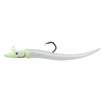
Sweet spot 6 to 10oz, and it handles to 12oz on the drop. It drops a 10oz jig 150 feet. Vertical paddles, harness eels and sand eel jigs, with the compact blank keeping the leverage penalty off your back.
- Where it matches the 5'9": Mid-depth marks, moderate jig weights, and any session that is jigging in phases rather than start to finish.
- Where it gives up ground: Sustained deep work over hours. The 5'9" is more efficient when the whole day is vertical, and that difference compounds across multiple hookups.
Methods
| Method | Weight window | What it covers |
|---|---|---|
| Casting | 4oz – 6oz | Sliders, chug poppers and paddles at range from a compact blank |
| Jigging | 6oz – 12oz, sweet spot 6–10oz | Vertical paddles, harness eels and sand eel jigs on the same rod |
| Trolling | In a pinch | A flat-line harness jig or a light bar at speed. Not the dedicated tool |
Reel
- Reel class: 14,000 to 18,000 spinning. The 18,000 is the pick because it handles the jigging end of the range better: more spool capacity and a higher drag ceiling when fighting heavy at depth. A 14,000 handles the casting side well.
- Drag: 12 to 15lb casting, to 20lb jigging, measured off a bent rod at the tip, not at the reel and not by feel.
- Knot: PR or FG. Both pass cleanly under casting and vertical line pressure. Wind-on leader with a loop-to-loop connection is preferred when running heavy.
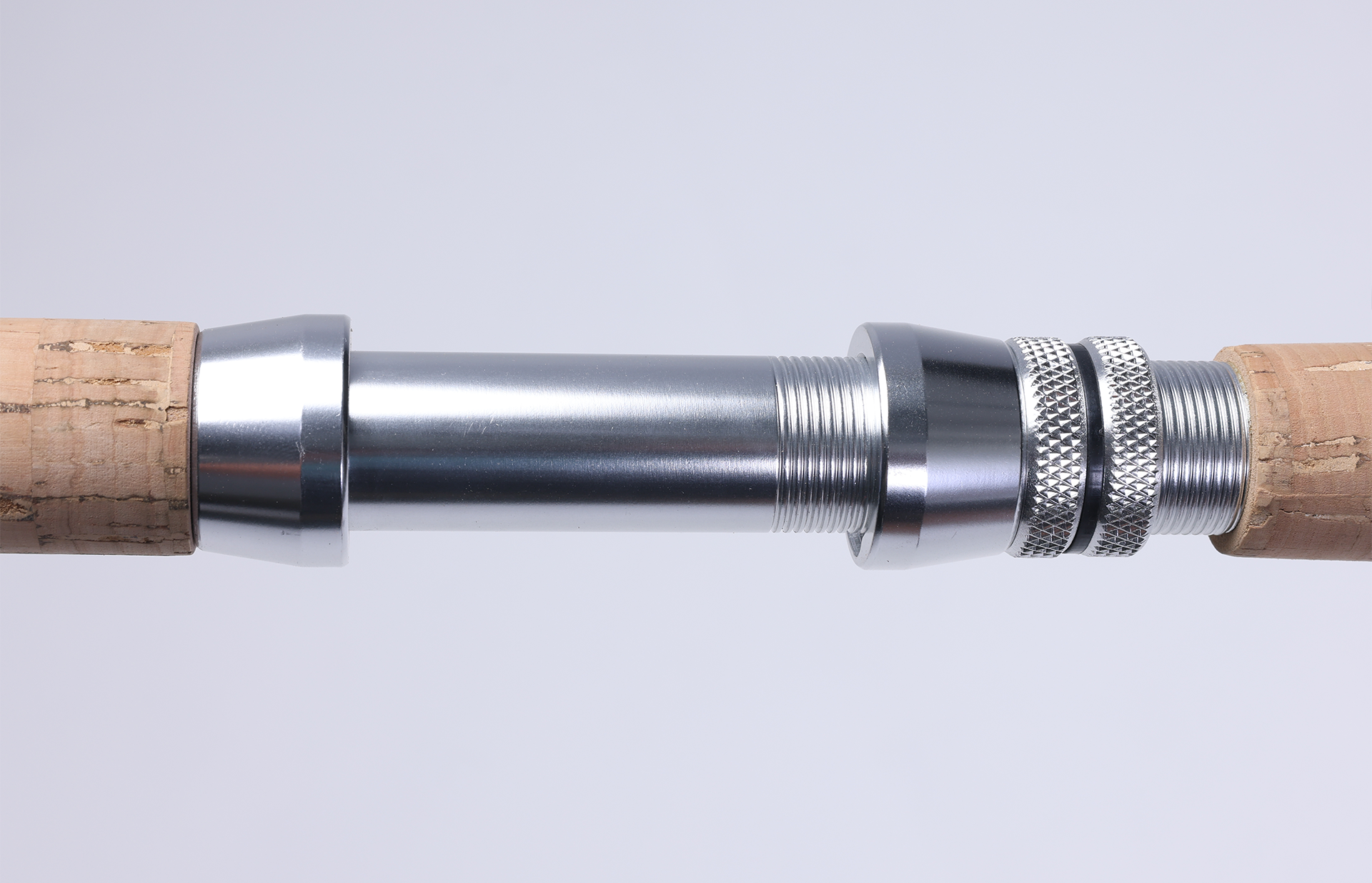
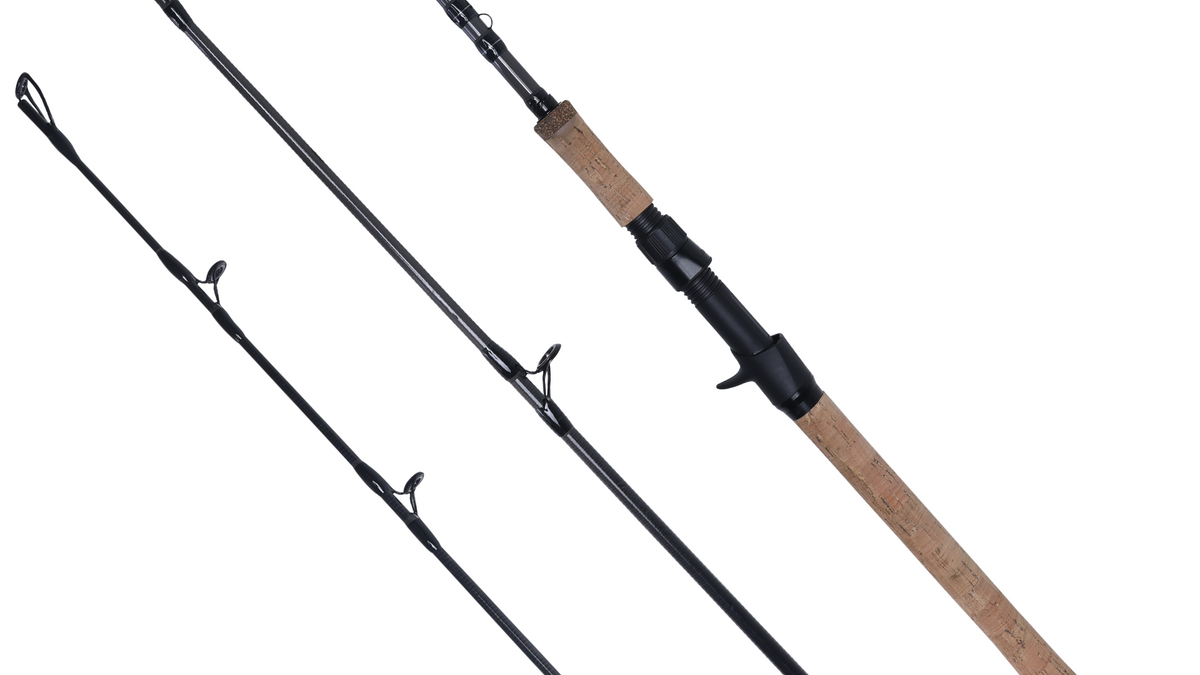
The reel seat. Built for a 14,000 to 18,000 class spinning reel, and the 18,000 is my pick.
Hollow core or solid braid?
Depends on how you are using it that day, which is a very hybrid answer to a hybrid question. For casting, solid braid: thinner diameter, longer casts, better depth control on the retrieve, less wind resistance. For jigging, 100lb hollow core is the option, because the spliced loop connection for wind-on leaders passes more cleanly through the guides than a heavy knot.
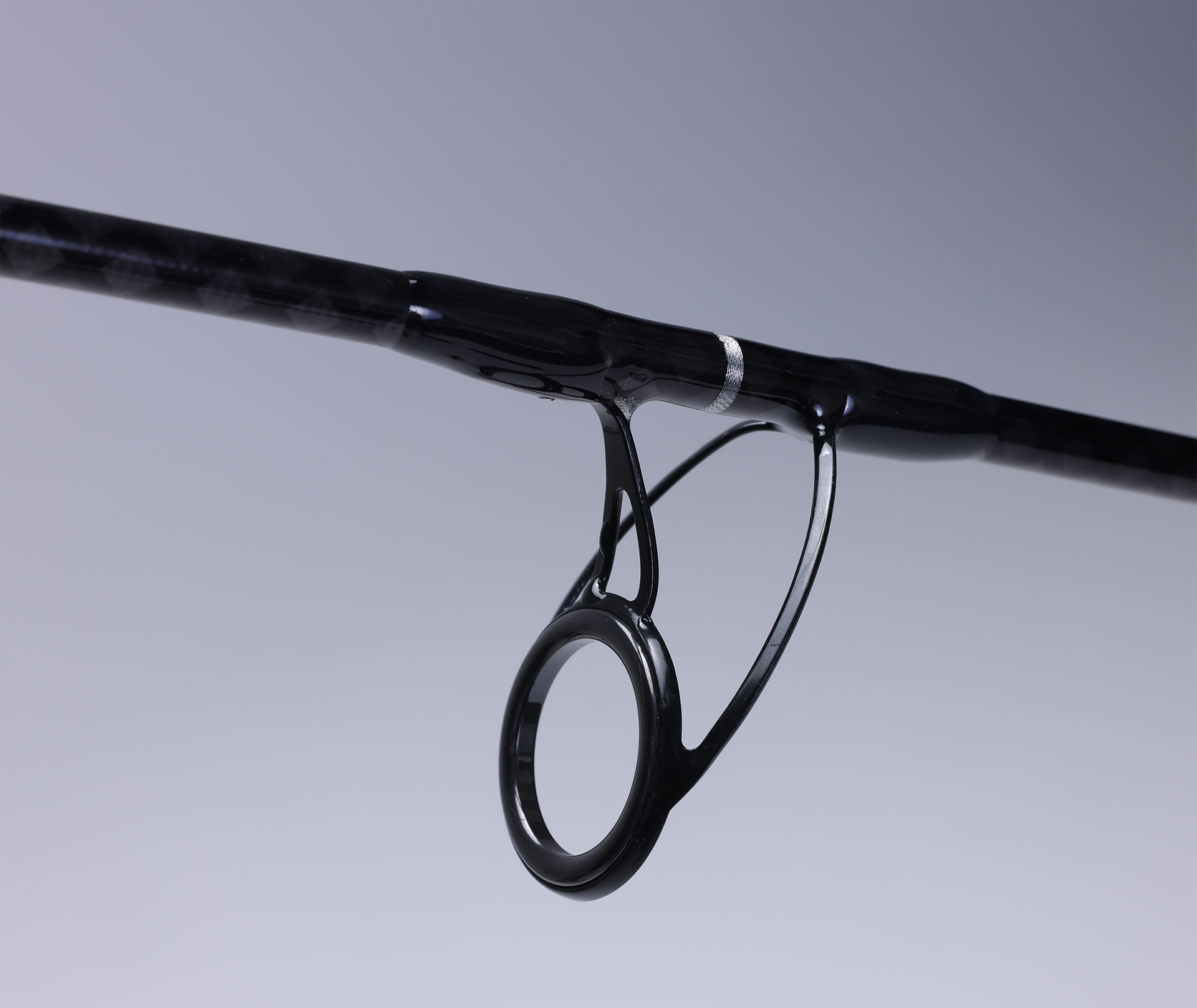
Ceramic guides. Solid braid on the cast, hollow core and a spliced wind-on on the drop.
Line, leader and knots
- Main line: 60 to 80lb braid, with 100lb hollow core an option if you lean toward the jigging end of this rod's range.
- Leader: 60 to 130lb fluorocarbon. 60lb is my casting starting point here, lighter than the 7' standard because this setup often meets smaller or more pressured fish.
- Length: a 12ft wind-on casting, 25ft jigging. The one rod in the system that runs both, which is the whole point of it.
- Connection: Tie direct at 80lb and under, crimp at 100lb and up. Chafe gear to a crane swivel, 130lb minimum and 220lb on 130lb fluoro, and a split ring at the lure.
- Drag: 12 to 15lb casting, to 20lb jigging, off a bent rod.
Build and endurance
- Medium butt, by design: The one exception to the short-butt law, tuned for stand-up jigging comfort under the arm.
- Travel-friendly: The shortest casting blank in the offshore lineup, which matters when rod count is limited.
- Solo or minimalist: One rod, one reel, full tuna capability. The answer when rod count is limited by choice or by space. It will not maximise performance in any single category the way a specialist does, but it will not leave you unable to fish a situation either.
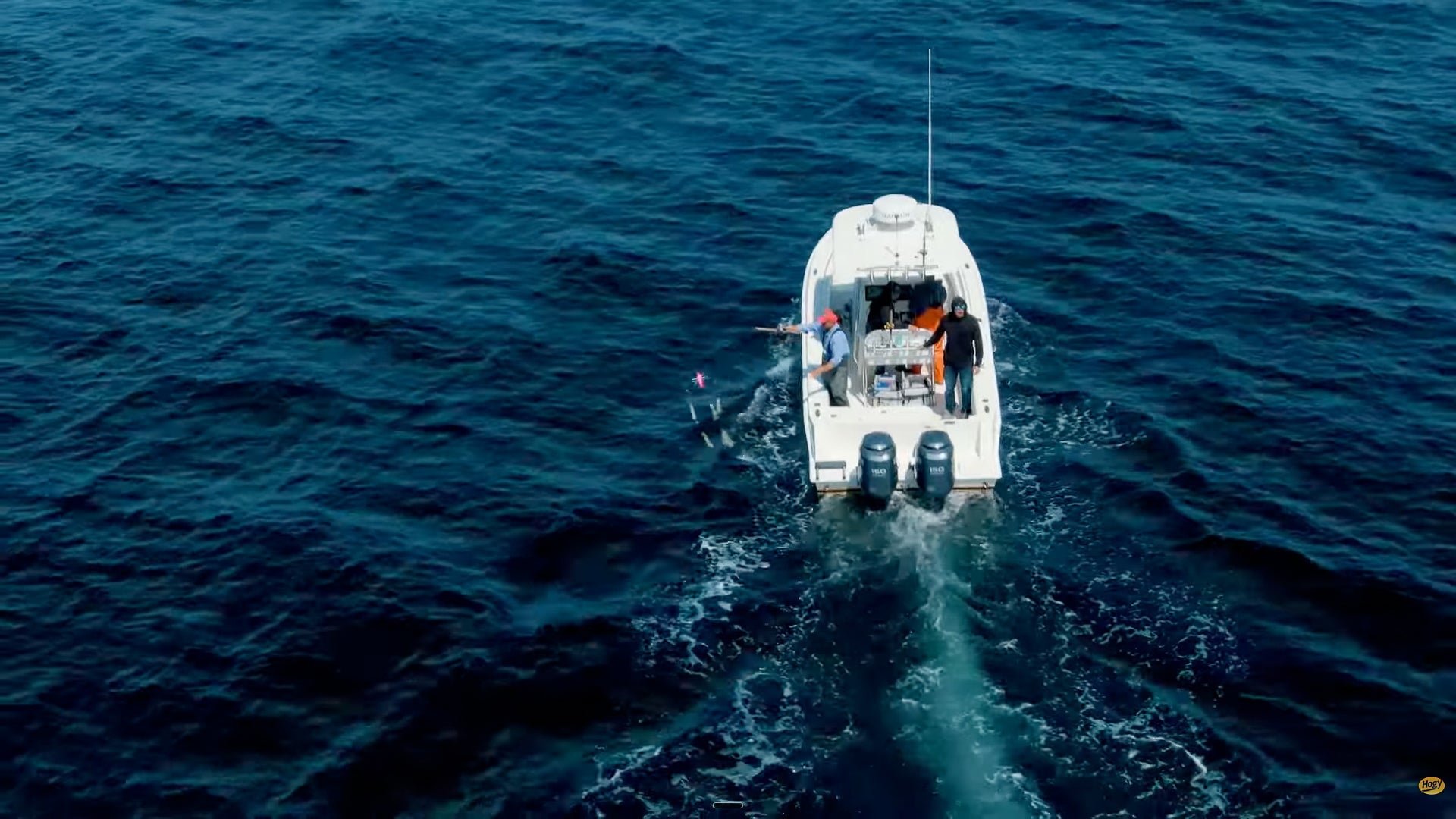
- Running guests: Fewer rods on the deck means less confusion, less tangling and faster decisions. When a surface feed comes up, guests cast. When fish mark deep, the same rod drops. No handoff, no re-rig, no explaining which rod is which.
- On a two-rod center console: In a two-rod offshore spinning setup, this pairs with either the 7' Casting Rod or the 5'9" Jigging Rod depending on the day. If the day leans casting with occasional jigging, pair it with the 7'. If it leans vertical, pair it with the 5'9".
Through the Season, Species by Species
On a one-rod day, this rod covers every phase of the tuna season. Here is what it does, micro season by micro season.
The 6'6" Cast & Jig sits outside the core four tuna rods, and that is the point: it is the one-rod answer when you cannot bring the full system, and the backup that switch-hits when you can. The calendar answer: as the one rod on board, it covers the whole tuna season.
Bluefin
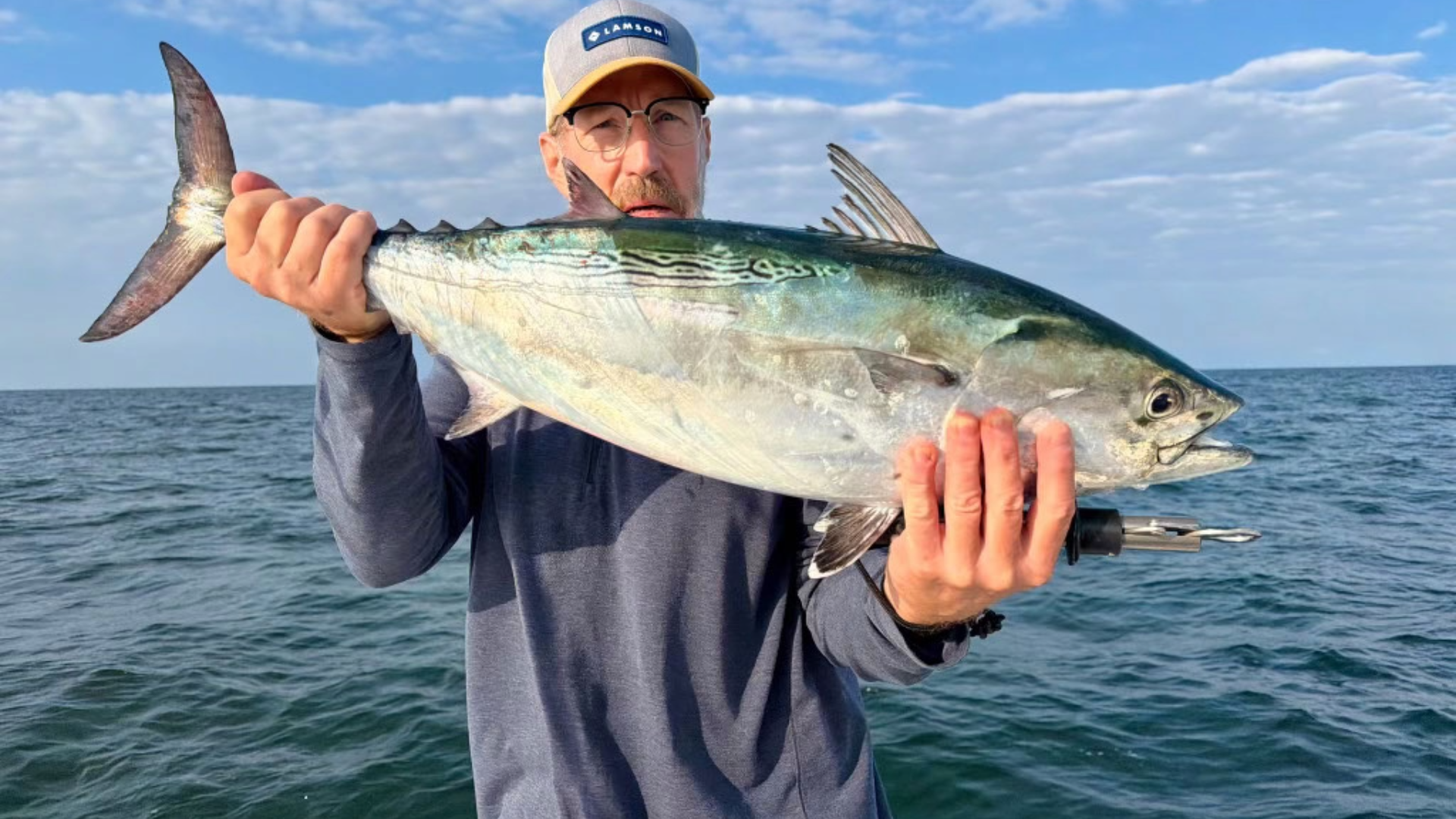
Not part of the core four, but worth knowing. The 6'6" bridges casting and jigging: long enough to throw a 5oz Slider with distance, compact enough to drop a 10oz jig 150 feet. It is the right call for captains or travelers who need a single-rod tuna setup, or for decks where space demands a shorter cast-jig platform. It is a compromise rod, and that is exactly the point.
This is the rod I recommend when someone asks what to bring if they can only bring one tuna rod. That is not a simple question and the answer is not always this rod. If I am running a dedicated casting day, I take the 7'.
It is a utility player by design, and I mean that as praise. It does not dominate a category and it does not need to. It is the one that is right more often than any other when you do not know what the day will ask for.
- Over to the 7C: When the day is dedicated surface casting: sustained topwater, long-range slider work, precise popper placement at 80 yards and beyond. The 7' is the specialist and this rod gives up a small amount of reach to it.
- Over to the 5.9: When fish are committed to deep marks and the whole trip is vertical with heavy jigs at 100-plus feet, the shorter more parabolic blank is the right tool.
- Over to Lefty: The conventional manages the trolling spread and flat-line duties, freeing this rod to stay rigged for casting or jigging.
| Micro season | Window | What I tie on | The read |
|---|---|---|---|
| 718 First Bluefin | Jun 1–Jul 15 | Pro Tail Paddle 4–6oz, cast or dropped | Cold-water school fish. Pods pop up and go down. Cast the showing, and drop on them when side scan finds them again. |
| 744–746 Summer Mode Bluefin | Jul 10–Oct 31 | Charter Grade Slider 4–6oz, Chug Popper 4oz, Sand Eel Jig 6.5–12oz | Surface feeds and marks under them, then the deep marks as fish drop in the fall. No rod change. |
| 750 Late Fall Bluefin (CCB) | Oct 20–Nov 30 | Harness Pro Tail Paddle 6oz, cast or jigged | Cape Cod Bay, bigger fish on butterfish. Colder days. |
| Lure | Why it works here |
|---|---|
| Charter Grade Sliders 7", 4 and 6oz | Long-range swimmers for blind casting and foam feeds. The 6'6" handles both weights cleanly inside its casting sweet spot. |
| Charter Grade Chug Popper 4oz | Surface explosions and reaction strikes. A slightly more compact casting stroke than the 7', still effective at distance. |
| Pro Tail Paddles 4–6oz | Cast-and-retrieve softbaits with thumping tail action. The most versatile lure in this rod's casting lineup. |
| Lure | Why it works here |
|---|---|
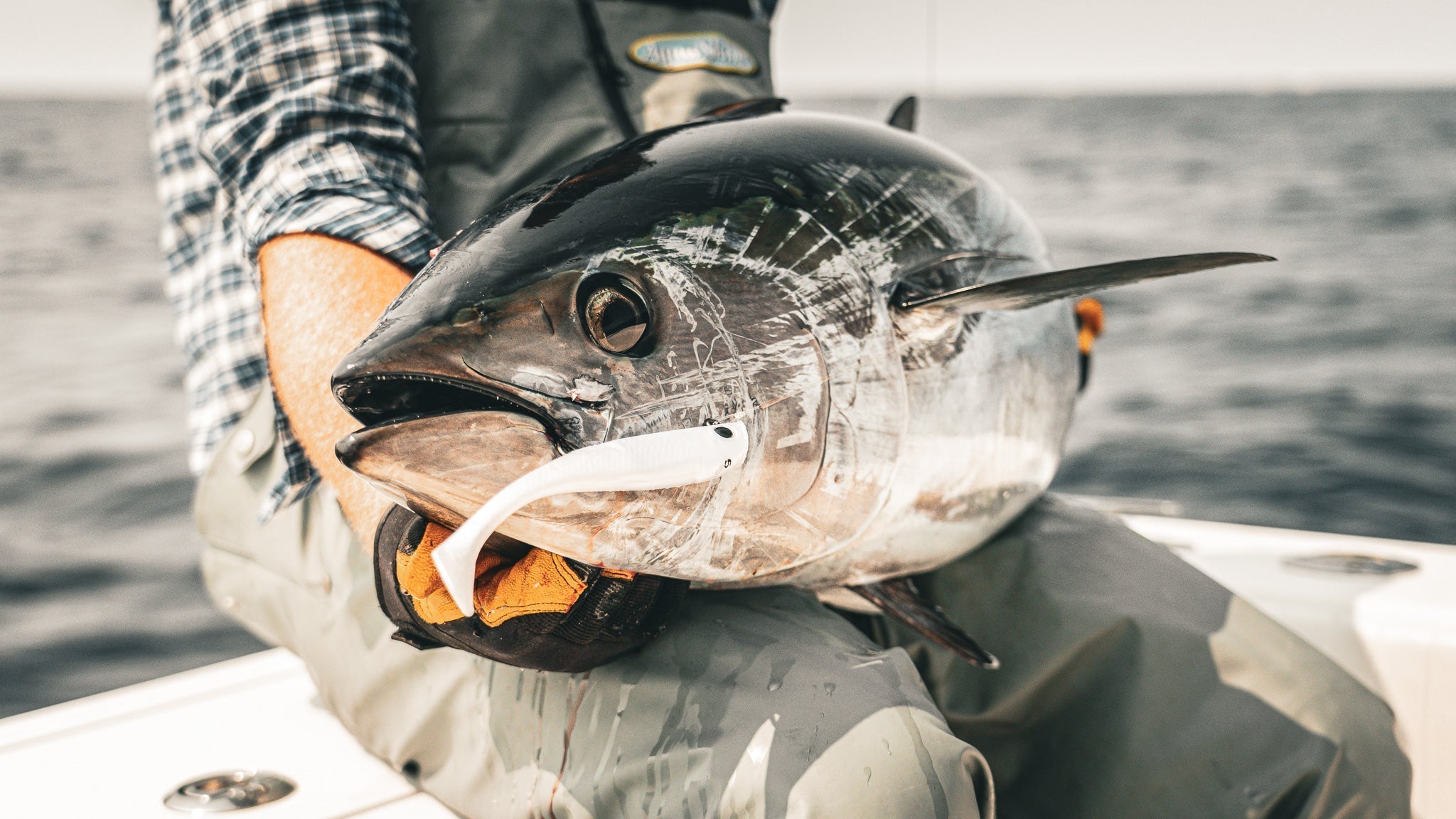
| Pro Tail Paddles 4–6oz | Drop and lift in mid-column. The same lure that casts also jigs, so no re-rigging when fish move off the surface. |
| Pro Tail Harness Paddles 4X, 6oz | Deeper jigging and heavier fish. The reinforced harness handles tuna-grade drag on vertical presentations. |
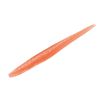
| Harness Jig Eel Tails 4oz | Vertical profile with spiral drop action. Excellent for mid-depth marks and kerplunk presentations. |
| Sand Eel Jigs 6.5–12oz | Fast-sinking metals for deep water and strong current. This covers the deep end of the rod's jigging spectrum. |
Yellowfin and bigeye
Same program: cast on the showing and drop on the marks. Mahi and light pelagics get paddles pitched where medium-heavy power is comfortable rather than excessive.
| Micro season | Window | What I tie on | The read |
|---|---|---|---|
| 724 Summer Blue Water | Jul 15–Sep 30 | Poppers and Sliders on top, Sand Eel Jig when marks sit deep | The warm side South of the Vineyard. One rod for both. |
One-Rod Tuna Outfits: The Full Picture
Some trips do not allow a quiver. These are the outfits that cover a whole tuna day on their own, and the real comparison is what each one gives up.
| Outfit | Reel | Line and leader | When it is the right call |
|---|---|---|---|
|
6'6" Cast & Jig The One-Rod Quiver |
18,000 spinning | 60–80lb braid, HC optional 12 ft cast / 25 ft jig |
The answer. An A in one method and a B in everything else. Wins on the overall scorecard |
|
7' Tuna Casting Casting-led |
14K–20K spinning | 80lb braid 80lb fluoro, 12ft wind-on |
If your day is mostly surface. About 25 feet more reach, and it handles an unplanned vertical fight better than it should |
|
5'9" Tuna Jigging Jigging-led |
18K–20K spinning | 100lb hollow core 25 ft wind-on |
If your day is mostly deep. Far more efficient vertically, and a short lob is its casting ceiling |
|
5'6" Hybrid Conventional The fourth rod |
Avet LX6 two-speed | 60lb braid + top shot | If the spread is going out. Trolling and heavy jigging, and it casts about 20% shorter than a 7-footer |
| Rod | Role | Reel | Line | Leader | Drag |
|---|---|---|---|---|---|
| 7' Tuna Casting | Daily Driver | 14K–20K spinning | 80lb braid (60–80) | 80–100lb fluoro, 12ft wind-on | 12–15lb |
| 7' Heavy Hybrid | Crossover | 8000–14,000 spinning | 50–80lb braid | 60–80lb fluoro, tied direct | 12–15lb |
| 5'9" Tuna Jigging | Work Truck | 18K–20K spinning | 65–80lb braid or 100lb hollow core | 80–130lb fluoro, 25ft wind-on | 15–20lb |
| 5'6" Hybrid Conv. | Light Tackle Troller | Avet LX6 two-speed | 60lb braid, mono top shot for bars | 60–80lb fluoro or mono | 10–15lb |
| 6'6" Cast & Jig | One-Rod Quiver | 14K–18K spinning | 60–80lb braid | 60–130lb fluoro | 12–15lb cast, to 20lb jig |
FAQ
What makes it different from the 7' or the 5'9"?
It does both. The 7' is longer, optimised for topwater and long-range sliders, and reaches farther on the cast. The 5'9" is shorter, more parabolic and purpose-built for vertical jigging. This one sits between them on purpose.
Is it a compromise rod?
Yes, and that is exactly the point. It wins on the overall scorecard rather than in any single category.
What if I can bring two rods?
The 7' Tuna Casting rod for everything you throw, and the 5'9" Tuna Jigging rod for everything you drop. This rod is the one-rod answer, and the backup that switch-hits when you bring the pair.
Can I troll with it?
In a pinch. It handles a flat-line Harness Jig or a light bar at trolling speed without issue. It is not the dedicated trolling tool. That belongs to the 5'6" Hybrid Conventional.
When should I use it instead of the 7'?
When you expect to need both casting and jigging on the same trip. When rod count is limited. When you are managing a setup for guests who will switch techniques. When you are travelling and want one rod that covers the whole program. And when you go offshore a few days a year and want one rod for all of them.
Why not a 7'6" instead?
Maneuverability and jigging efficiency. An extra six inches beyond 6'6" gives you marginally more casting distance on one end and meaningfully more leverage working against you on the jigging end. That is a bad trade for a rod whose whole job is doing both.
Do I need a fighting belt?
No. Butt against the hip, thick fishing bibs, elbows at or below shoulder height. That is where your core does the work instead of your shoulders.
Cast, jig or troll?
Surface activity, cast. Deep marks on sonar, jig. Fish in the area but scattered, troll if the conventional spread is not already out and this is the rod in your hand. Same three sight rules that run the whole system.


Leave a comment
All comments are moderated before being published.
This site is protected by hCaptcha and the hCaptcha Privacy Policy and Terms of Service apply.