















Black Seabass

Cracking The Code: Deep Summer Seabass

Cracking The Code: Deep Summer Seabass
Cracking the Code: Deep Summer Sea Bass — Long Drifts, No Bait, 95 Feet
Deep Summer Sea Bass  ·  Vineyard Sound
Cracking the Code
Location
Vineyard Sound — Elizabeth Islands
Season
Summer — Fourth of July
Species
Black Sea Bass
System
8.5oz Squinnow + Jig-Biki Rig
Depth
95–100 ft

When They Move Deep — Long Drifts, No Bait, 95 Feet of Water

Fourth of July weekend, Vineyard Sound. Sea bass are off the shallow rock piles and down in the troughs. Long contour drifts, 8.5oz Squinnow, no bait — and a cooler full of dinner by midmorning.

SC
Salty Cape TV powered by Hogy
Summer
9 min read
Deepwater sea bass fishing in Vineyard Sound

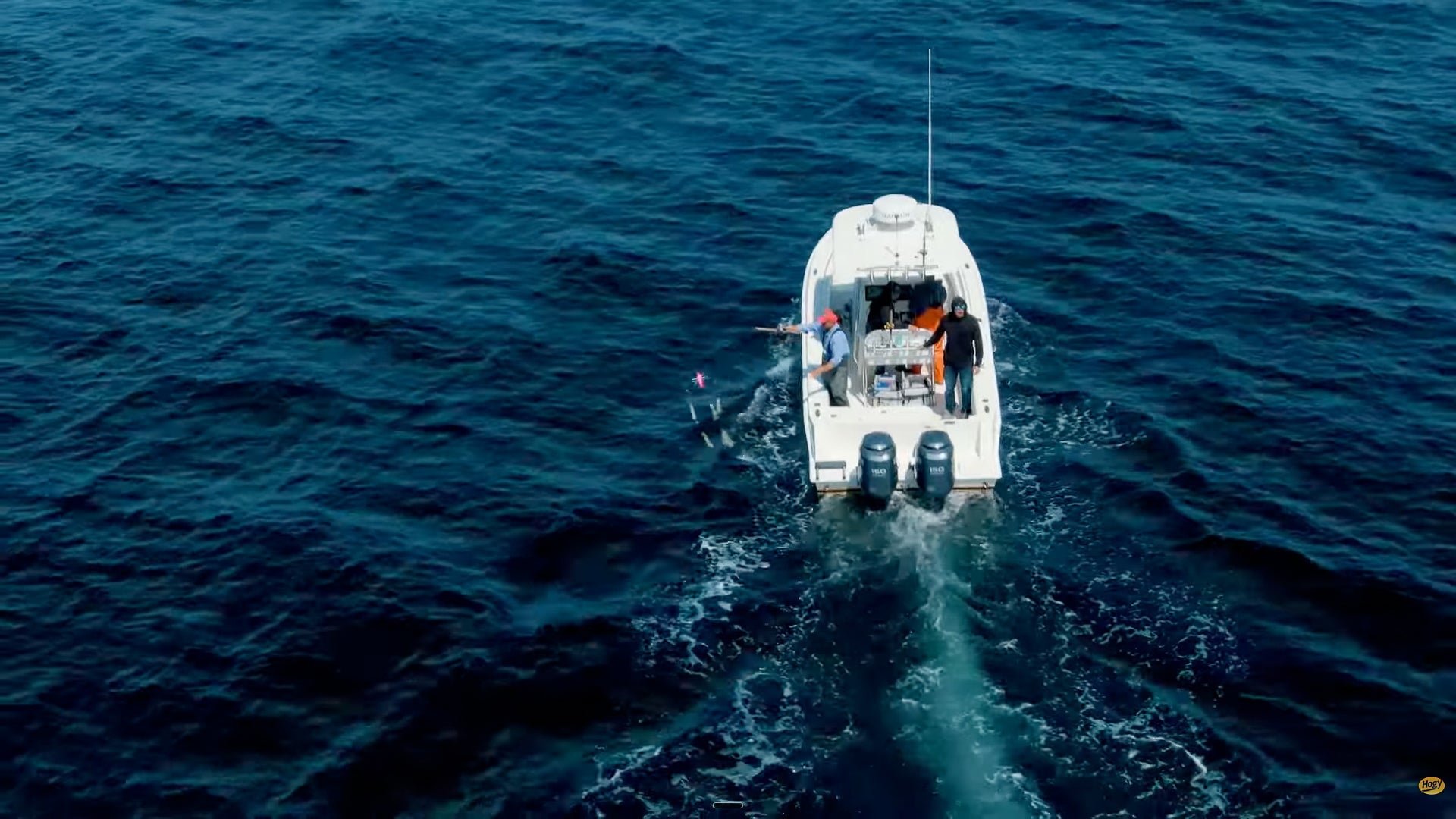
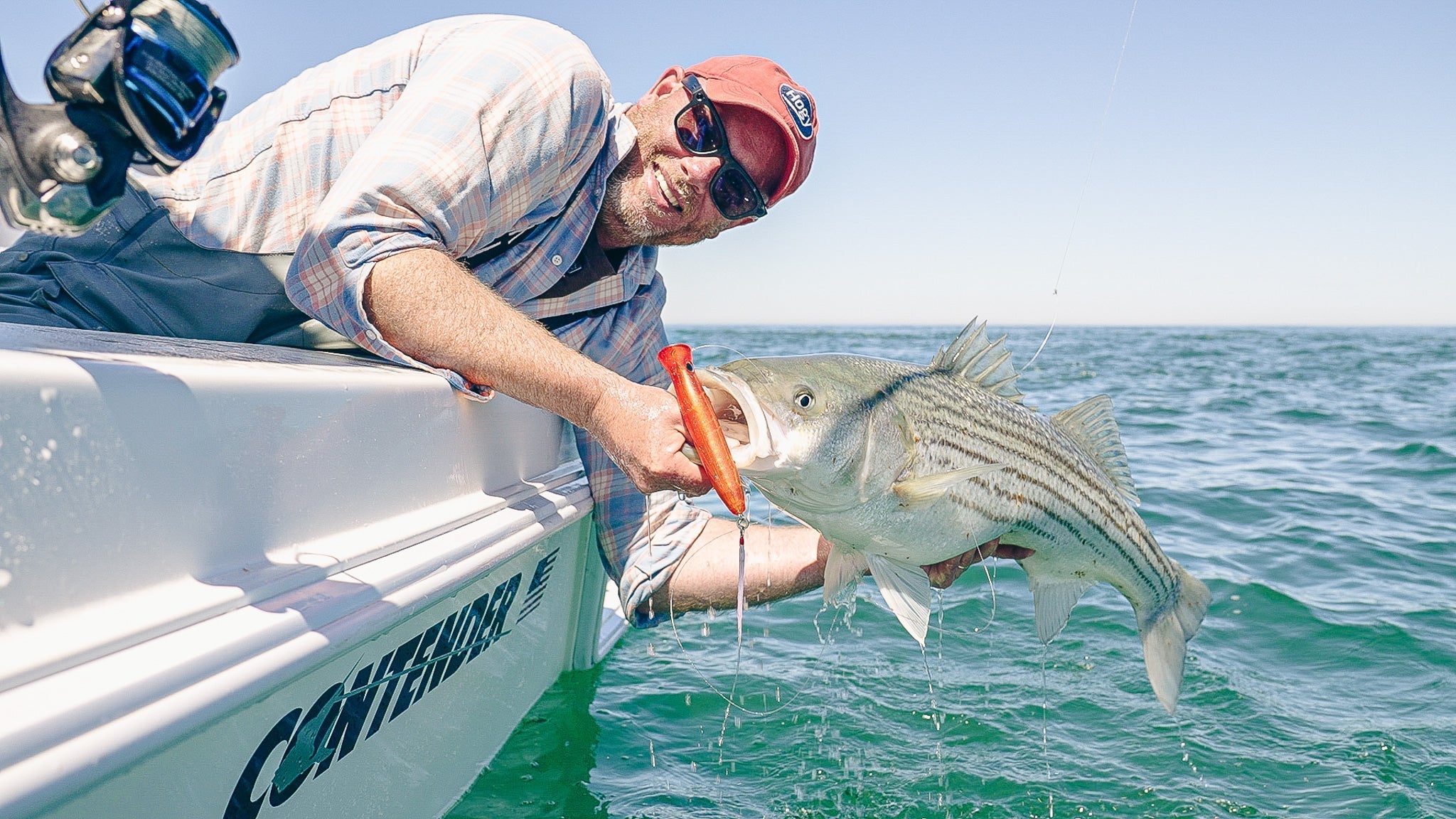
Vineyard Sound, Fourth of July weekend. 95–100 feet of water, long contour drifts along the Elizabeth Islands, the 7ft Hogy Hybrid bent in half. Sea bass for the cookout.

By Fourth of July weekend, the sea bass have shifted. The shallow rock piles that fish well in May and June are still producing, but the larger fish have moved to the deeper structure — underwater troughs, drop-offs, contour lines in 80–110 feet of water. The approach changes completely. Short rock pile hops give way to long deliberate drifts along the trough edge. The 2oz Heavy Minnow gets replaced by an 8.5oz Squinnow. And the fish are bigger.

The goal on this session was simple: a cooler full of sea bass for the Fourth of July cookout. The method was equally simple: 8.5oz Squinnow Jig clipped to the Jig-Biki Teaser Rig, big slow sweeps of the 7ft hybrid rod, vertical presentation maintained through the drift by paying line out. No bait. Home early enough to surprise the family.

The challenge: deep summer sea bass at 95–100 feet in Vineyard Sound — wind against tide, drift trajectory changing through the morning, the productive trough zone narrow and easy to miss. The system has to maintain vertical presentation as the drift lengthens, read when the zone ends, and reset without running through other anglers.
Step 1Historical Analysis

What the calendar tells you about deep summer sea bass

Context that shapes every decision that follows.

Sea bass follow a predictable depth migration through the season. They start inshore on shallow rock piles in May and June, then push progressively deeper as summer water temperatures climb. By Fourth of July weekend in Vineyard Sound, the big fish are in 80–110 feet of water — long troughs and contour lines along the Elizabeth Islands, not the 30–50 foot boulder fields of spring. The fish are still there, on structure, eating crabs. But the structure is different and the approach has to match.

Local Knowledge — Deep Summer Vineyard Sound
  • Fourth of July = deep water mode. If you’re fishing the same shallow spots you fished in May, the big fish aren’t there anymore. Look for underwater troughs and drop-offs in 80–110 ft along the Elizabeth Islands.
  • Fish coughed up crabs on this session — confirming crustacean forage at depth. The Squinnow’s “crustalicious” color and the Jig-Biki teasers mimic exactly what’s on the bottom at this depth.
  • The productive trough zone is narrow. Small scup and sea robins signal the end of the good bottom — pick up and reset uptide rather than continuing through empty water.
  • Wind against tide in Vineyard Sound creates complex drift trajectories. No two drifts are identical. Recalibrate the starting position after each run and be willing to adjust mid-drift.
  • Go around boats to reset, not through them. The fleet on productive deep structure is tight — cutting through another angler’s drift is both unproductive and poor etiquette.
Step 1 output
Fourth of July = deep water shift. Target 80–110 ft troughs and contour lines, not shallow rock piles. Crustacean forage confirmed at depth. Long deliberate drifts, not rock pile hops.
Step 2Environmental Factors

Wind against tide — no two drifts are the same

The conditions that defined every drift decision.

Wind against tide in Vineyard Sound is the Vineyard Sound condition — it’s what makes the water choppy and the drift unpredictable. The two forces push and pull the boat in competing directions, which means the drift trajectory shifts through the morning as the tide builds and the wind angle changes. What worked as a starting position at 7am needs to be recalibrated by 9am.

This isn’t a problem to be solved — it’s the condition to be managed. Pay attention to which way the drift is going after each reposition. A short move to repoint the boat before starting the next drift is worth the extra time. A drift in the wrong direction covers no productive water.

Step 2 output
Wind against tide — drift trajectory changes through the session. Recalibrate starting position each drift. Repoint before drifting if the angle is wrong. No two drifts are the same.
Step 3Observational Factors — B.A.S.E.

Reading the trough, reading the drift

Four layers. Each one narrows the answer further.

MH
The Unlock Key

“I’m periodically paying line out to keep up with the drift. As we drift further the lure is getting further from the boat and it’s going to lift off the bottom. So I constantly pay line out — I want a vertical presentation with a vertical jig.”

LayerWhat We SawWhat It Eliminated / Confirmed
B
Birds & Bait
No surface bird activity — at 95–100 feet, nothing is driving bait to the surface. Bait marks visible on the fish finder in the mid-column above the bottom confirmed fish and forage in the zone. When bait disappeared from the finder, the drift was ending.
Ignore the surface for deep summer sea bass. Fish finder mid-column bait marks are the signal. “Seeing bait on the fish finder — that’s how you know you’re in the spot.” When bait marks disappear, pick up and reset.
A
Activity
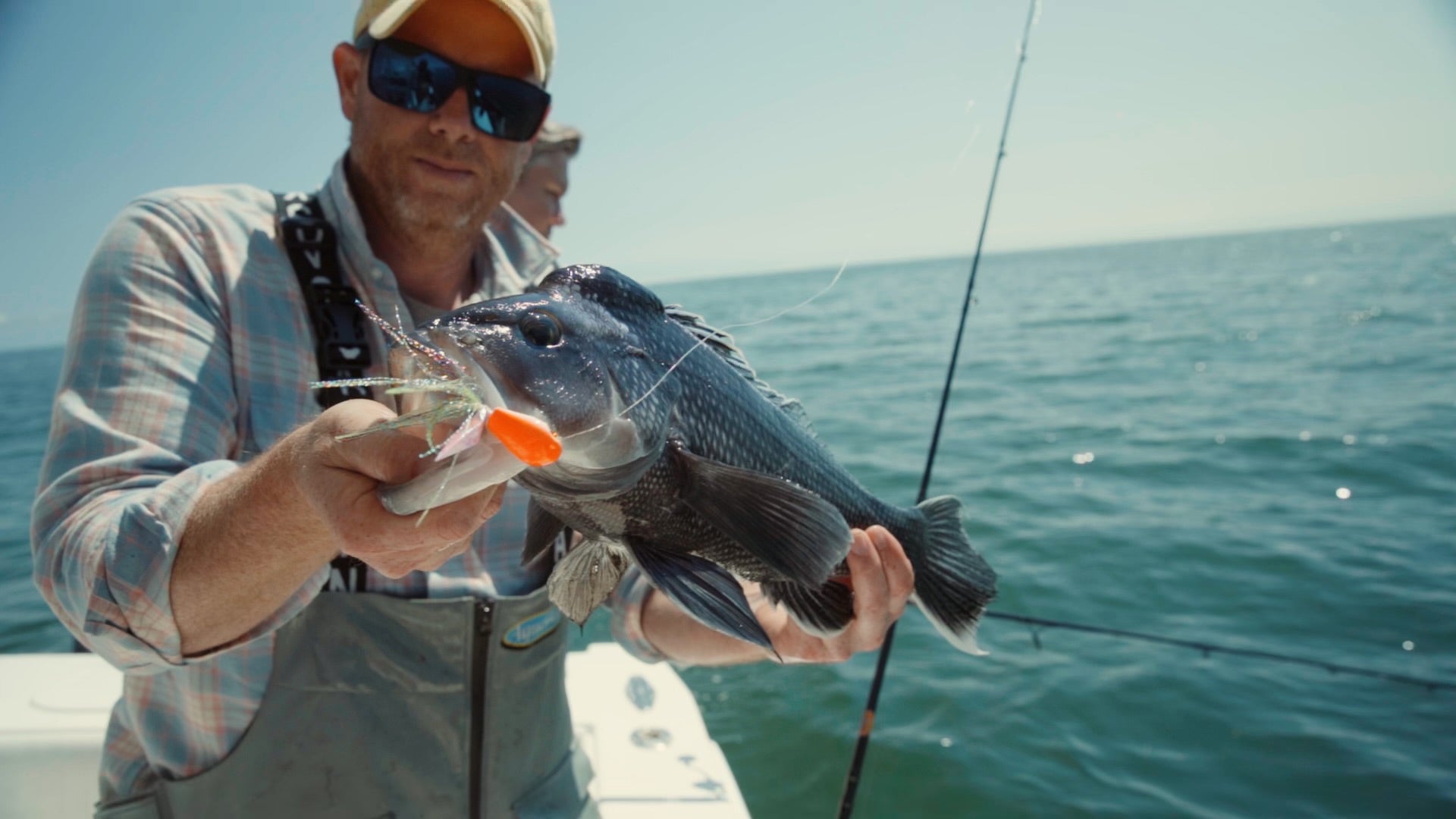
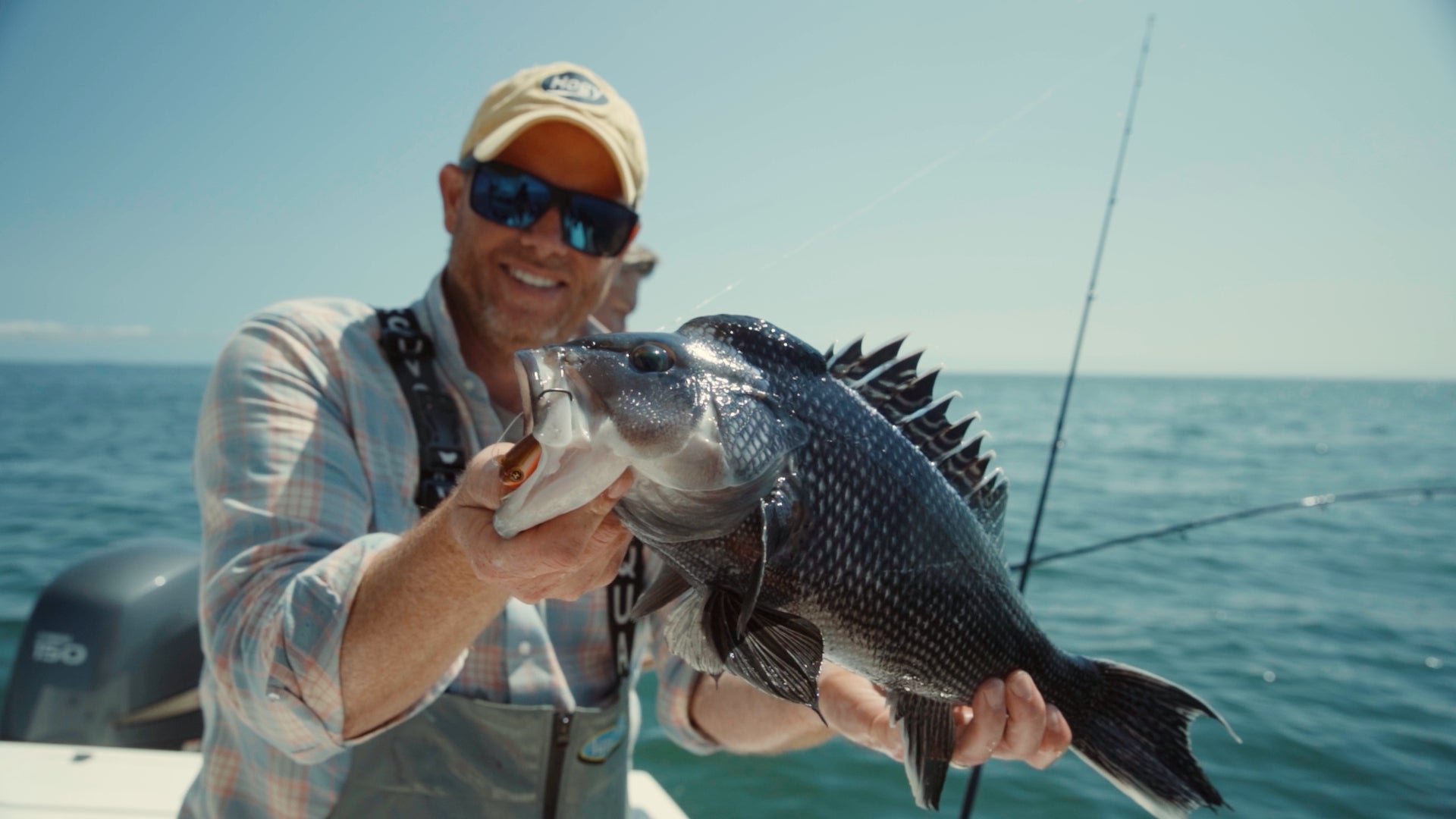
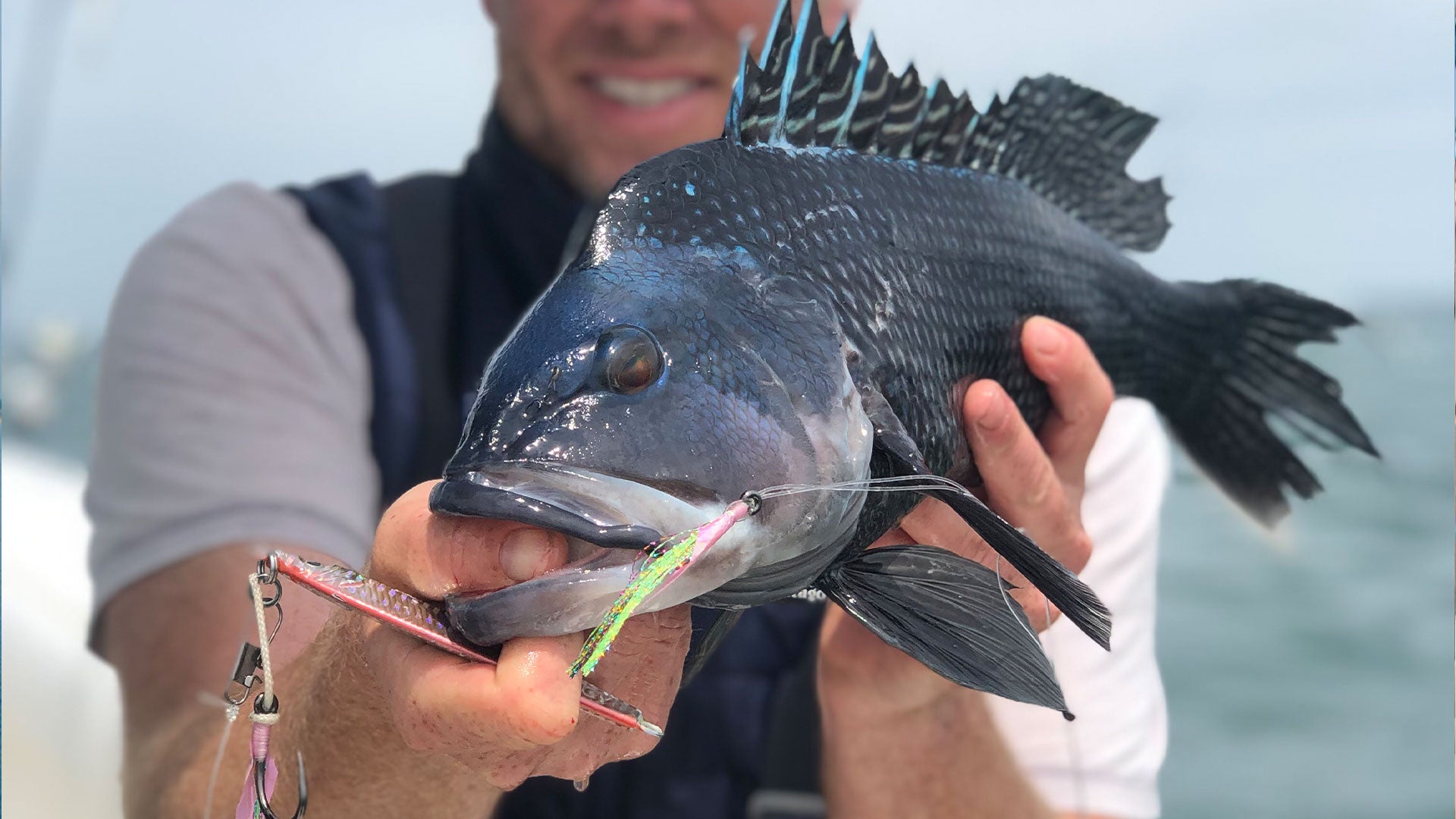
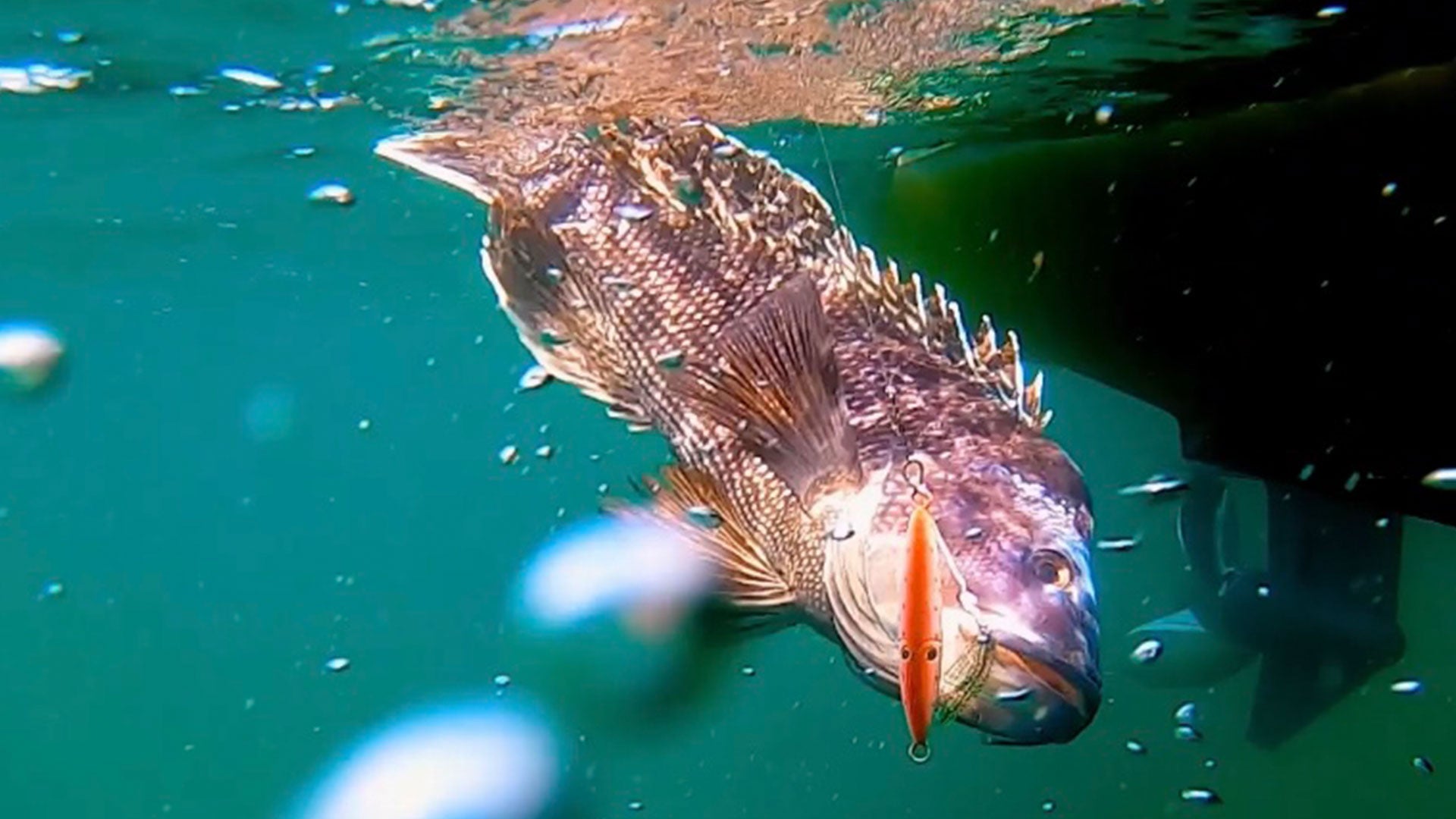
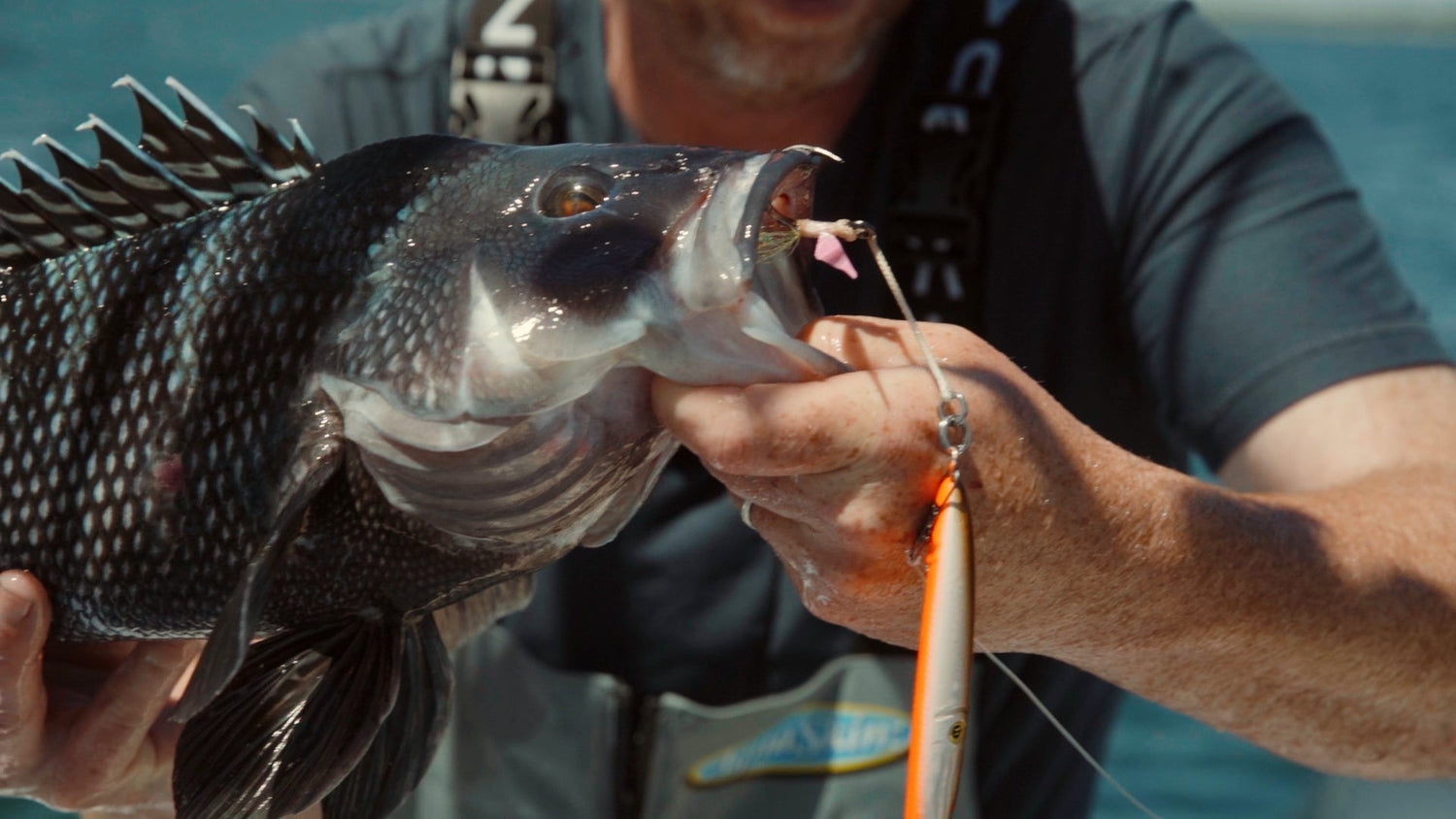
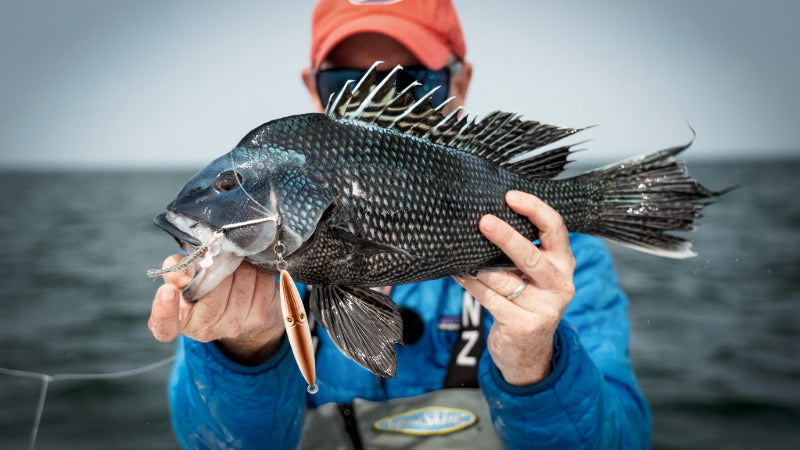
Big sea bass on the jig body, scup and smaller fish on the teaser. The size distribution between hooks confirmed the system was covering both profiles. Fish coughed up crab parts mid-session — direct confirmation that crustalicious color and crustacean teasers were the right match.
Confirmed: the two-bet system (large Squinnow below, micro teasers above) is the right call when crabs are the forage. Fish coughing up crabs is the best possible forage confirmation you can get on the water.
S
Structure
Deep trough between two shallower areas — the two humps create micro-rips that concentrate bait in the valley between them. Sandy bottom with rock piles and drop-offs mixed in. The productive zone is the trough floor and the ledge faces on either side, not the shallower hump tops.
Confirmed: the trough is the target, not the humps. When the drift carried the boat up onto the shallower water, small fish and sea robins followed. The quality fish were in the deep valley. Recalibrate the drift to stay in the trough.
E
Echoes / Sonar
Mid-column bait marks above hard bottom confirmed the zone. The transition from clean bait marks to absent marks was the move signal. Two key sonar tells: bait marks = stay, no marks + small fish = pick up and reset.
The fish finder is the primary navigation tool on this drift. When bait marks disappear or the bottom type changes to featureless sand, the productive zone is behind you. The signal to move is sonar-driven, not time-driven.
Step 3 output
Bait marks on sonar = stay in zone. No marks + small fish + sea robins = pick up and reset. Fish coughed up crabs confirming crustalicious match. Deep trough floor is the strike zone, not the hump tops.
Step 4Structure & Approach

Long contour drifts — read the zone, reset right

The deep summer approach is patience, not coverage speed.

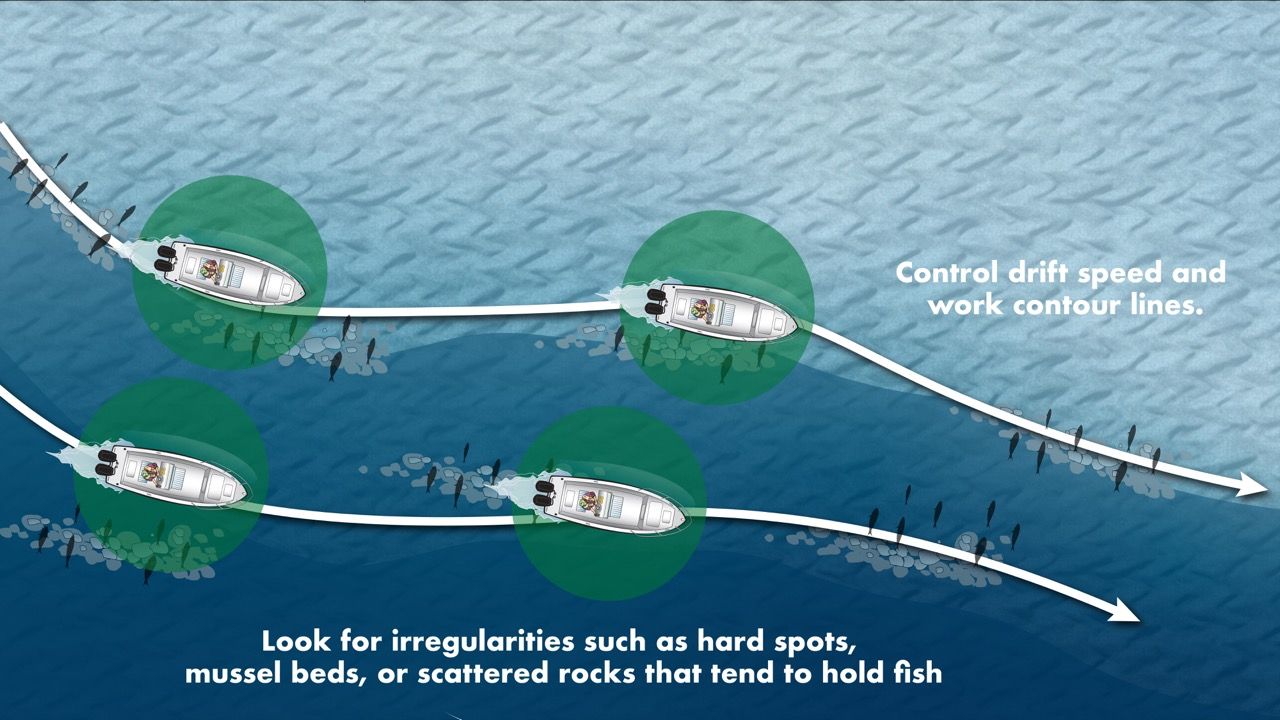
Deep summer sea bass on a contour trough is a long-drift fishery. You’re not hopping rock piles — you’re making deliberate passes along the trough floor, reading the fish finder, and managing the drift trajectory as the conditions shift. The goal is to keep the Squinnow Jig in the productive zone as long as possible on each drift, then reset as efficiently as possible without disrupting the other boats.

MH
Capt. Mike Hogan

“No two drifts are the same. Once you set up a drift and you notice you’re drifting in a different trajectory and you don’t like that trajectory — a short little move to repoint your drift, once you calibrate which way you’re going to go, is worth the extra effort.”

Approach — step by step
1
Set up uptide of the trough. Position the boat so the drift carries you along the trough floor — not across it sideways and not over the shallower humps on either side. The first drift tells you the trajectory; calibrate from there.
2
Drop as soon as sonar confirms the trough bottom. Mid-column bait marks above hard bottom is the greenlight. Don’t wait for a perfect picture — get the 8.5oz Squinnow down fast. The productive zone may be shorter than the full drift length.
3
Pay line out as the drift lengthens. This is the critical technical point. As the boat drifts further from the jig, the scope angle increases and lifts the jig off the bottom. Periodically pay 2–3 feet of line to restore vertical presentation. If there’s too much scope, reel in and drop again close to the boat.
4
Read the move signal: small fish, sea robins, no bites. These are consistent indicators that the drift has carried past the productive zone. Don’t wait for the bite to die completely — pick up and reset as soon as the size and species quality downgrades.
5
Reset by going around boats, not through them. Wide loop uptide. Other anglers are on the same drift track — cutting through their presentations is both unproductive and bad etiquette on a crowded piece of structure.
6
Repoint if the wind has shifted. Wind direction changes through the morning. Check the drift angle before starting each pass. A short repositioning move before the drift beats a long drift in the wrong direction.
B3200 Drifting Contour Lines for Groundfish — deep summer sea bass

B3200 Drifting Contour Lines for Groundfish — long passes along the deep trough floor. Pay line out to maintain vertical presentation. Reset when quality downgrades.

Step 4 output
Long contour drifts along trough floor. Pay line out to stay vertical. Read the move signal early. Reset by going around boats. Repoint after each drift — no two are the same.
Step 5Gear, Lure & Technique

8.5oz Squinnow + Jig-Biki Rig — heavy, slow, vertical

Deep water demands heavy jigs. The technique is big slow sweeps — let the jig do the work on the drop.

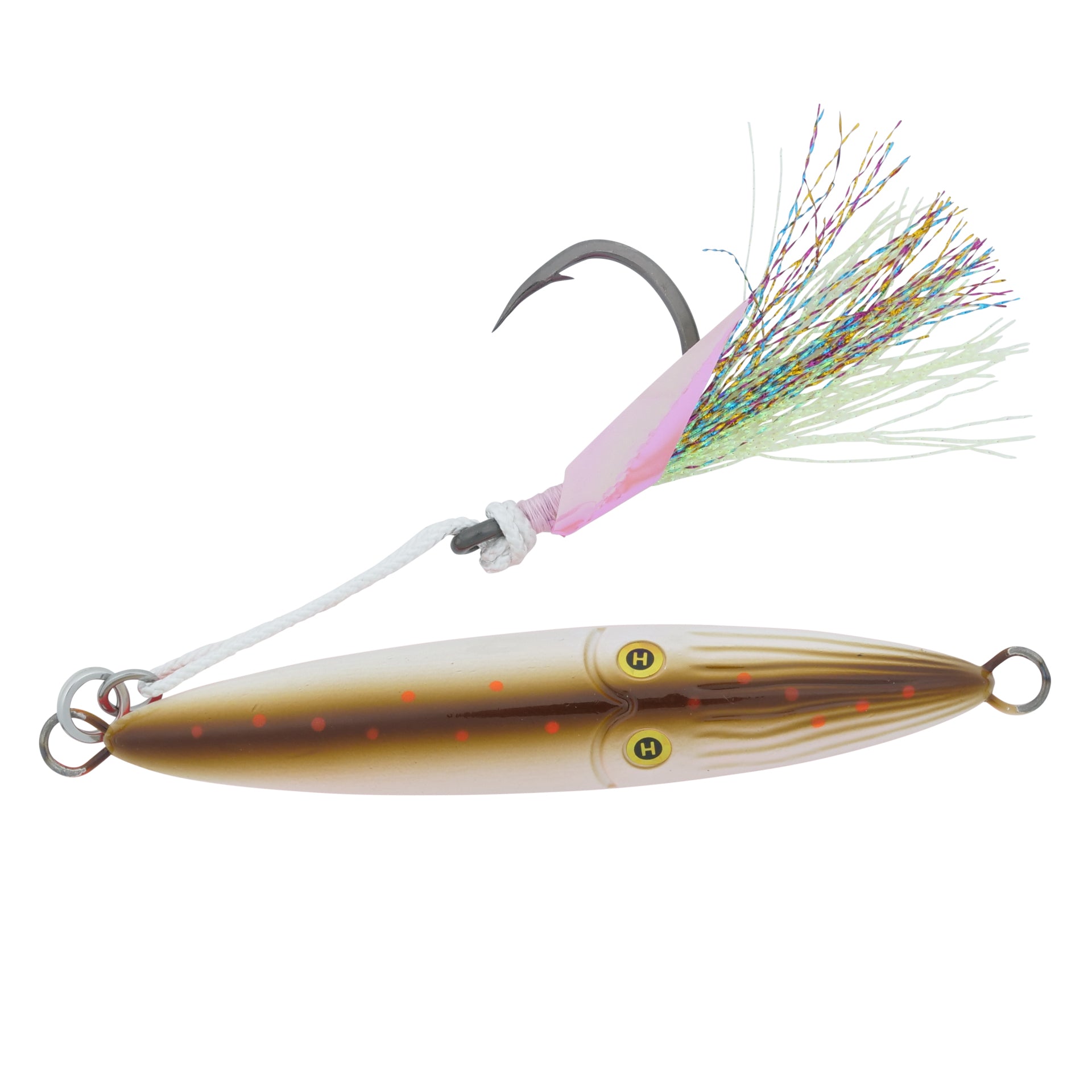
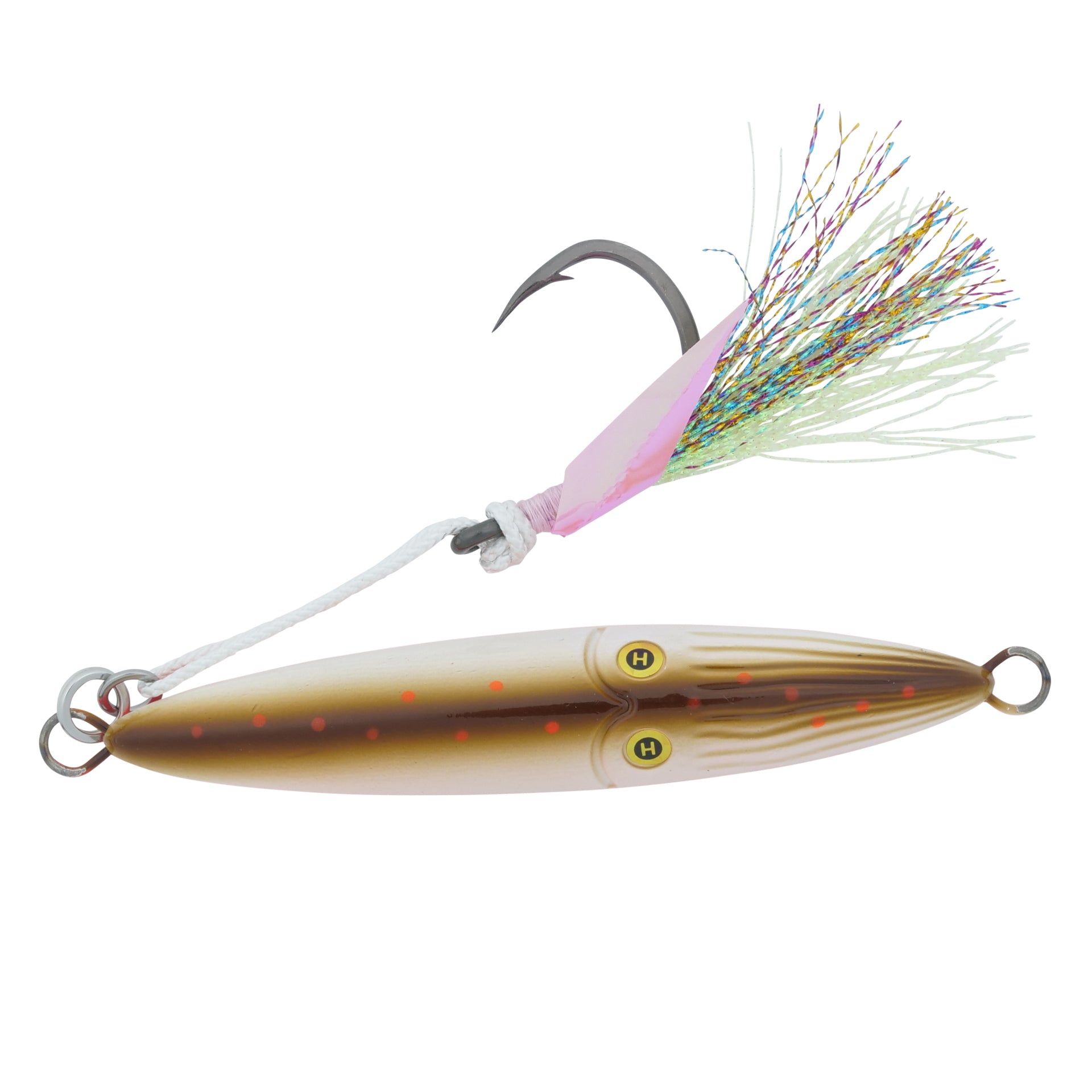
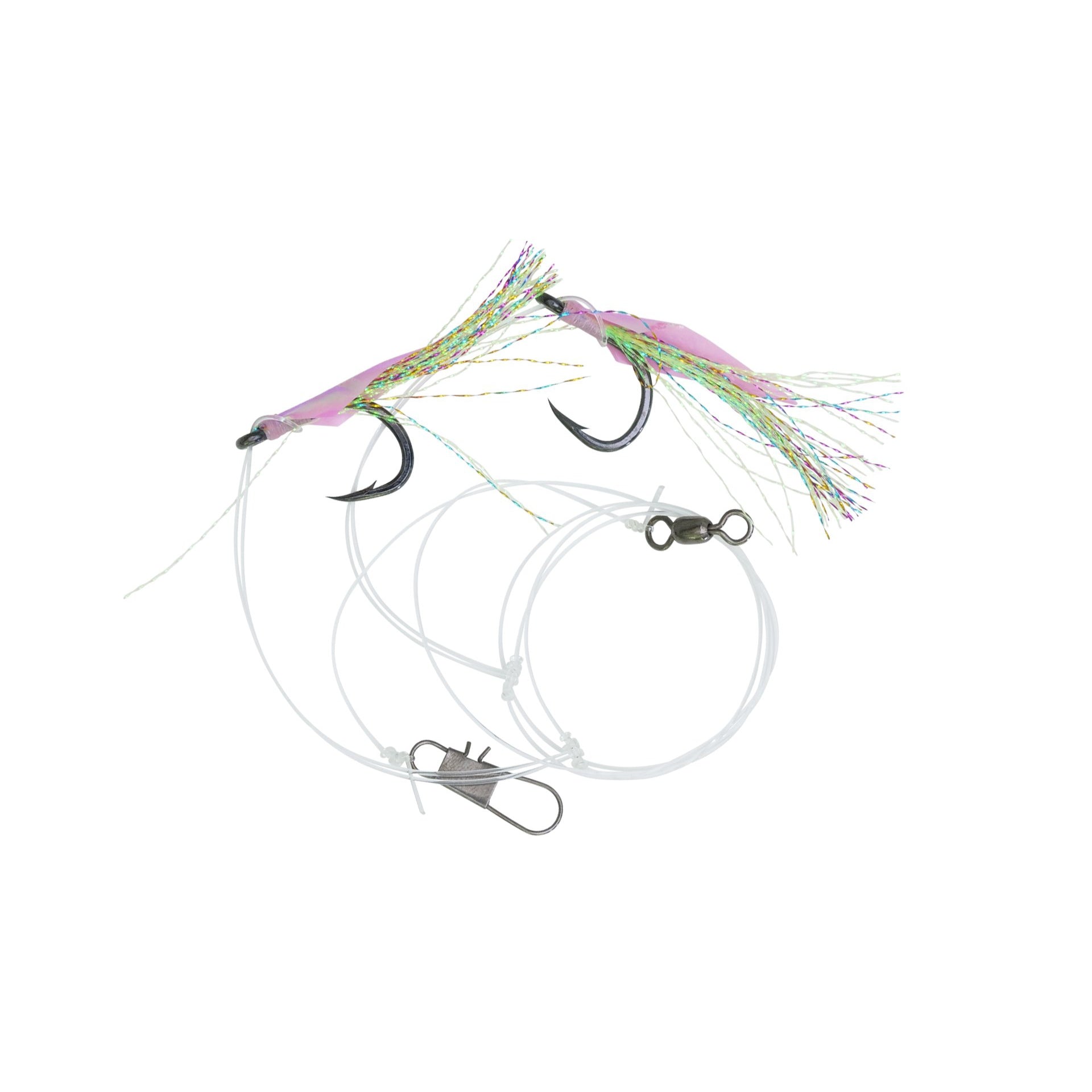
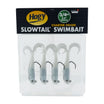
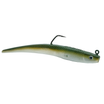
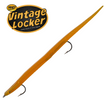
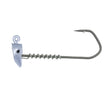
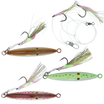
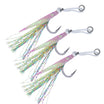
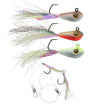
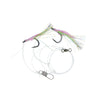
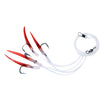
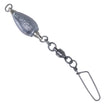
The Hogy Squinnow Jig at 8.5oz is the right tool for 95–100 feet of water in Vineyard Sound current. It gets to the bottom fast, stays in contact through the drift, and its rounded belly creates a pronounced flutter on every drop. Clipped to the Jig-Biki Teaser Rig on 60lb mono, you have the large crustacean profile below and the micro teasers above — the same two-bet system that works in shallower water, now scaled for depth and current.

The System
8.5oz Squinnow Jig clipped to the Jig-Biki Teaser Rig on 60lb mono. Heavy enough to get to the bottom fast in 95–100ft of water and hold contact through the drift. The same two-bet presentation as shallow water: large profile jig below, micro crustacean teasers above. No bait required.
Color
Olive, pink, and orange — the “crustalicious” color family. Sea bass coughed up crab parts mid-session, directly confirming crustacean forage at depth. The Squinnow color and the Jig-Biki teaser match this forage profile. When fish tell you what they’re eating, don’t change the color.
Action
Big long slow sweeps of the rod — lift 2–3 feet, pause, let the jig sink completely back to the bottom. The Squinnow’s rounded belly creates a “circuitous route” on the drop: flutter, waver, side-to-side fall. That action on the descent is when sea bass eat. The teasers pulse with the same motion above.
Speed
Very slow. Big sweeps, full drop, full bottom contact before the next lift. In between active jig cycles, occasional dead stick periods with the rod resting — jig on the bottom, drift creating gentle motion. The slow approach works at 95ft just as it does at 40ft.
Vertical Presentation
The most important technical point for deep water jigging. As the boat drifts further from the jig, the line angle becomes more horizontal and the jig lifts off the bottom. Pay 2–3 feet of line periodically to restore vertical presentation. If too much scope accumulates, reel in completely and drop again close to the boat.
Limitations
The 8.5oz jig requires a rod with enough backbone to support it and enough parabolic action to enjoy the fight on sea bass. A stiff fast-action rod is unpleasant with this jig weight. The Hogy Hybrid’s moderate parabolic action handles it well and still makes a 3lb sea bass feel like an event.
Rigging
  • Squinnow Jig clipped to the bottom snap of the Jig-Biki Rig. Swap weights without retying.
  • Jig-Biki Rig on 60lb mono — heavy enough to handle a bluefish or striper if one shows up in the mix.
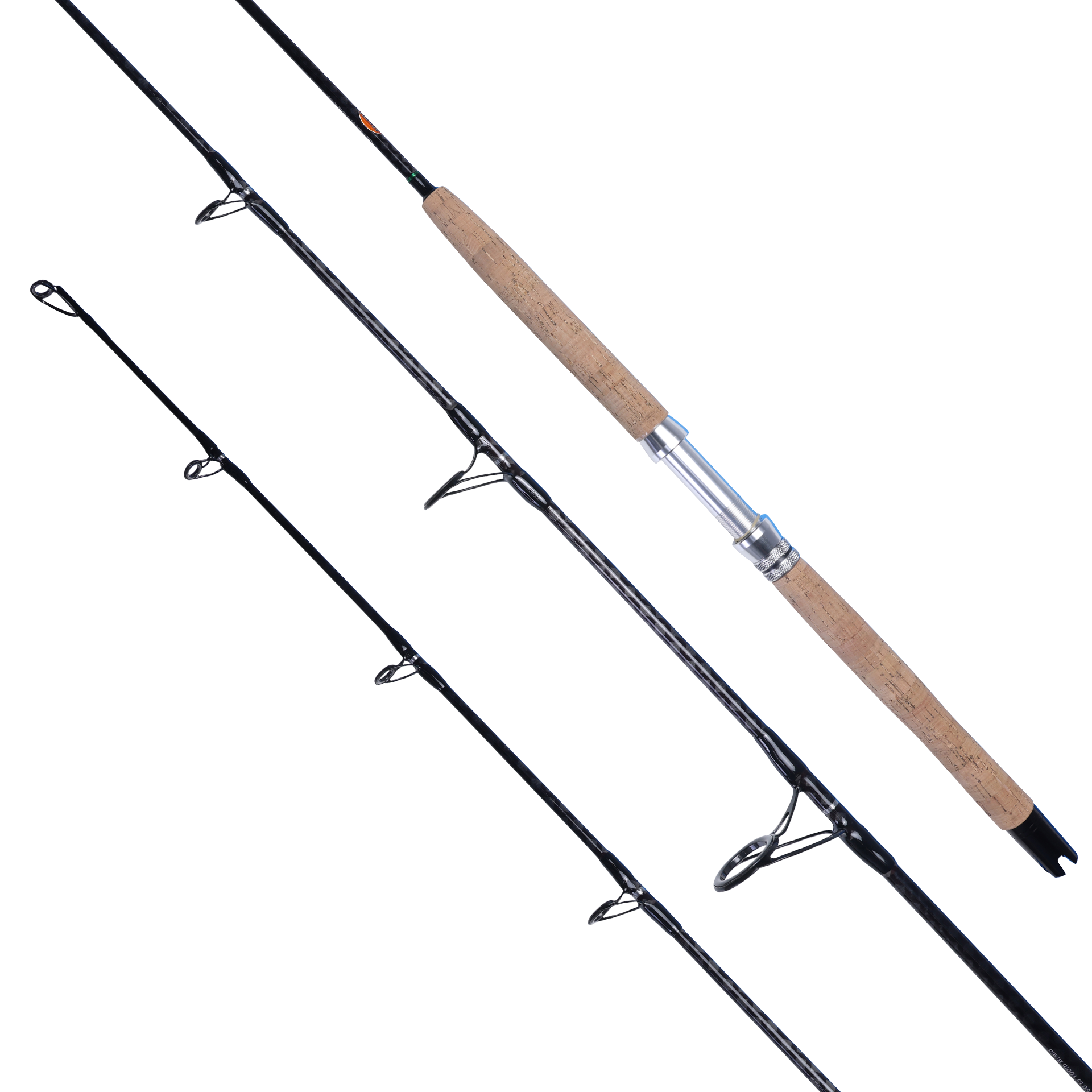
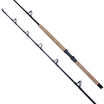
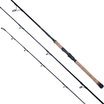
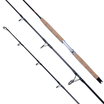
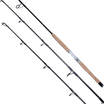
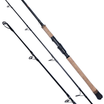
  • Rod: 7ft Hogy Hybrid Inshore/Offshore Spinning — parabolic action handles the 8.5oz jig and protects light leaders.
  • Reel: VS2000. Line: 60lb braid, 60lb fluorocarbon leader.
  • No bait. Turnkey out of the box.

The retrieve — step by step
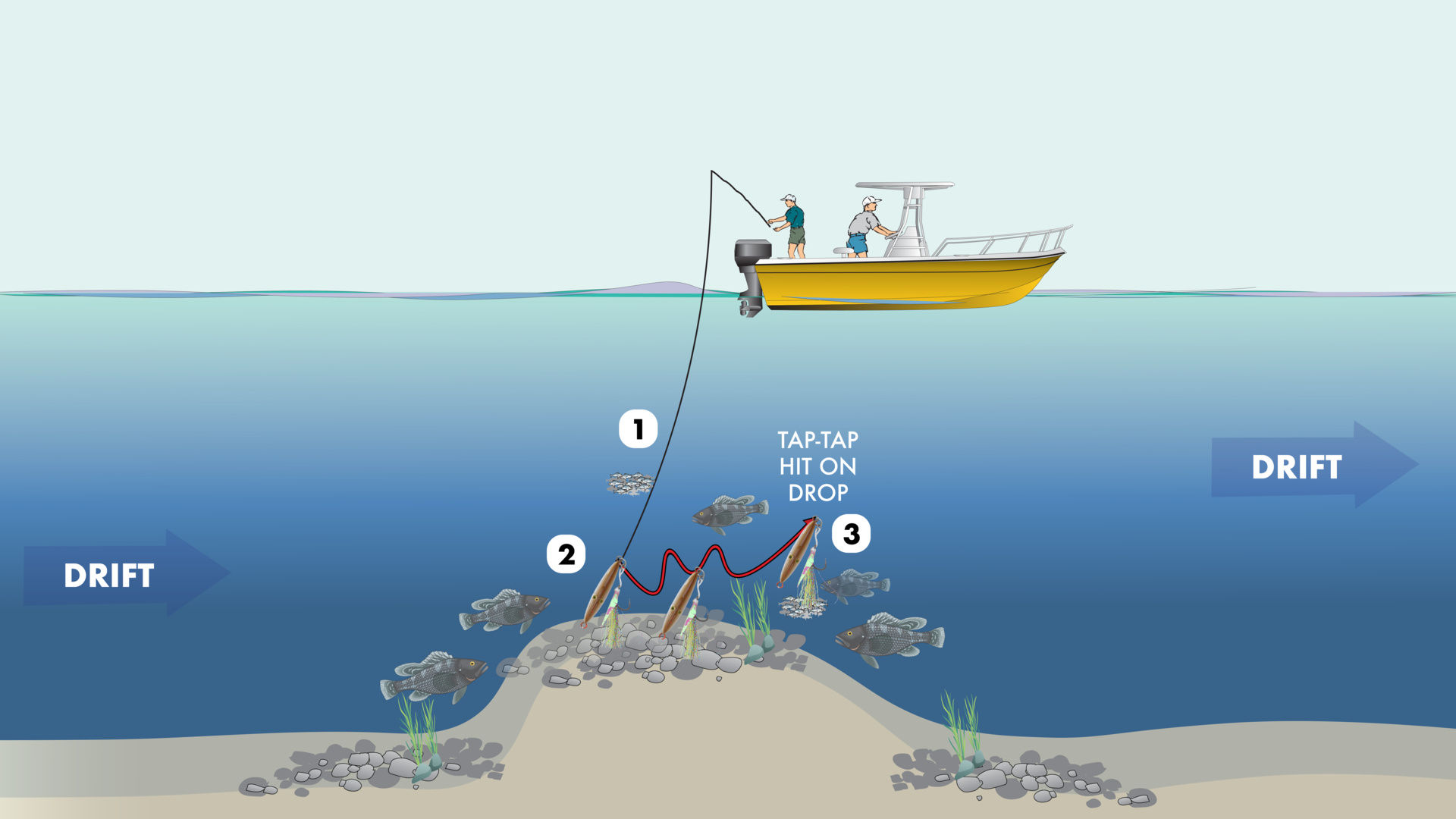
1
Drop to the bottom and confirm contact. At 95–100ft, count the drop. If the jig doesn’t reach the bottom in the expected time, you’ve drifted out of the trough onto shallower structure. Check the fish finder.
2
Big slow sweep of the rod — 2–3 feet up, pause. This is not a short twitch. The Squinnow needs a full sweep to load the flutter action on the drop. At this depth, the lift needs to be deliberate and slow.
3
Let the jig drop completely back to the bottom. Full drop, full bottom contact. Don’t start the next sweep until the jig has settled. The bite often comes in the last few feet of the drop as the jig settles. Feel for any check or added weight.
4
Pay line out to stay vertical. Every few jig cycles, release 2–3 feet of line as the boat drifts further from the jig. This is the most important technique point for deep water jigging and the one most anglers skip.
5
Occasional dead stick: rod in the holder, jig on bottom. Between active cycles, let the jig sit. The drift creates gentle motion in the jig and the teasers. Mike caught multiple fish this way in shallower water this season — it works at depth too.
6
When scope gets too long — reel in, drop close to the boat. Don’t keep paying out line indefinitely. Once the angle becomes too horizontal, retrieve completely and restart the drop close to the boat. Fresh vertical presentation.
R2800 Bottom Thump — Squinnow Jig sea bass deep water retrieve

R2800 Bottom Thump at depth — big slow sweeps, full drop, full bottom contact. Pay line out to maintain vertical presentation through the drift. Strikes on the descent.

Loadout
Jig
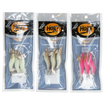
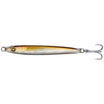
Hogy Squinnow Jig 8.5oz — olive/crustalicious, assist hook, clipped to Jig-Biki Rig
Rig
Hogy Jig-Biki Teaser Rig, 60lb mono — handles bluefish or stripers in the mix
Rod
7ft Hogy Hybrid Inshore/Offshore Spinning — parabolic moderate action, handles 6.5–10oz jigs
Reel
Van Staal VS2000
Line
60lb braid + 60lb fluorocarbon leader
No bait
Turnkey system. Clean boat. Home early.
MH
Capt. Mike Hogan

“We had a cooler full of beautiful and delicious sea bass — mission accomplished. May be one of my favorites of the season. Not a whole lot of crowds. Home early enough to surprise my wife for once. I don’t think that’s ever happened with me — but today it is.”

Black sea bass are subject to annual size and bag limit regulations in Massachusetts. Deep water fish in summer are typically larger than early-season fish — check current DMF regulations for size limits and bag limits before keeping fish. Regulations change year to year.

The decision at a glance

Signal from the SystemDecision
Fourth of July weekendDeep water mode. Target 80–110ft troughs and contour lines, not shallow spring rock piles.
Bait marks on sonar above hard bottomYou’re in the zone. Get the jig down, start the retrieve. Stay on this drift track.
Fish coughing up crab partsForage confirmed. Stay on crustalicious Squinnow color. The system matches what’s on the bottom.
Jig lifting off the bottom mid-driftPay out 2–3 feet of line to restore vertical presentation. Don’t let scope build up unchecked.
Small sea bass + sea robins appearingThe drift has moved past the productive zone. Pick up immediately and reset uptide.
Drift trajectory changed from previous passShort repoint move before starting the drift. One minute of repositioning beats a long drift in the wrong direction.
Fleet of boats on the troughReset by going around, not through. Wide loop uptide. Other anglers are on the same structure.
Big fish on jig body, smaller on teaserThe system is size-sorting the fish. Keep both hooks in the rig — the data from which hook produces tells you how the fish are feeding depth-wise.
Step 5 output
8.5oz Squinnow + Jig-Biki Rig, 60lb mono, no bait. Big slow sweeps, full drop, pay line out to stay vertical. Bait marks = stay. Small fish = reset. Go around boats. Home early.
Putting it together
Deep summer sea bass

Step 1 set the context: Fourth of July, Vineyard Sound, sea bass have shifted to 95–100ft troughs along the Elizabeth Islands. Step 2 identified the complication: wind against tide means no two drifts are the same, and the trajectory needs recalibration each pass. Step 3 delivered the key observations: mid-column bait marks are the stay signal, fish coughing up crabs confirms the crustalicious match, and sea robins signal the end of the productive zone. Step 4 built the approach: long contour drifts along the trough floor, pay line out to maintain vertical presentation, reset wide around the fleet. Step 5 closed it: 8.5oz Squinnow clipped to the Jig-Biki Rig, 60lb mono, big slow sweeps with full drops, no bait required. Cooler full of sea bass, home before noon.
Also in the series
S2025 E3 — Eldridge Shoal: Three Retrieves, One System
Squinnow Jig + Groundfish Biki Teasers at Eldridge Shoal — a step-by-step tutorial on three retrieves for the same rig.
Black Sea Bass Squinnow Jig Jig-Biki Rig Vineyard Sound Elizabeth Islands Contour Drift Deep Water No Bait Summer Capt. Mike Hogan Cracking the Code

Reading next

Cracking The Code: Seabass Three Ways

Leave a comment

All comments are moderated before being published.

This site is protected by hCaptcha and the hCaptcha Privacy Policy and Terms of Service apply.

Related Videos

Slack Tide Seabass Thumping

Captain Mike goes Black Seabass fishing on Cape Cod and discusses the effectiveness of fishing during slack tide. Drifting Over Structure: Using the Navionics chip in the Garmin device to locate good structures like rocks for successful drifts. Jigging Technique: Bouncing jigs on the bottom using Hogy Groundfish Biki Jigs designed to replicate crabs.

Combo Trip | Jig Seabass | Topwater Stripers

Captain Mike's Adventure: Captain Mike embarks on a fishing trip with friends, starting from Falmouth Harbor. The goal is to catch a mix of stripers and seabass using the Hogy system.

Seabass Fishing Cape Cod | Hogy Jig-Biki Teaser Rig

Capt. Mike Hogan & Capt. Rob Lowell of Cape Cod Offshore Charters spends the morning targeting Buzzards Bay Seabass in bumpy conditions. In this video, we introduce the new Jig-Biki Teaser rig paired with the Hogy Flutter Pitch Jig.

Seabass Jigging Cape Cod - Hogy Squinnow Jigs + Jig Biki

Capt. Mike Hogan shows us how to modify the Hogy Squinnow Jig was a teaser assist hook + jig-biki rig for targeting seabass on cape cod.

Related Blogs

Black SeabassCracking The Code: Deep Summer Seabass

Cracking The Code: Deep Summer Seabass

Cracking the Code: Deep Summer Sea Bass — Long Drifts, No Bait, 95 Feet Deep Summer Sea Bass  ·  Vineyard Sound Cracking the Code Capt. Mike Hogan  ·  Salty Cape TV powered b...

Black SeabassCracking The Code: Seabass Three Ways

Cracking The Code: Seabass Three Ways

Sea Bass Three Ways  ·  Eldridge Shoal  ·  S2025 E3 Cracking the Code Capt. Mike Hogan  ·  Salty Cape TV powered by Hogy Location Eldridge Shoal Season Early Summer Species Black Sea B...

Black SeabassCracking The Code: Seabass Gay Head / Devil's Bridge

Cracking The Code: Seabass Gay Head / Devil's Bridge

Black Sea Bass  ·  Gay Head / Devil’s Bridge Cracking the Code Capt. Mike Hogan & John Burns  ·  Salty Cape TV powered by Hogy Location Gay Head / Devil’s Bridge Season Early Summer ...

Black SeabassCracking The Code: Seabass Season Opener

Cracking The Code: Seabass Season Opener

Sea Bass Season Opener  ·  Buzzards Bay Cracking the Code Capt. Mike Hogan & Capt. Rob Lowell  ·  Salty Cape TV powered by Hogy Location Buzzards Bay Rocky Ledges Season Early Summer...

InshoreCracking The Code: Spring Squid

Cracking The Code: Spring Squid

Cracking the Code: Cape Cod Squid — Drift to Find, Anchor to Load Cape Cod Squid  ·  Spring Cracking the Code Capt. Mike Hogan & Capt. Rob Lowell  ·  Salty Cape TV powere...

GroundfishCracking The Code: Spring Haddock & Cod Stellwagen Bank

Cracking The Code: Spring Haddock & Cod Stellwagen Bank

Stellwagen Bank  ·  Early April 2022 Cracking the Code Capt. Mike Hogan & Capt. Rob Lowell  ·  Salty Cape TV powered by Hogy Location Stellwagen Bank SE Corner Month Early April Sp...