














Striped Bass

Capt. Mike's Guide to Fall Plugs and Big Bass in Boulder Fields

Capt. Mike's Guide to Fall Plugs and Big Bass in Boulder Fields

The Fall Series  ·  S300 Boulder Fields  ·  Boat
Fall Run Playbook
Structure
S300 Shallow Boulder Fields
Season
Mid-Sept into November
Species
Striped Bass
System
OG Swimmer + Chug Popper
Forage
Pogies, Peanut Bunker, Sand Eels

Capt. Mike's Guide to Fall Plugs and Big Bass in Boulder Fields

Two plugs, one rock line. I swim the OG Swimmer through the lanes beside the boulders and I chug the popper across the open pockets. Here is how I decide which, cast by cast.
MH
Capt. Mike Hogan
Hogy Lure Company · saltycape.com
Fall Run  ·  Topwater & Swimming Plugs
9 min read
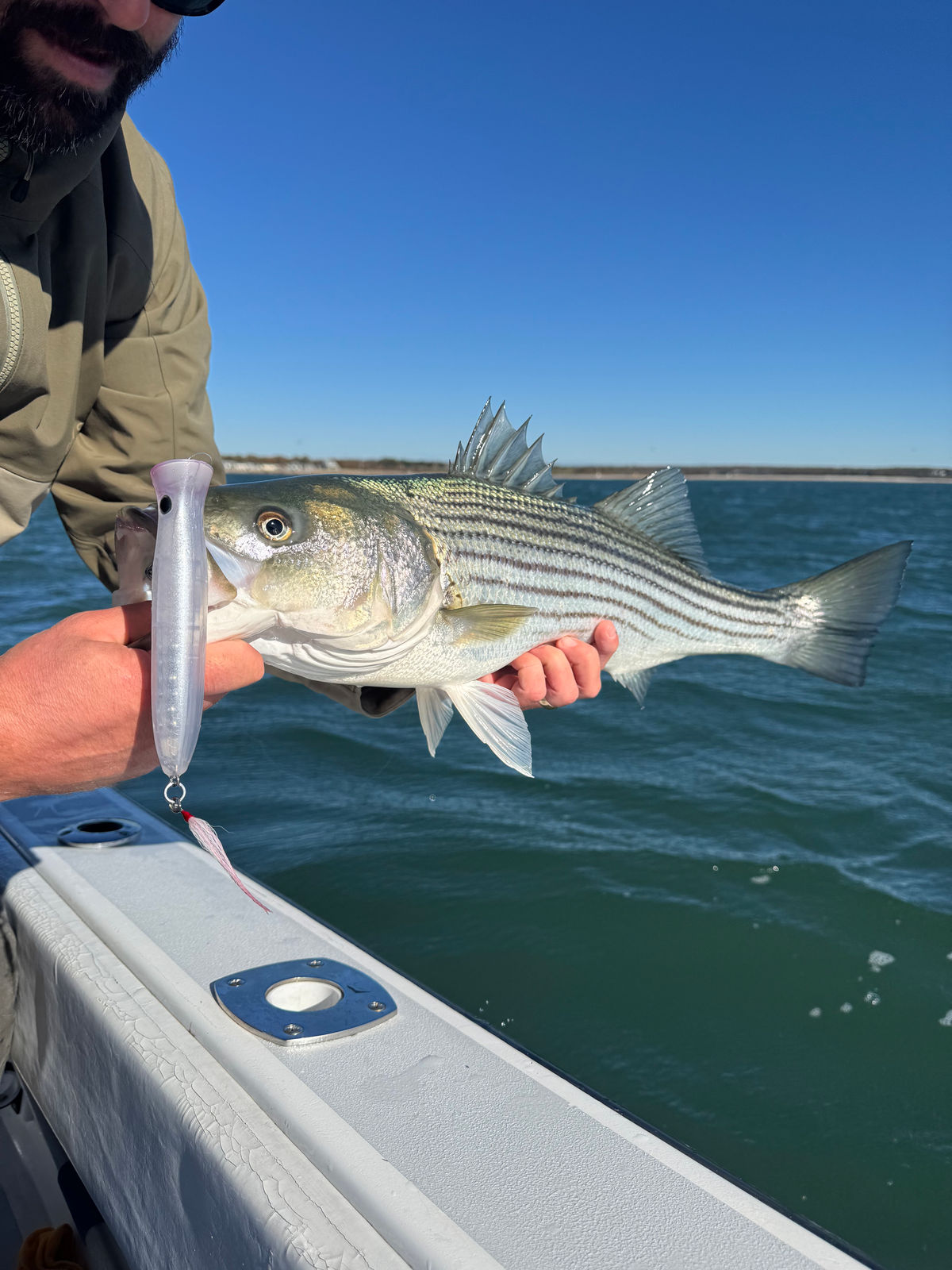
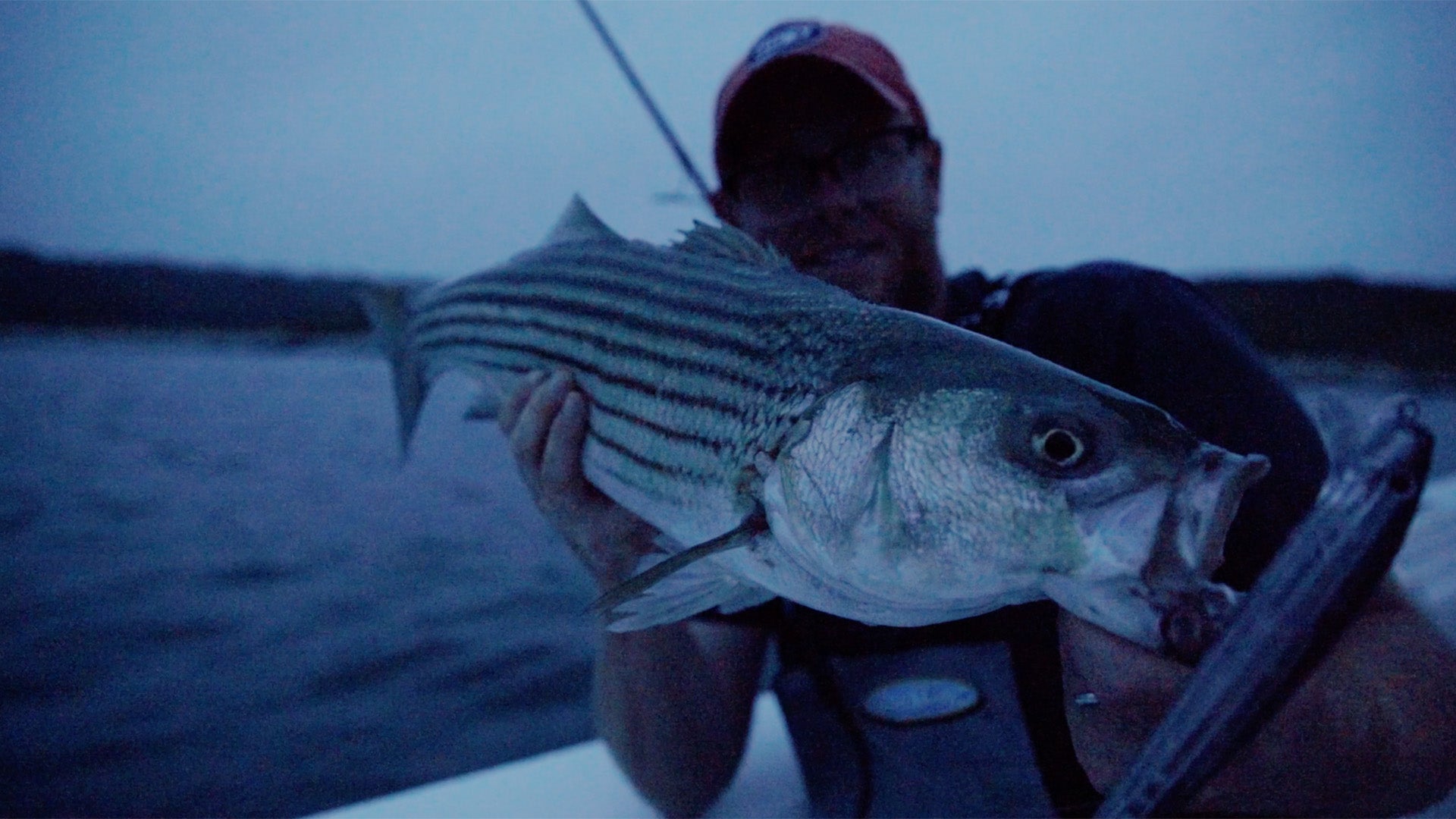
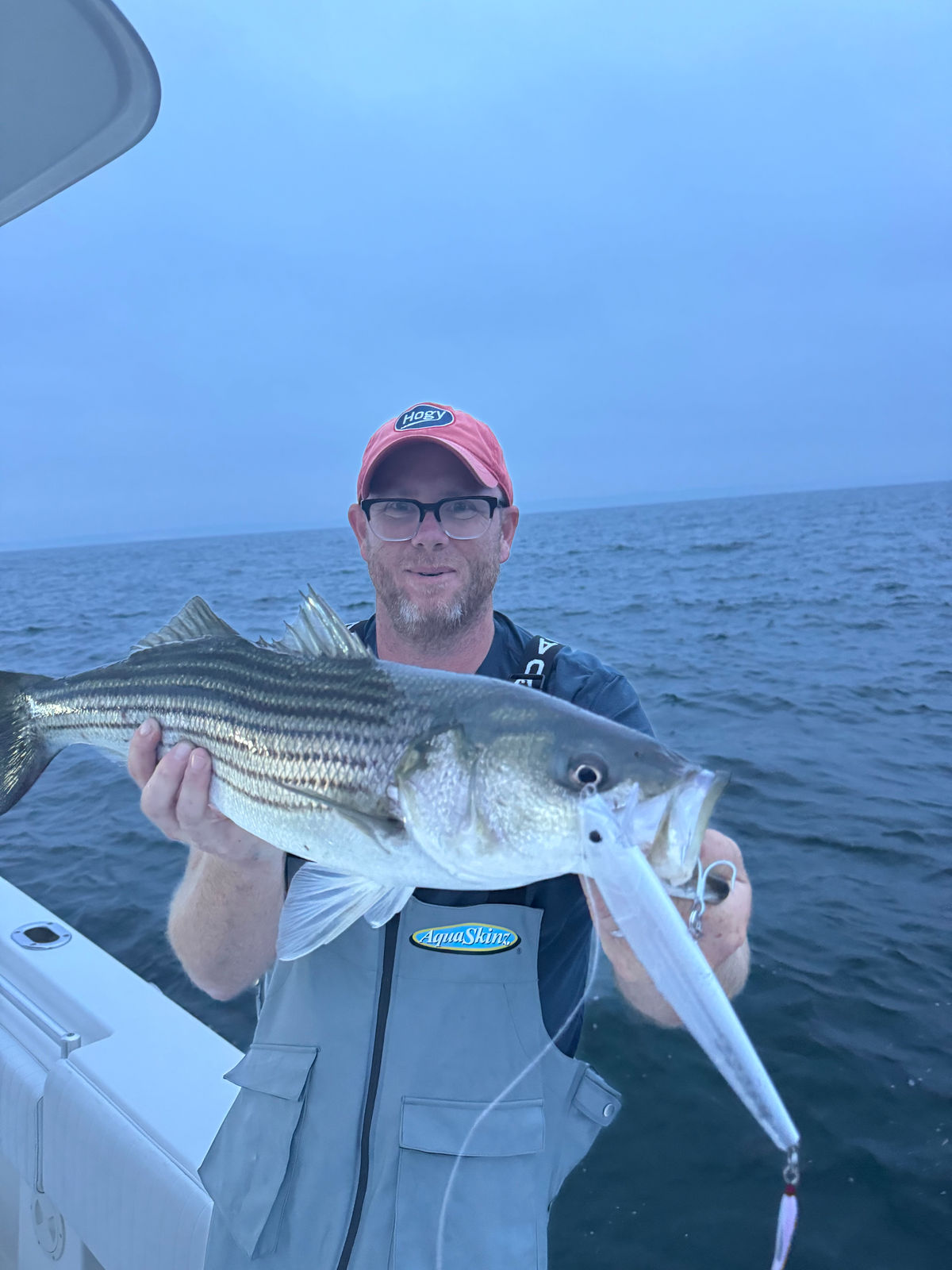
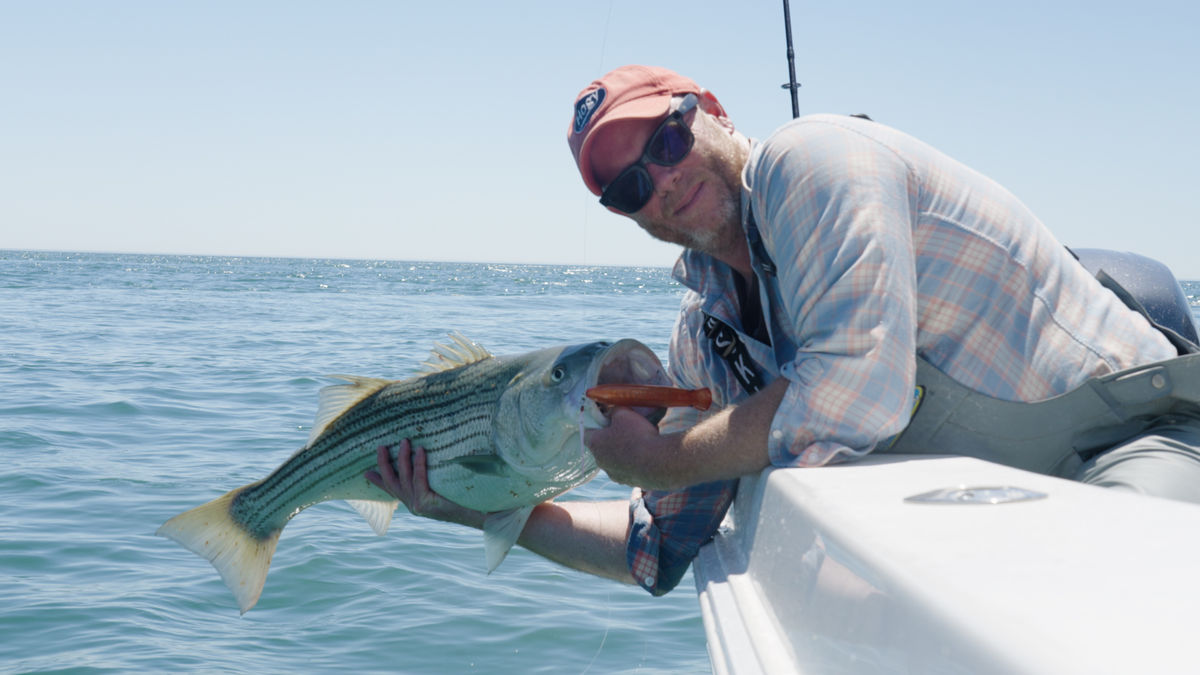
A striped bass held horizontally aboard the boat with an OG Swimmer clearly visible in its mouth.
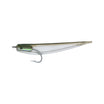
Editor: at full size the plug in IMG_4410 reads long and lipless, more needle than OG. Confirm before publishing.

A fall bass with the OG Swimmer where it belongs. This is what a slow swim through the open lane beside the rocks produces.

A rocky shoreline looks like one long stretch of good water. It is not. The pieces that matter are small: a ridge that keeps going under the surface, a gap between two boulders, a pocket of softer water, the outside edge where the rocks meet deeper water. Those are the casting targets. I fish them one at a time and a boulder field stops being a wall and becomes a list.

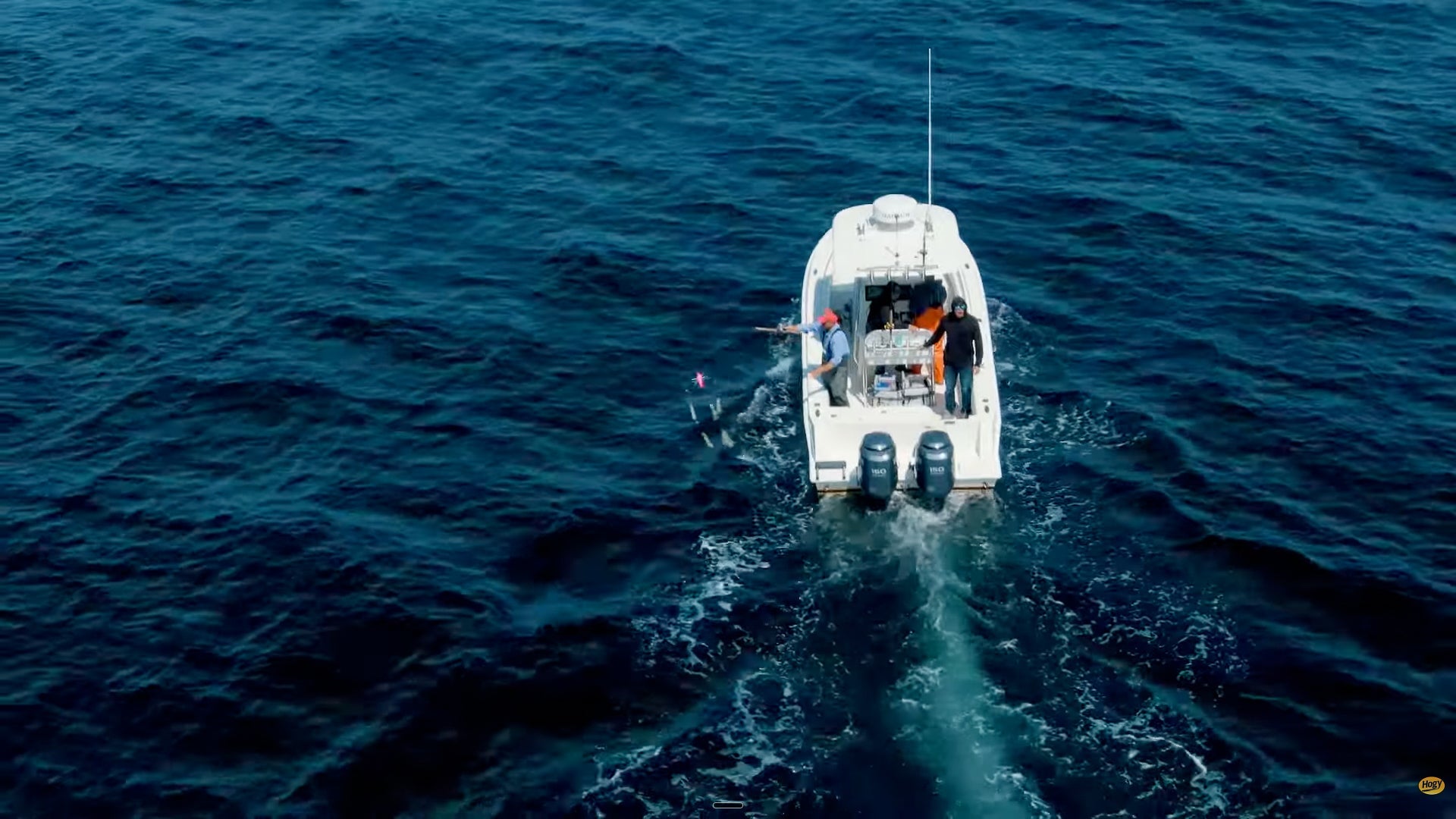
On the Elizabeth Islands I worked exactly that kind of shoreline with the OG Swimmer. The boat sat in about fifteen feet while the plug crossed rocks two and three feet under the surface. A slow retrieve kept the swimmer working above the structure, and short engine-assisted drifts let me cover one patch, then slide down the shoreline to the next.

The challenge: big fall bass tucked into a shallow boulder field, with the boat unable to go where the fish are. The job is to pick the right plug for each lane, put it there from outside the rocks, and give it time to work without losing the drift or the boat.

The call: swimmer or popper?

I carry both on every boulder-field pass and I never carry a third. The choice is not about mood; it is about what each plug buys me on that cast.

Time in the zone
OG Swimmer
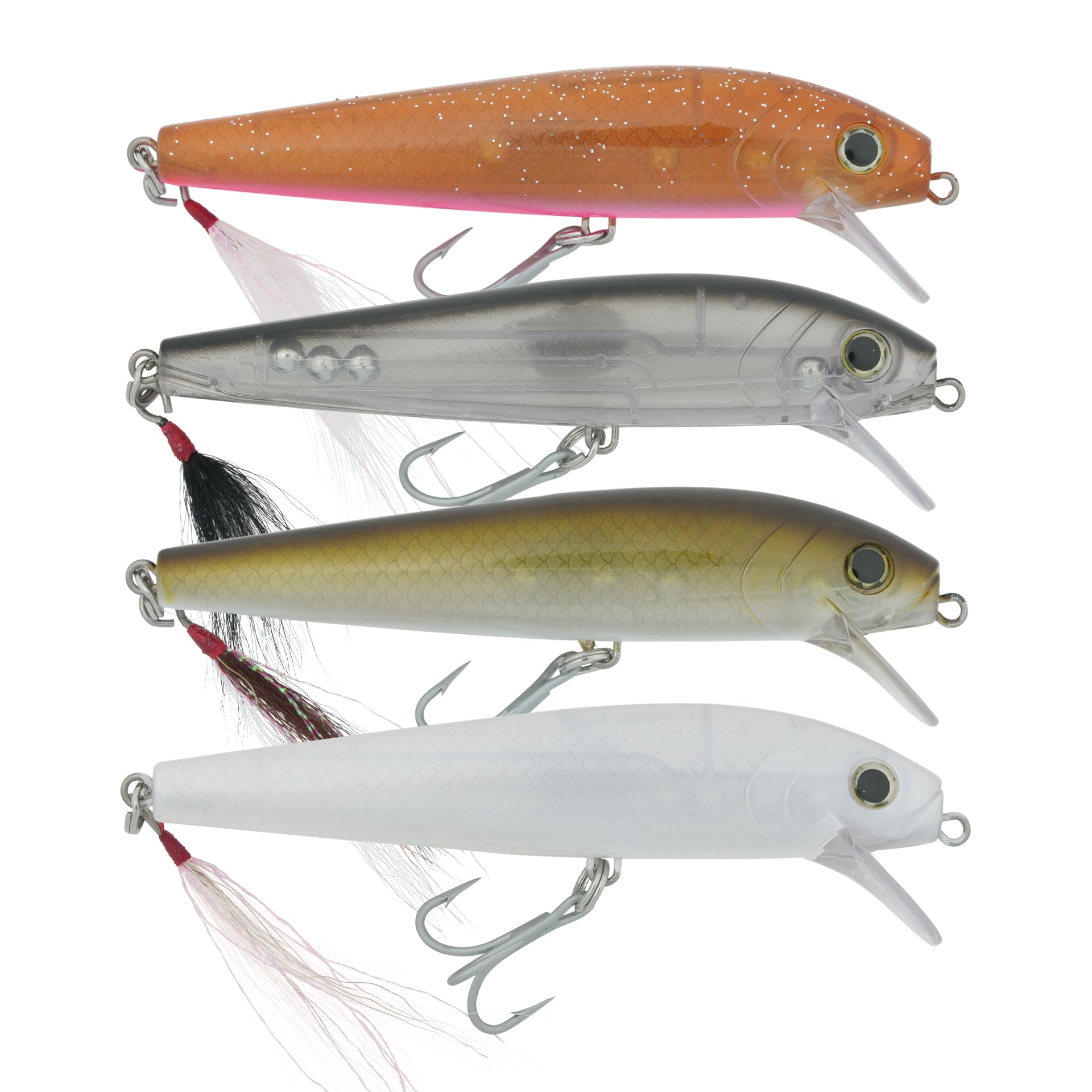
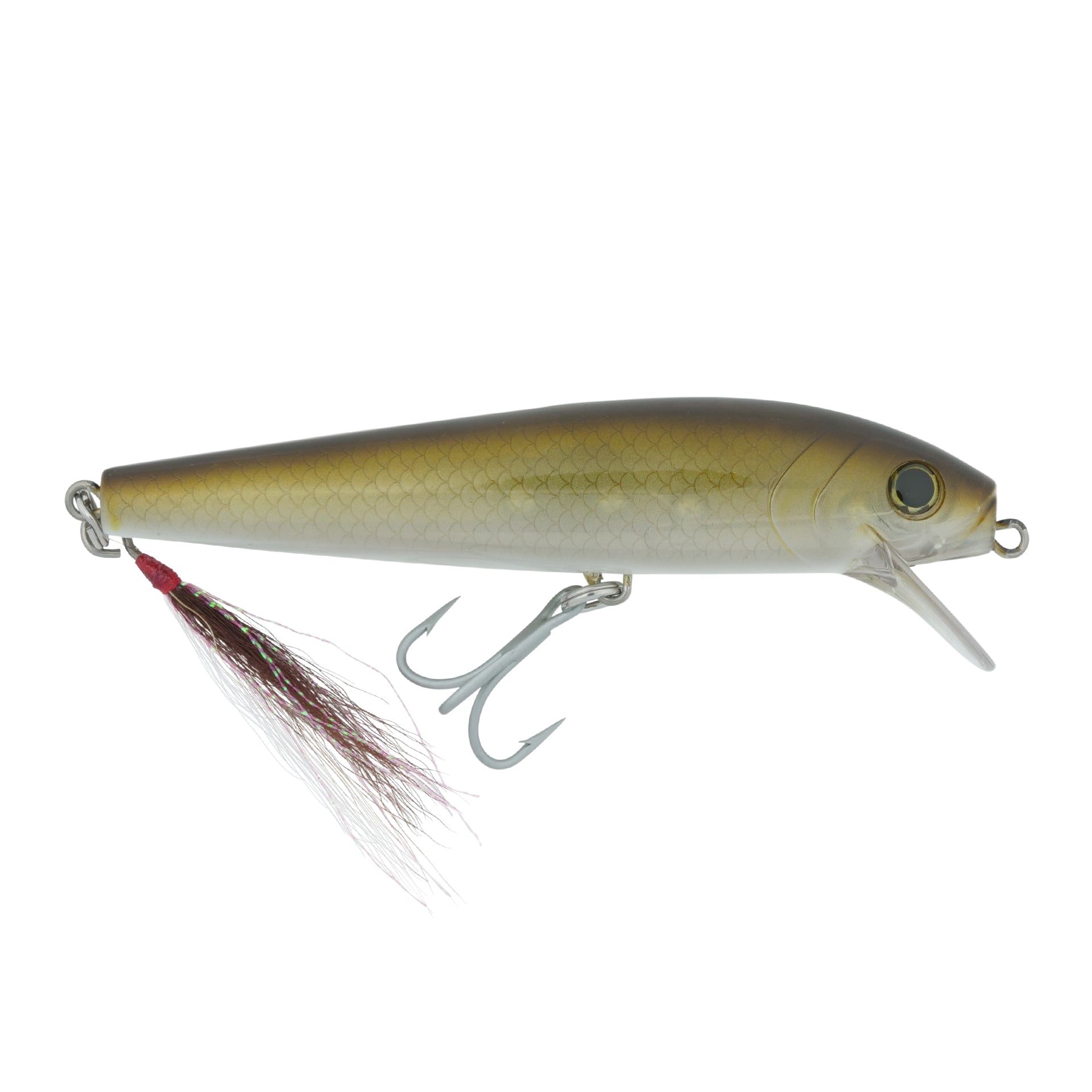
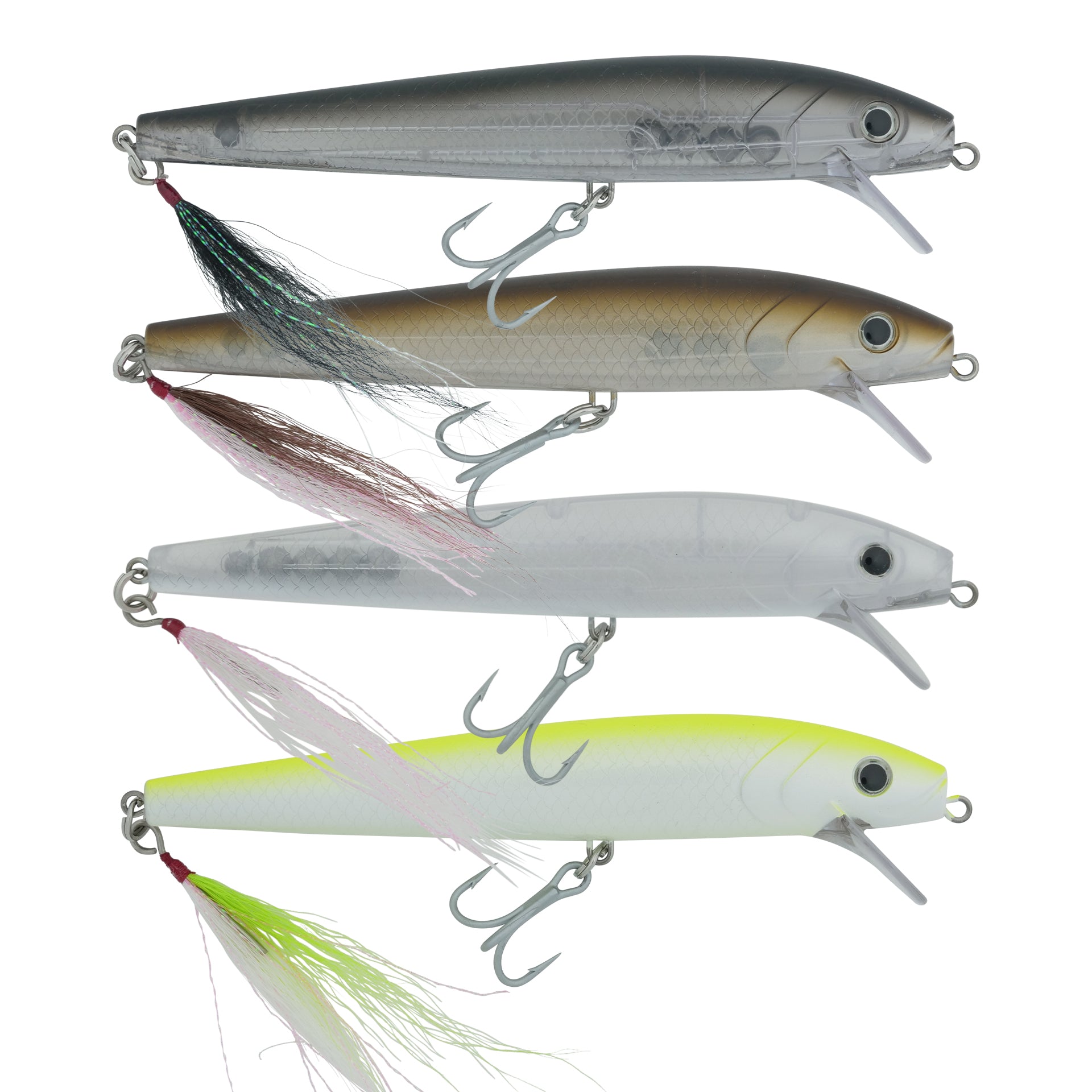
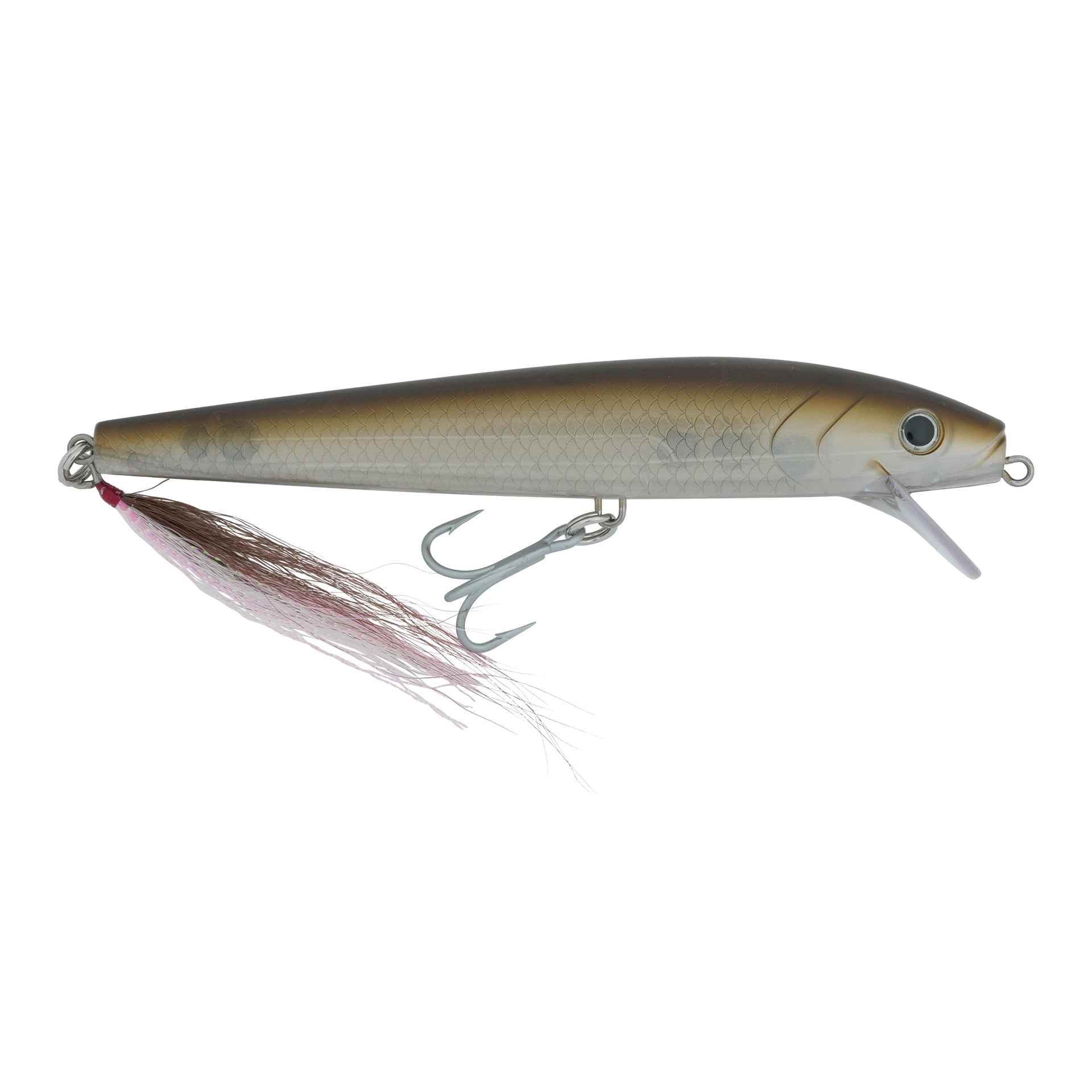
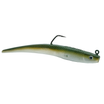
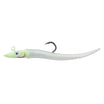
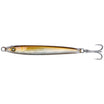
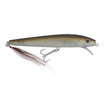
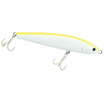
Hogy OG Swimmer, 7 inch, translucent white with shallow diving lip.

A slow, shallow swim beside the rock. The plug spends the whole retrieve in the lane, and a holding fish gets a long look.

  • A clean lane along a rock face and nothing showing on top
  • Low light, overcast, first and last hour
  • Fish that have refused a fast presentation
The pause: it floats, so I stop it, let it rise, and swim again.
Reach and presence
Charter Grade Chug Popper
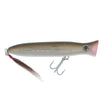
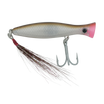
Olive Hogy Charter Grade Chug Popper with cupped face.

A longer cast and a surface show. The chug pulls fish out of pockets the swimmer would never reach and calls them up through broken water.

  • Bait or bass showing on top over an open pocket
  • Broken water where a quiet plug goes unnoticed
  • A wide stretch I want to cover before I commit the boat
The pause: a chug, take up the slack, wait, then the next one.
Popper first to find them, swimmer to finish them.

A follow that does not eat is the signal to switch. If the chug raises a fish that will not commit, I swim the OG through the same lane on the next cast. If the swimmer gets refusals, I shorten the popper strokes and walk it. The fan of casts never changes; the plug and the retrieve do.

Step 1Historical Analysis

The rocks hold bait, and the bait holds the run

Why a boulder field earns a deliberate pass in the fall.

In the fall the bass move along the coast on the bait, and the rock lines are where bait stalls. Cover, moving water and something to eat, all in one place. A boulder field with life on it earns a deliberate pass. An empty stretch does not earn extra time because it is October.

Three baits drive this fishery: adult pogies, peanut bunker and sand eels. They are not the same profile. A seven-inch swimmer is the right size when the big bait is around. When the fish are locked on peanuts or thin sand eels, I read the refusals before I assume the biggest plug is the closest match.
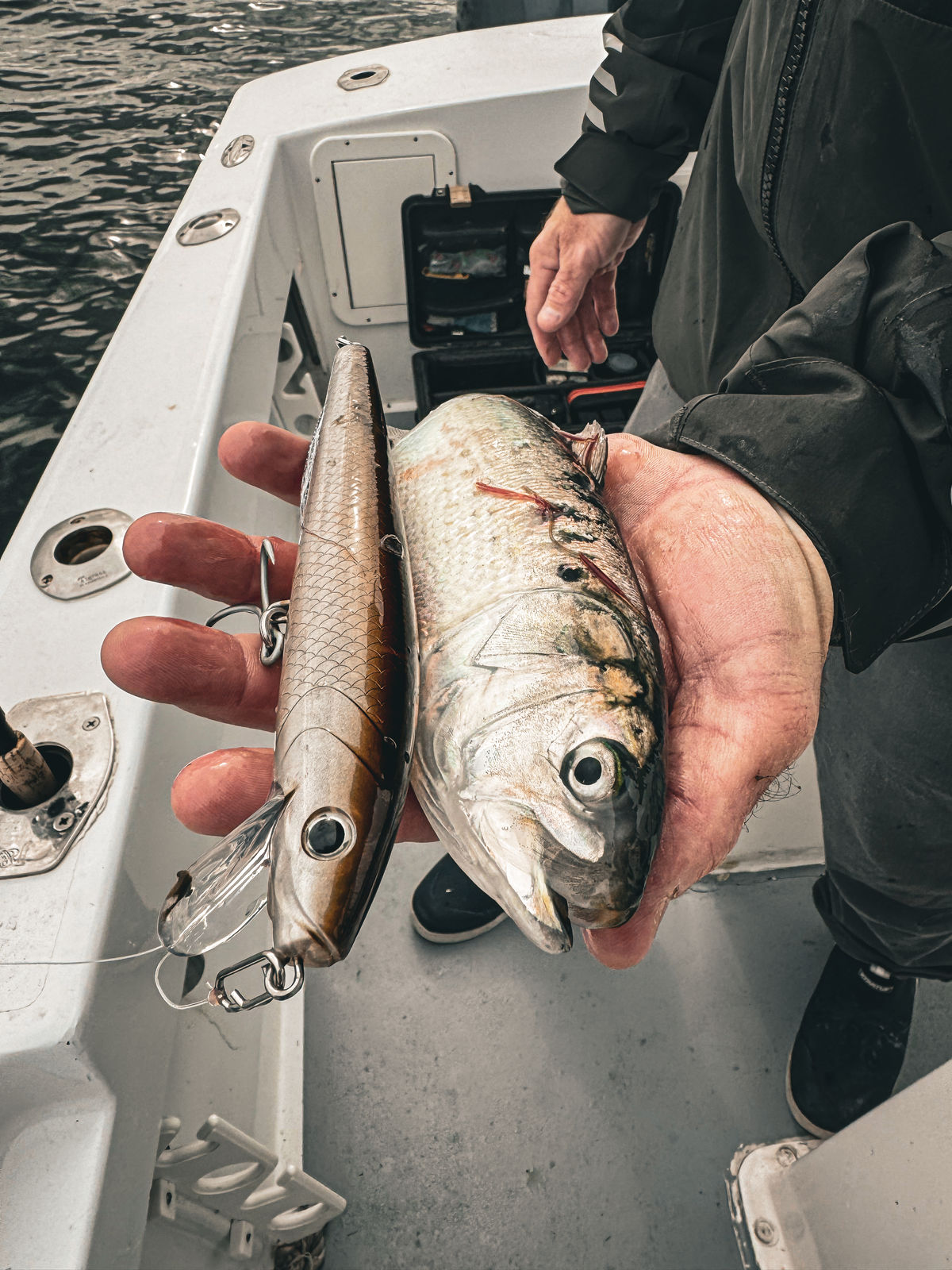
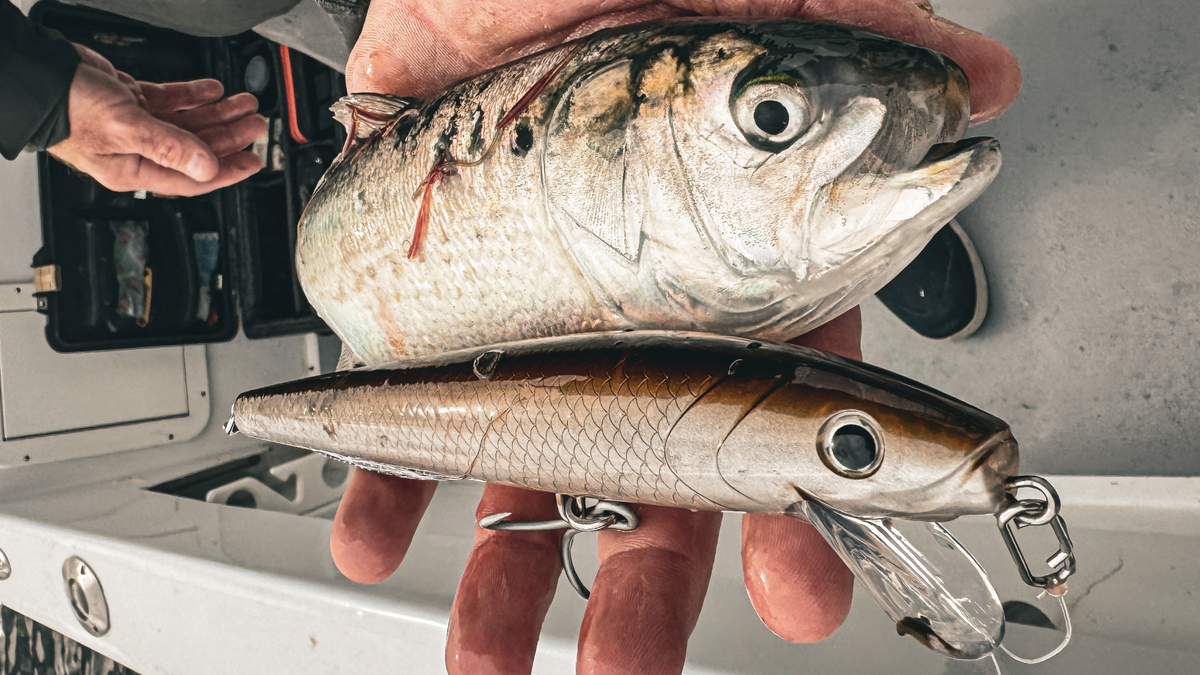
An OG Swimmer with its shallow lip visible held beside a broad-bodied pogie aboard a boat.

The OG Swimmer beside a pogy. Same length, slimmer body. When the bait is this size, a seven-inch plug is the right amount of presence.

Local Knowledge: Fall Boulder Fields
  • Worked example. The Elizabeth Islands. The approach carries to any rocky shoreline where the boat stays in clear water and casts into shallower lanes.
  • Window. Mid-September into November, as the run moves along the coast on bait.
  • Three baits. Adult pogies, peanut bunker, sand eels. Size the plug to the bait that is actually there.
  • Life decides. A field with bait on it gets a full pass. An empty one gets a quick look and I move.
▼
Step 1 output
Fall bass stall on bait along rock lines. Fish the boulder fields with life on them and size the plug to the bait.
Step 2Environmental Factors

Wind, water level and current, read separately

Three inputs. Each one changes where the boat sits and how the plug runs.

An onshore wind I can manage pushes bait to the rocks and puts broken water over them, and the bass use that cover. It also pushes the boat at the same rocks. I pick a drift with room to fish and room to get out.

Water level decides which boulders are showing and how much clearance the plug has over their tops. Current decides how the bait and the lure travel around them. I watch the actual flow through the gaps, because a falling tide does not tell me the direction or the strength at every rock.

Low light and an overcast sky are what I hope for. On the Elizabeths the tide was high and dropping, and wind against tide slowed the drift and gave me more time on each patch. Another day, the same shoreline wants a different starting position and shorter passes.

Boat depth is not lure depth

The depth under the transducer is where the boat is. The water over the boulder at the end of the cast can be a fraction of that. I pick the lane and the retrieve for the water the plug is crossing.

▼
Step 2 output
Manageable onshore wind, real flow through the gaps, low light. Pick a drift with room to fish and room out.
Step 3Observational Factors: B.A.S.E.

Find the lane that is working

Four layers. Each one narrows the answer further.

MH
The Unlock Key

“A follow tells me something. A rock touch tells me something. That is the next cast.”

LayerWhat I Look ForWhat It Tells Me
B
Birds
Working birds over or near the rock line.
They shorten the search. I look at the bait under them before I decide what the bass are eating. A quiet shoreline still gets a careful pass.
A
Activity
Bait flushing out of a gap, a swirl behind a rock, a follower behind the plug.
I mark the spot and the angle even when the fish does not eat. That lane gets the next cast.
S
Structure
Visible ridges running into the water: rock faces, gaps, current seams, the outside edge.
The lure goes through the open lanes beside the rocks, not into them.
E
Electronics
The chart and the sounder: the outside contour and the drift.
A blank screen under the boat does not rule out a fish tucked into the shallow rocks ahead.
Editor: B.A.S.E. here = Birds / Activity / Structure / Electronics. CTC posts use Bait / Activity / Structure / Echoes. Pick one canonical set before publishing.
▼
Step 3 output
Follow the ridges into the water, mark every follow and swirl, and fish the open lanes beside the rocks.
Step 4Structure & Approach

Fan-cast a section, then move

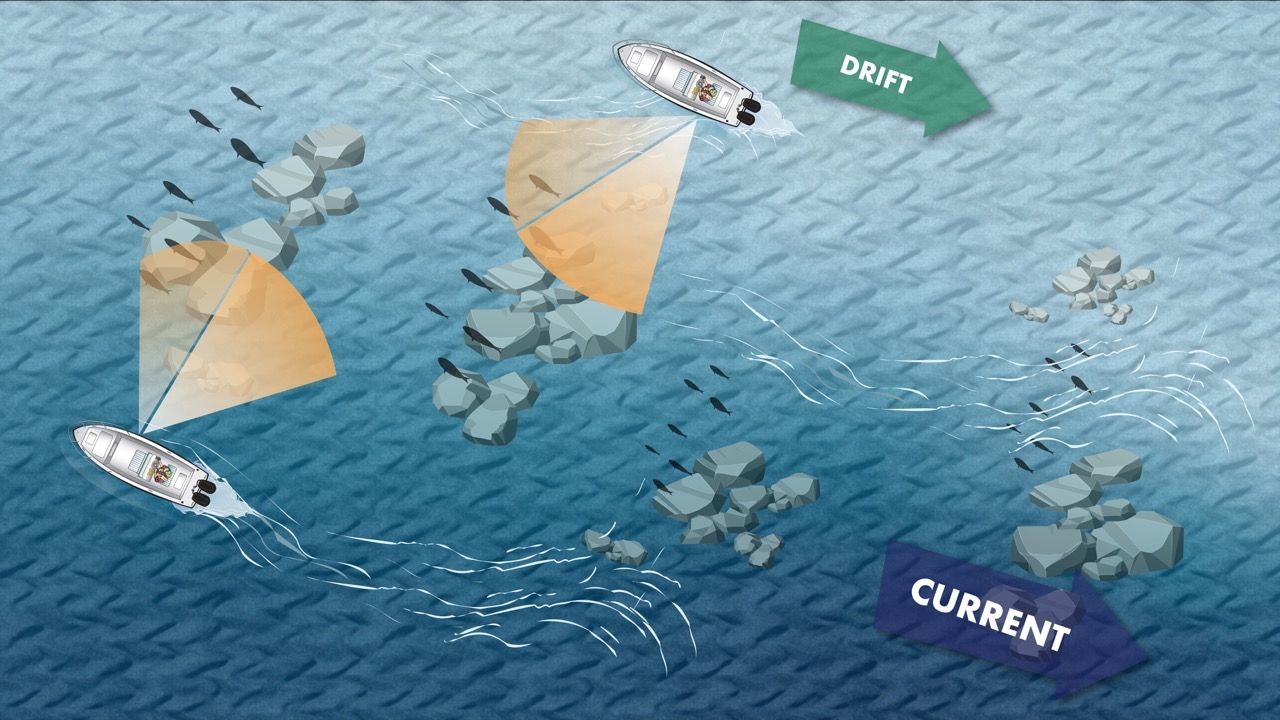
S300 Shallow Boulder Fields / B600 Fan Cast.

I start outside the field with the boat set so the drift keeps my casting angles. The plug crosses a pocket or tracks along a rock face while the hull stays clear. Small corrections early, before I lose the lane.

Approach: step by step
1
Choose the stretch and the exit. I pick the submerged ridge, the pockets worth casting to, and the clear water I will use to reset. I sit off the field long enough to see the drift before the first cast.
2
Cover the water in front of me. One side of the section to the other: the near lane, the pockets between boulders, the outside edge, with overlapping casts. The boat stays off water I have not fished.
3
Control the landing. I feather the cast before the plug lands, close the bail by hand, and gather the slack. The swimmer starts working at once and wind-blown line does not drag it off course.
4
Change the angle before leaving. A follow or a boil at one rock gets another controlled cast through that lane, then a small reposition so the plug passes a different face of the same boulder.
5
Reset outside the field. When the drift takes the angle or the clearance, I retrieve, move back into open water and set up the next short section. I do not let the boat drift into the rocks.
B600 Fan Cast: two boat positions outside boulder clusters, with fan-shaped casting coverage and drift and current arrows.

B600 Fan Cast: two setups on the same field. The boat never enters the rocks.
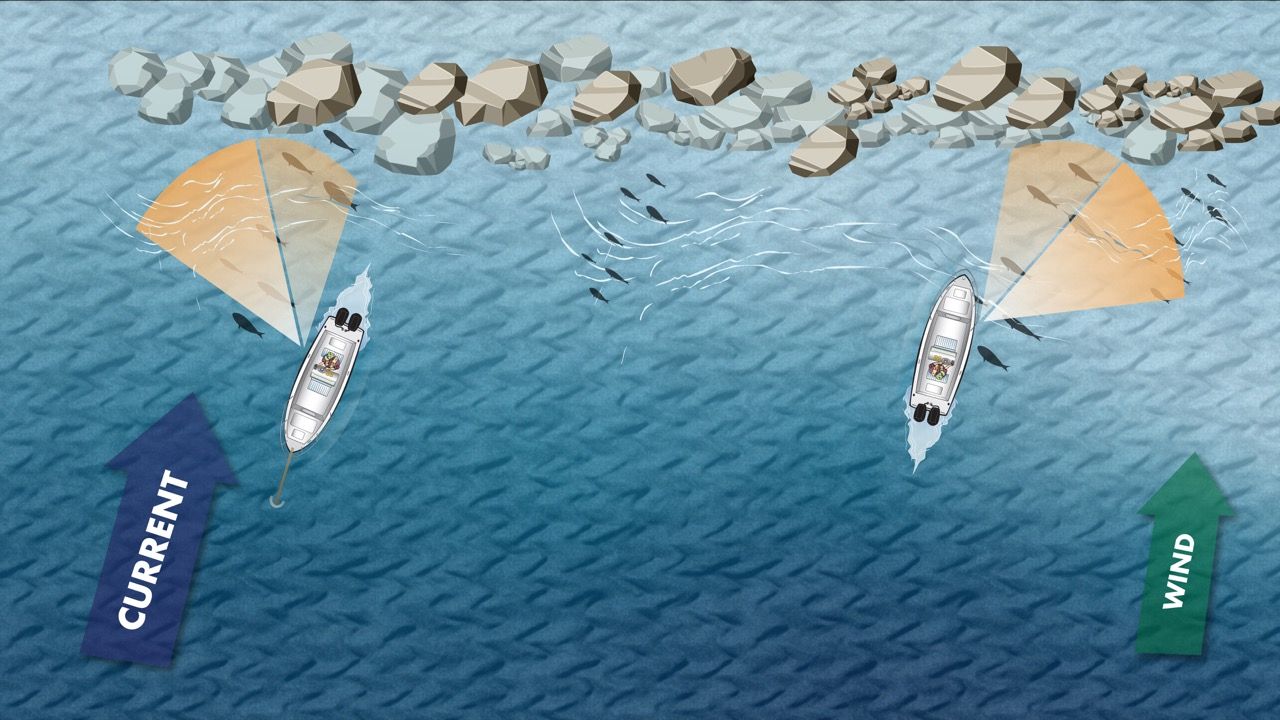
B600 Shallow Boulder Casting: two boats casting into a shallow rock line, one set against the current and one against the wind.

Along a rock line: I set the bow into whichever is stronger, current or wind, and fan the shoreline from outside it.

▼
Step 4 output
Set up outside the field, fan-cast one short section, feather every landing, then reset before the drift takes the angle.
Step 5Gear, Lure & Technique

Two plugs. One clear job each.

OG Swimmer to start, Chug Popper for the switch. Five retrieves between them.

The OG Swimmer is my starting plug when I want a slow, shallow presentation through the pockets. The Charter Grade Chug Popper is the switch when I want reach and surface disturbance across an open lane. The Elizabeth Islands session is the swimmer on film; the popper is the same water, the same fan of casts, on top.

The starting plug · Time in the zone
7″ · 1.75 oz
Hogy OG Swimmer, 7 inch, in translucent white with the shallow diving lip, belly treble and rear flag.
System
Shallow swimming plug. My starting plug on every rock.
Action
Slow, shallow wobble. It floats, so a stop lets it rise for a second presentation on the same cast.
Speed
Slow. If I cannot see the wobble I am too fast. R1602 Shallow Swim, R800 Reel-Pause.
Color
Every color is in play this fall. Dark in low light, translucent black as it gets darker for the silhouette. Placement and speed change long before color does.
Size
7″, right when adult pogies are around. Read refusals before assuming it matches peanuts or thin sand eels.
Limitations
Needs clearance over the rock. Where the current carries it into a boulder, I keep it moving instead of pausing.
Rigging
Cast beyond the pocket, in clear water beside the boulder, with enough lead-in to start the wobble before the target. A cast along a rock face keeps it in the lane longer than one straight across.
Shop the 7″ OG Swimmer
The cast is the same for both plugs; the retrieve line changes Side view. Boat stays outside the boulders at right. Cast left past the open pocket. Retrieve toward the boat just under the surface, with a pause to rise. OG Swimmer Slow, steady swim, brief pause, swim Cast beyond the pocket Boat outside Pause: let it rise Open lane Side view · schematic · not to scale

One fan of casts for both plugs. The swimmer runs just under the surface with a pause to rise; the popper takes the same cast on top: chug, slack, pause.

Watch the swimmer approach

Elizabeth Islands: controlled drifts, feathered landings, and a slow retrieve with the OG Swimmer.
The switch · Reach and presence
6″ · 1 7/8 oz
Olive Hogy Charter Grade Chug Popper with cupped face, belly treble, and rear flag.
System
Cupped-face surface popper. The switch plug when I want reach and a surface show.
Action
Separated chugs that throw water, or short alternating twitches that walk it side to side without chugging.
Speed
Burst and stall. Chug, take up the slack, pause, next stroke. Never a plug dragged across the target.
Color
Every color in the box. I have caught fish on olive, amber and pale this fall.
Size
6″, with the weight to reach a wide stretch before I commit the boat.
Limitations
Needs a workable surface lane. Keep it clear of exposed rock and breaking wash.
Rigging
Same fan, an open surface track. Cast past the pocket with room to take up slack before the first chug. Rod tip down; lower it further as the plug gets close.
Shop the 6″ Charter Grade Chug Popper
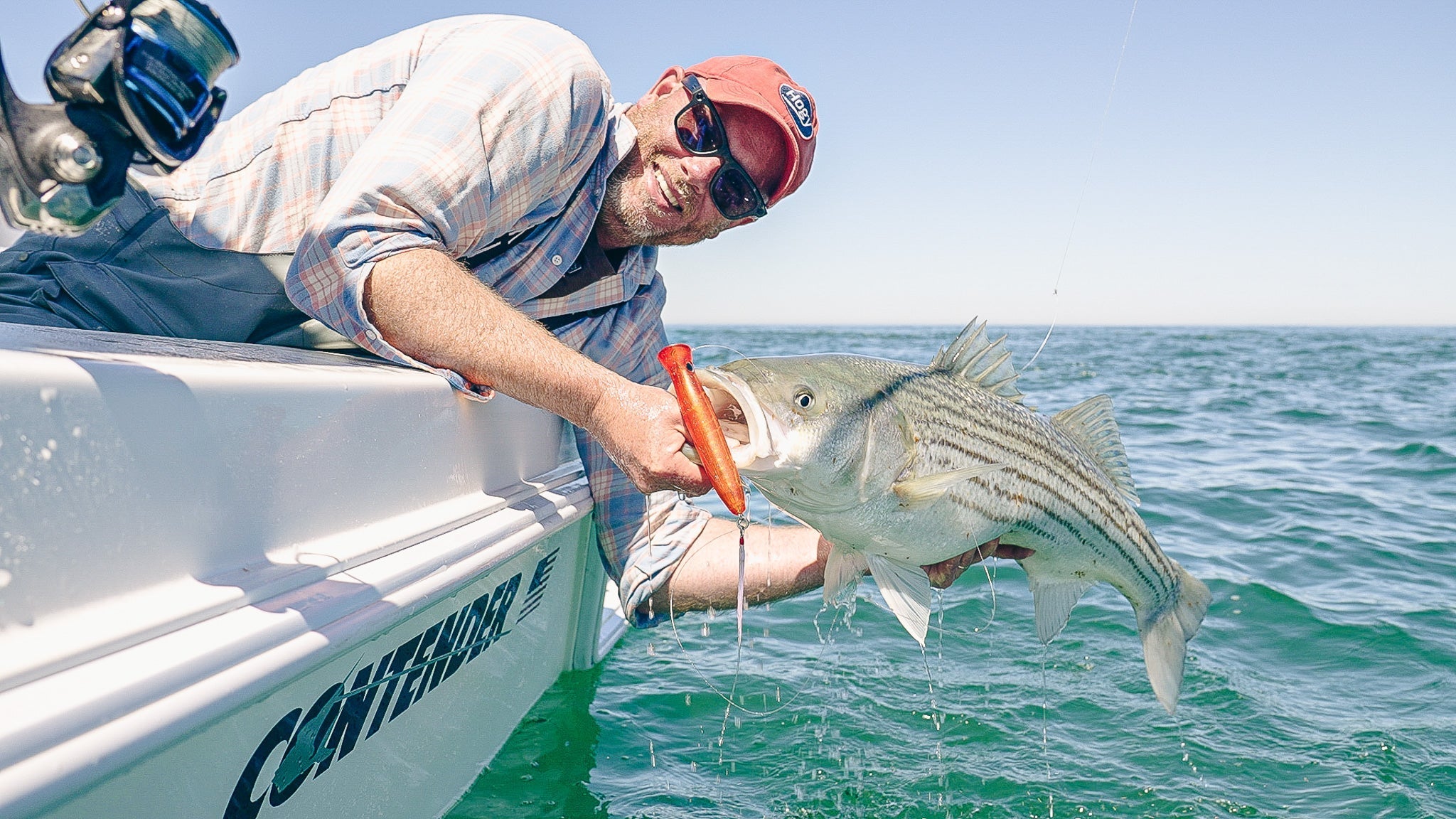
Capt. Mike leaning over the gunwale with a striped bass on the amber Charter Grade Chug Popper.

The amber Chug Popper, boatside. Same water, same fan of casts, on top.

Retrieves

The plug is half of it. The other half is what my hands do, and on a boulder field from the boat I keep it to five things I can repeat on every drift.

R1602The steady crankOG Swimmer
When: every rock, first cast. The retrieve that keeps the plug in the lane longest.
Trigger: a visible wobble held beside the boulder.

Tip low, over the gunwale, a slow even wind, and I watch for the wobble. If I cannot see the wobble I am too fast; the OG is a slow plug.
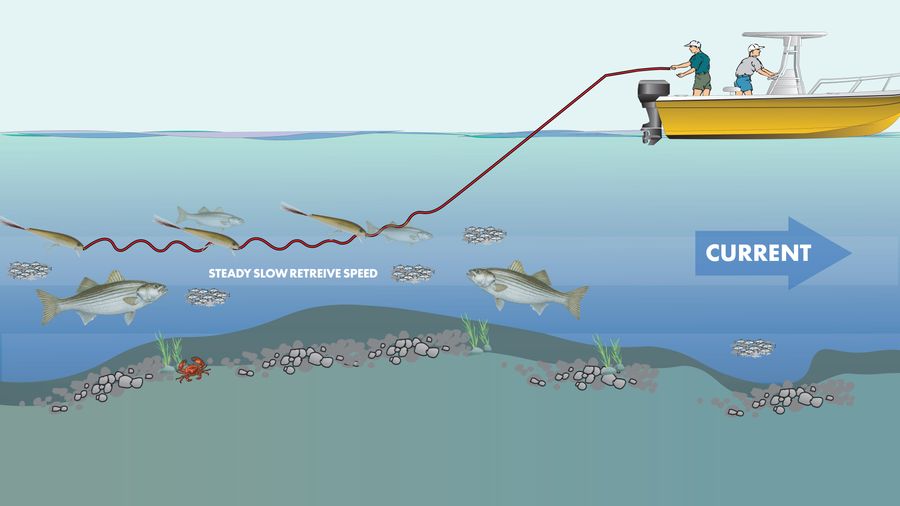
R1602 Shallow Swim: steady, slow, rod low, the swimmer ticking over the rocks with the current.

Steady, slow, rod low: the swimmer ticking over the rocks with the current.

R800Crank, stop, floatOG Swimmer
When: beside a boulder with clearance, or a fish followed the crank.
Trigger: the rise. The eat comes as the plug lifts off the rocks.

Three or four turns, then stop dead. The OG floats, so it rises in the pocket, nose up, hanging there before I swim it again. Where the drift is carrying the plug into the rock I keep it moving.
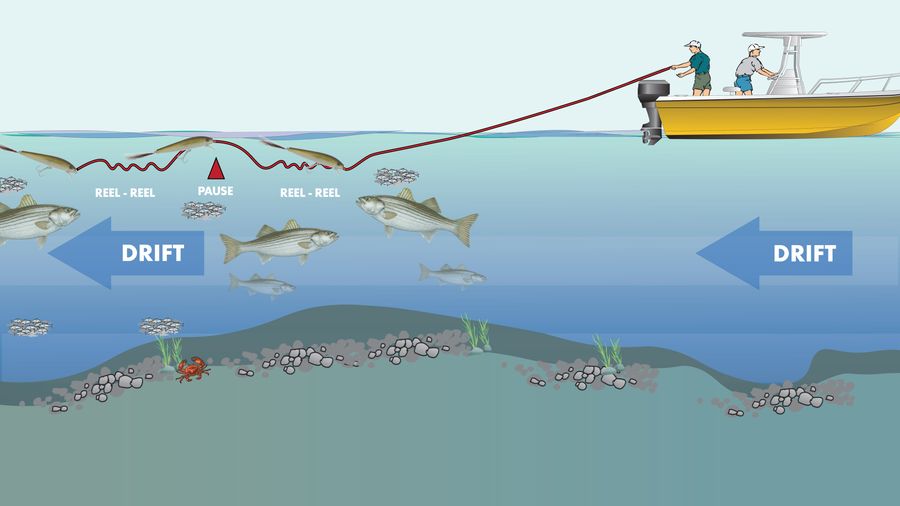
R800 Reel-Pause: reel, reel, pause, the plug rising off the rocks.

Reel, reel, pause. The stop is where the eat comes.

R110Walk the dog, tip downChug Popper
When: a fish boiled on the chug and would not eat.
Trigger: same lane, less commotion, still on top.

Rod tip pointed at the water, short alternating twitches, slack taken up between them, and the plug walks side to side across the surface without chugging. Quiet for a popper.
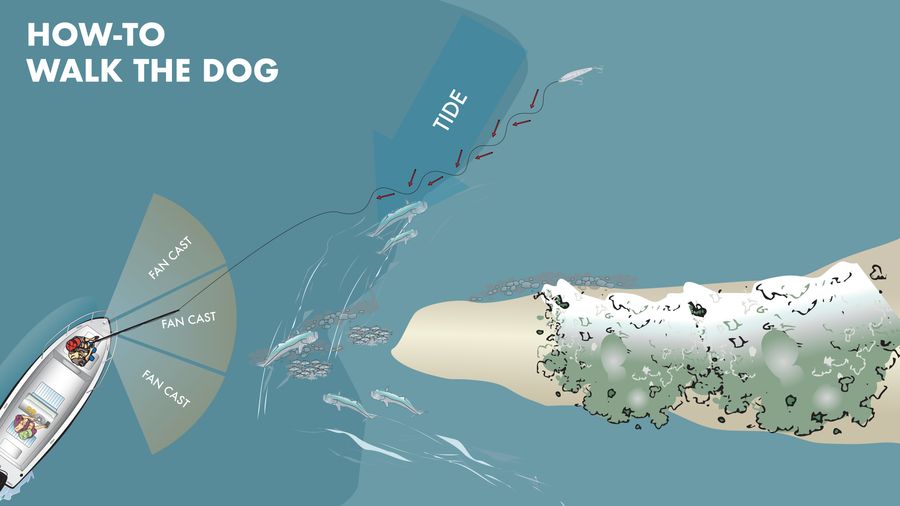
R110 Walk-the-Dog: fan-cast off the rocks and walk it back across the tide, rod tip down.

Fan-cast off the rocks and walk it back across the tide, rod tip down.

R1250Blast and pauseChug Popper
When: broken water on a windy day.
Trigger: the long pause. The blast calls the fish up; the pause is where it eats.

One hard stroke that throws water, then nothing. A long pause, three or four seconds, the plug dead in the pocket.

R200Chug, chug, pauseChug Popper
When: searching the outside edge on a long drift.
Trigger: the stall, timed for the spot beside the rock.

The classic. Two short chugs, take up the slack, pause, repeat, so the plug crosses the pocket in bursts with a stall between them. I time the pause for the spot beside the rock instead of letting the cadence pull the plug straight through it.
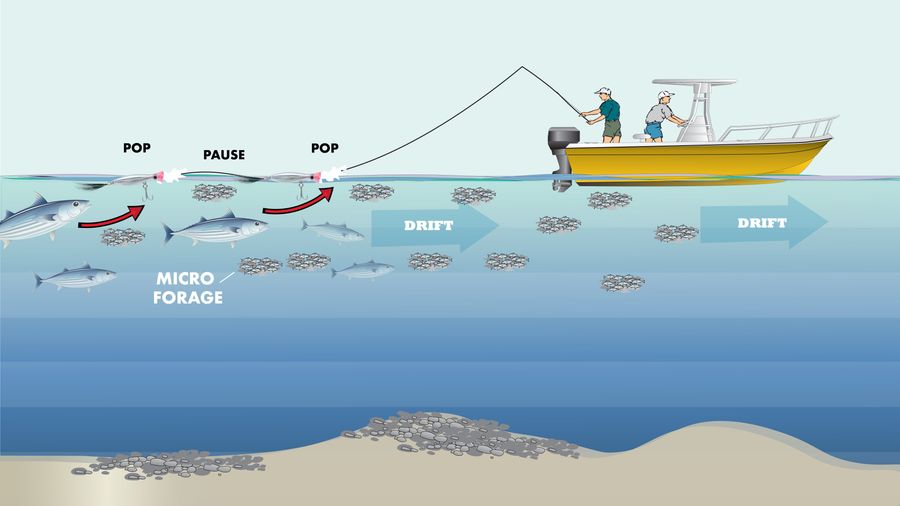
R200 Chug and pause: pop, pause, pop.

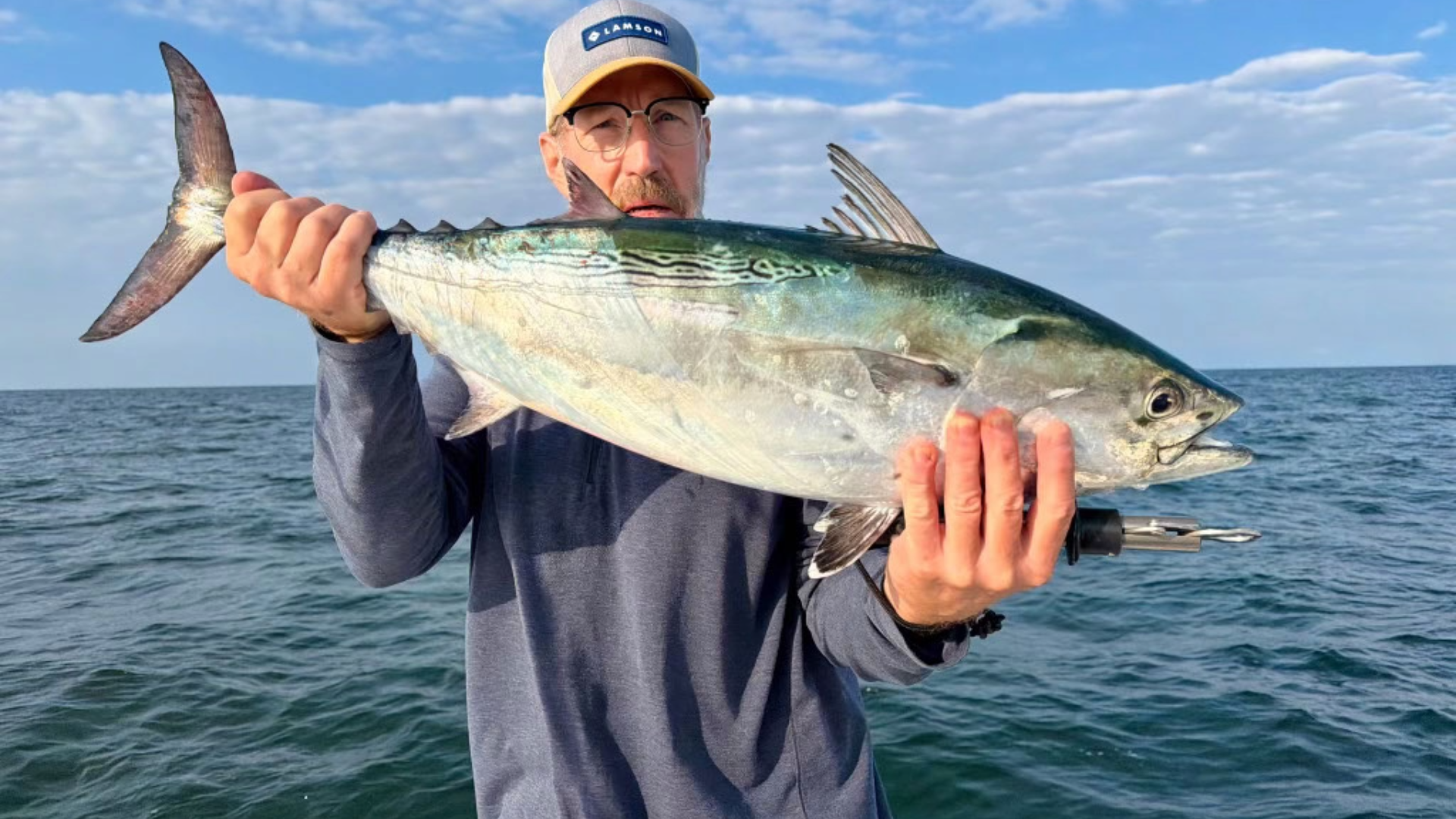
Pop, pause, pop. Drawn on albies, but the cadence is the same on bass in the rocks: the pause is the eat.

FromToWhy
Boil on the popper, no eatWalk it, tip down (R110)Same lane, less commotion.
Follow behind the walkOG Swimmer, steady crank (R1602)More time in the lane, below the surface.
Follow behind the OGCrank, stop, float (R800)The rise is a second look.

I go quieter each step, not louder.

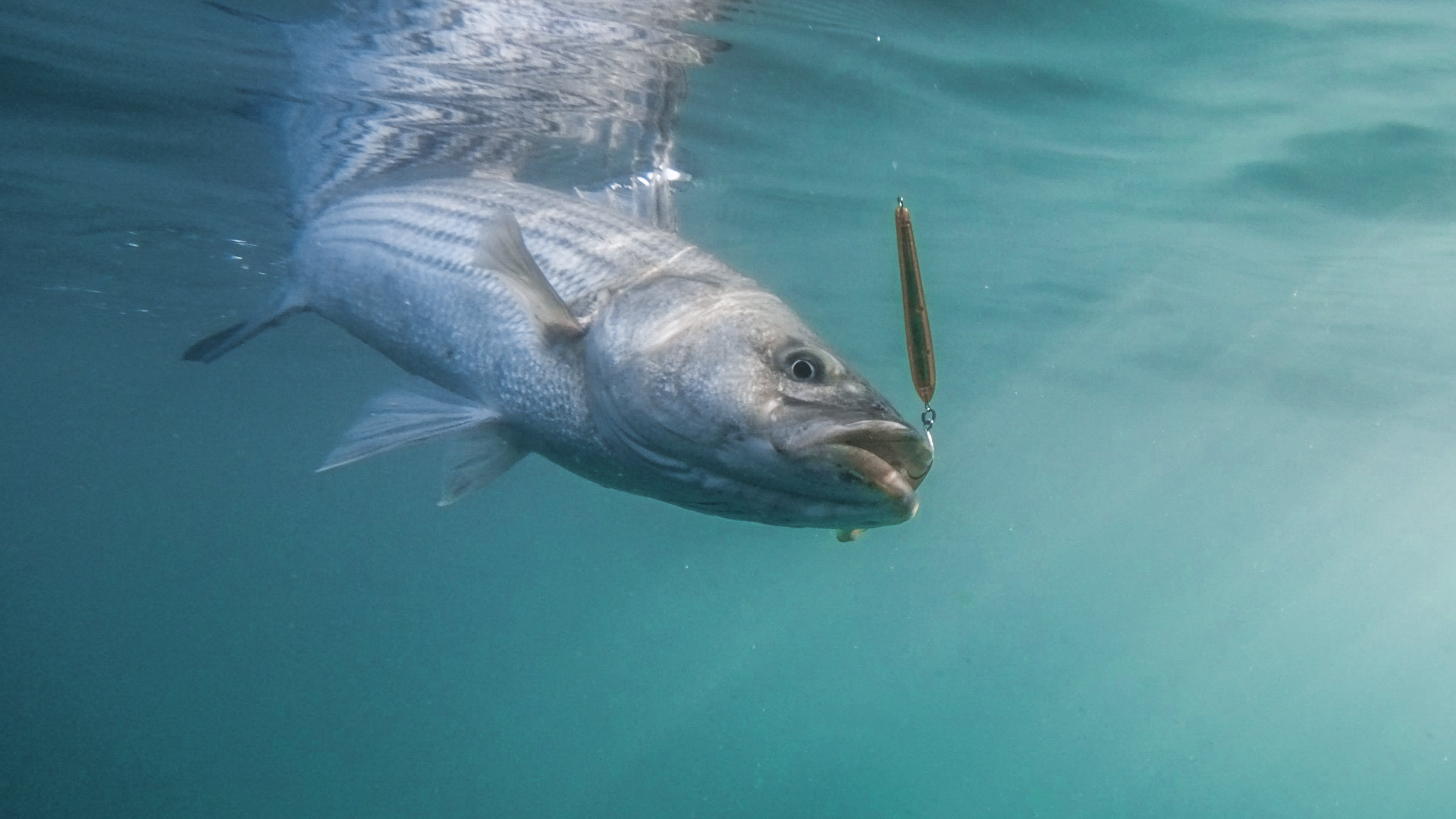
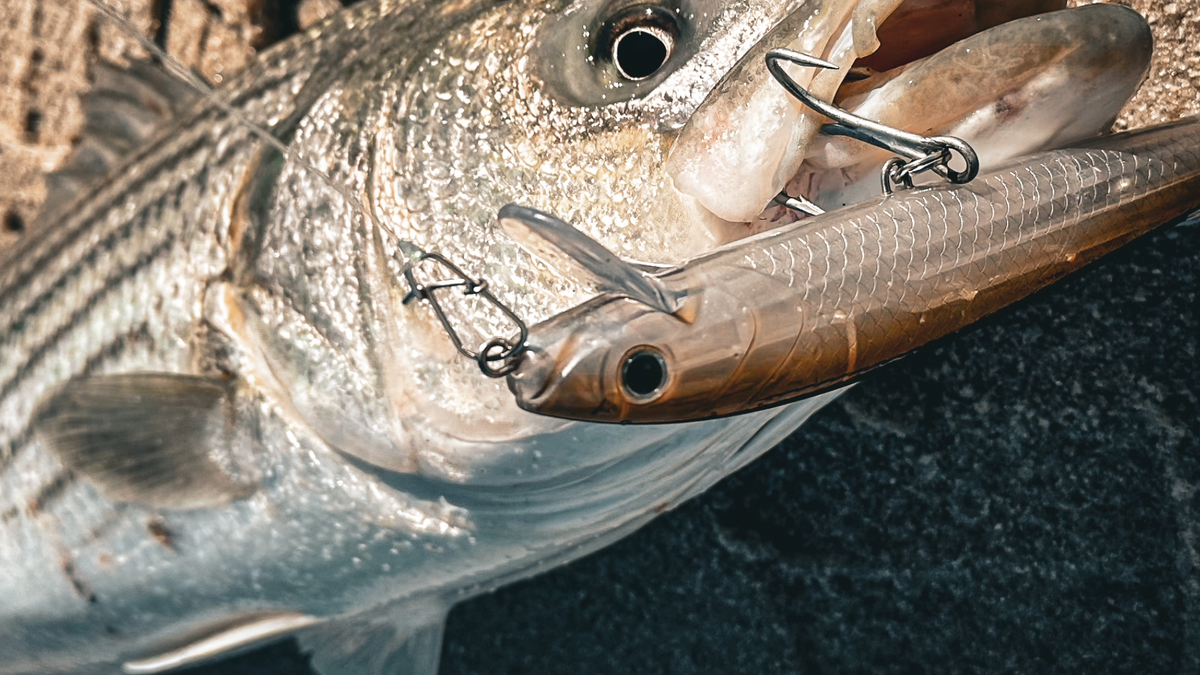
Close view of a striped bass with a pale Chug Popper in its mouth.

Every color has been in play this fall. Placement and cadence first; color a distant third.

Outfit

Loadout: One outfit for both plugs
Rod
Hogy Inshore Plugging Rod, 7′6″ MH, 1 to 3 oz. Covers the 1.75 oz swimmer and the 1 7/8 oz popper.
Reel
4000-class spinning.
Line
30 lb braid.
Leader
Chosen for the fish and the rock. I check it after every touch on structure.
Plugs
7″ OG Swimmer and 6″ Charter Grade Chug Popper. Never a third.

Stay, adjust, or move

What happensWhat I do next
A follow, boil, or bite at one rockStay with that lane. Same cast again, then a slightly different angle or a pause.
The plug keeps touching rockChange the track or the running depth. Do not keep grinding the same retrieve into the boulder.
Good signs, but the cast falls shortReset the drift for a better angle. If I still cannot reach the lane with clearance, pick another section.
Wind-blown slack spoils the actionReset the boat angle, feather the landing, get contact sooner.
No signs after a thorough passNext rock cluster, or a stronger feeding feature. Come back if the light or the flow changes.
The drift takes away my clearanceRetrieve and reset, now. Boat control comes first.
Conservation: Landing Around Rocks
Hooked up, I use steady pressure to bring the fish toward clear water. Release tools ready, fish kept wet, any lift brief and horizontal. Around boulders the boat still needs my attention while I am landing and releasing a bass.
▼
Step 5 output
OG Swimmer on a slow crank to start, Chug Popper for reach. Go quieter with every refusal, never louder.
Putting it together
Fish each pocket with a purpose

Step 1 put me on the rock lines, where fall bait stalls and the bass follow it. Step 2 had me read wind, water level and current separately so the drift left room to fish and room out. Step 3 turned the shoreline into a list of lanes, marked by birds, follows, ridges and the outside contour. Step 4 kept the boat outside the field, fan-casting one short section and resetting before the drift took the angle. Step 5 put the OG Swimmer in the lane to start and the Chug Popper out for reach, going quieter with every follow that did not eat.
Next in the Fall Series
Fall Plugs from the Rocks: Shore
Same two plugs, same boulders, fished from secure footing above the wash.
Striped Bass Fall Run Boulder Fields S300 B600 Fan Cast OG Swimmer Chug Popper Swimming Plugs Topwater Pogies Peanut Bunker Sand Eels Elizabeth Islands Inshore Capt. Mike Hogan Fall Run Playbook

Reading next

Capt. Mike’s Guide to Fall Plugs and Big Bass from the Rocks
How to Jig for Tautog Without Bait | Hogy Lures

Leave a comment

All comments are moderated before being published.

This site is protected by hCaptcha and the hCaptcha Privacy Policy and Terms of Service apply.

Related Videos

Catching Striped Bass in Boulder Fields

In this video, Capt. Mike takes us on an evening trip to the Elizabeth Islands targeting boulder field stripers using the OG Swimmer for fish tucked in along shallow boulders.

Related Blogs

Bonito & AlbiesCapt. Mike’s Guide to Productive Early Season Albie Recons

Capt. Mike’s Guide to Productive Early Season Albie Recons

Capt. Mike’s Guide to Productive Early Season Albie Recons Salty Cape  ·  Early Season  ·  Recon Capt. Mike’s Guide toProductive Early Season Albie Recons A tactical protocol for f...

Bluefin TunaCrack The Code: Outer Cape Bluefin Tuna Casting

Crack The Code: Outer Cape Bluefin Tuna Casting

Bluefin Tuna  ·  Offshore — Outer Cape Backside  ·  Late Fall Cracking the Code Capt. Mike Hogan & John Burns  ·  Salty Cape TV powered by Hogy Location Outer Cape Backside (Peaked Hil...

Bluefin TunaCrack The Code: Late Summer Bluefin Casting

Crack The Code: Late Summer Bluefin Casting

Bluefin Tuna  ·  Offshore — The Star  ·  Late Summer Cracking the Code Capt. Mike Hogan, Willy Goldsmith & Capt. Shaun Ruge  ·  Salty Cape TV powered by Hogy Location The Star (South o...

Bluefin TunaCrack The Code: East Of Chatham Tuna Trolling Spread

Crack The Code: East Of Chatham Tuna Trolling Spread

Bluefin Tuna  ·  Crab Ledge, East of Chatham  ·  Summer Cracking the Code Capt. Mike Hogan  ·  Salty Cape TV powered by Hogy Location Crab Ledge — East...

CastingCrack The Code: Topwater Striper Handkerchief Shoal

Crack The Code: Topwater Striper Handkerchief Shoal

Cracking the Code: The Franken Popper at Handkerchief Shoal Striped Bass  ·  Handkerchief Shoal  ·  Early Summer Cracking the Code Capt. Mike Hogan  ·  Salty Cape TV powered by H...

CastingCrack The Code: Micro Squid Rips Finicky Stripers

Crack The Code: Micro Squid Rips Finicky Stripers

Cracking the Code: Four Retrieves on One Cast — Surface Eraser vs. Finicky Monomoy Stripers Striped Bass  ·  Monomoy Rips  ·  Mid-June Cracking the Code Capt. Mike Hogan &...